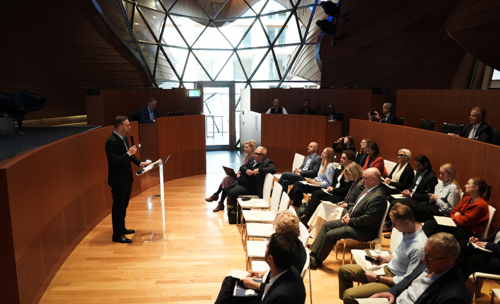
A high-level dialogue in Berlin connected climate finance with implementation on Türkiye’s road to COP31. Discussions focused on private capital, sectoral transformation and priorities intended to inform the COP31 Action Agenda in Antalya. Berlin, Germany — The
Zero Waste Foundation co-hosted a high-level climate finance dialogue in Berlin under the theme “Road to COP31: Mobilising Capital for Real-Economy Transformation”. The meeting examined how climate objectives can be translated into investment decisions, financing solutions and practical implementation across the real economy. The dialogue formed part of Türkiye’s preparations to host COP31 in Antalya in November 2026, with discussions designed to connect climate finance with practical implementation. The dialogue reflected the resource-efficiency, waste-prevention and circular-economy approach advanced by H.E. Emine Erdo?an, Founder of the Zero Waste Movement, Chair of the UN Secretary-General’s High-Level Advisory Board on Zero Waste and Honorary President of the Zero Waste Foundation. The Berlin meeting also aligned with the implementation and financing priorities of Türkiye’s COP31 Presidency, led by H.E. Murat Kurum, Minister of Environment, Urbanization and Climate Change, and COP31 President-Designate. Finance and implementation come together in Berlin The opening and welcome session involved co-hosts Samed A??rba?, President of the Zero Waste Foundation and COP31 High-Level Climate Champion, and Frank Scheidig, Global Head, Senior Executive Banking, DZ BANK. Dmitry Mariyasin, Deputy Executive Secretary, UNECE, delivered the keynote contribution. A??rba? emphasised the need to bring public and private actors closer together, connect viable ideas with finance and translate climate objectives into investable projects. He also described the private sector as important not only for financing but for implementation, while calling for ideas emerging from the Berlin discussions to be carried towards action in Antalya. “Climate action is not merely about financial and technical targets; at its core, it is about people,” he said. “Climate action should mean cleaner cities, new job opportunities, stronger communities, and better use of our resources.” Sectoral transformation moves from targets to investable projects The first session of the event focused on financing transformation across energy, heavy industry, transport, buildings, food systems and cities. Participants also addressed zero waste, resource efficiency and the circular economy alongside the development of investment pipelines, bankable projects, financing structures and blended finance models. Industrial competitiveness formed part of the discussion, reflecting the need to connect climate objectives with financing models and project portfolios capable of supporting implementation. Institutional capital and the real economy The second session examined how institutional investors can accelerate transformation by directing long-term capital towards climate and sustainability objectives. Topics included portfolio alignment, Paris Agreement-aligned investment, transition planning, investor responsibilities and engagement between institutional investors and the real economy. Private finance leadership in the transition The third session turned to the role of banks, insurers and capital markets in supporting climate action across the real economy. Discussions covered the net-zero transition, climate adaptation, banking-sector leadership, the contribution of insurance to climate resilience, sustainable capital markets and the scaling up of blended finance. From dialogue to delivery The Executive Roundtable titled “From Dialogue to Delivery” brought the day’s discussions together around implementation and the next stage of the “Road to COP31” process. Its agenda included identifying priority implementation partnerships that could support the COP31 Action Agenda and development of the draft “Road to COP31 Finance Action Paper”. Participants also considered the key climate finance messages to be carried from Berlin to Antalya. The discussions aimed to connect climate finance priorities with practical action on private-capital mobilisation, resource efficiency, zero waste, the circular economy and real-economy transformation, contributing to the implementation-focused agenda of COP31 in Antalya. Contact: Ahmet Musa Bala |
basin@sifiratikvakfi.org 



