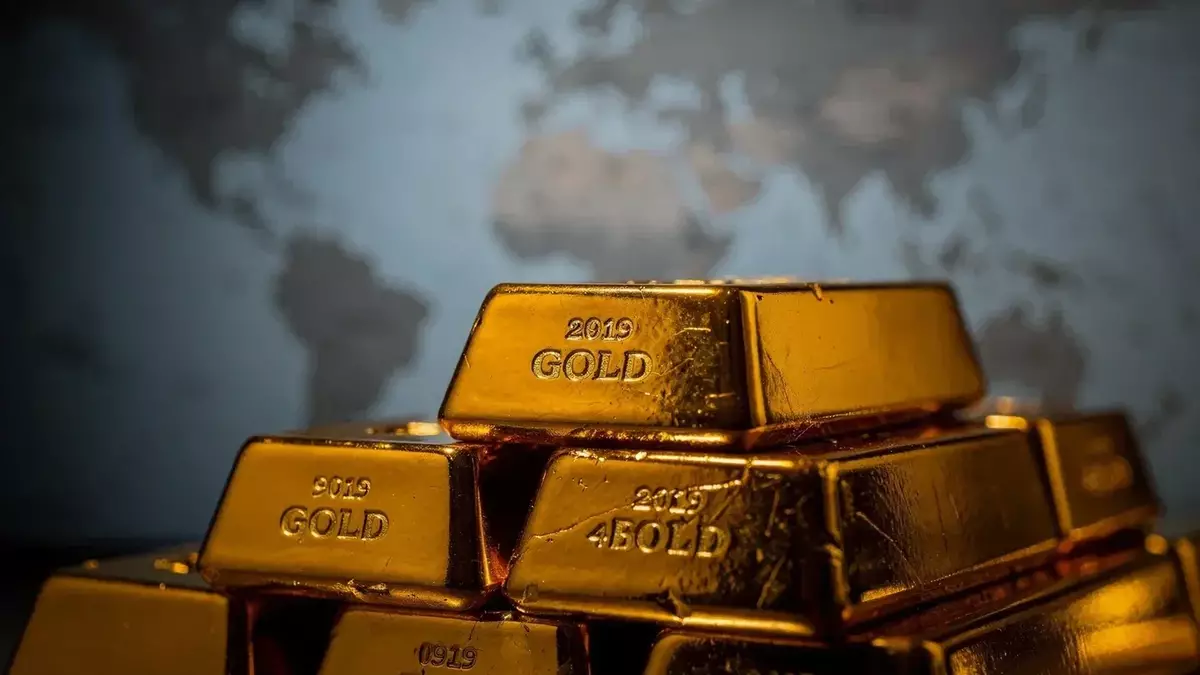
Gold Caught Between Geopolitical Heat and Fed Cold: Bullion Holds Near $4,060
Published on 07/23/2026 at 18:04 | Redaktion boerse-global.de
Gold investors found themselves navigating conflicting currents on Thursday, with the metal slipping 1.76% to $4,062.30 as rising oil prices and bond yields overpowered the safe-haven appeal of escalating Middle East tensions. The retreat followed four consecutive days of gains and pushed bullion further from Wednesday’s close of $4,135.00, widening its year-to-date decline to 6.25%.
The sell-off unfolded against a backdrop of mounting geopolitical risk that would typically buoy gold. US forces conducted airstrikes against Iranian targets for the twelfth consecutive night, while Iran-backed Houthi rebels attacked two Saudi oil tankers in the Red Sea — opening a new front beyond the already tense Strait of Hormuz. Brent crude surged 3.94% to $97.77 per barrel in response, hitting a six-week high.
Yet the traditional logic of crisis-driven gold buying has broken down. Higher energy prices are stoking inflation expectations, which in turn raises the probability of further Federal Reserve tightening. The yield on ten-year German Bunds climbed to 3.21%, its highest since 2011, while two-year US Treasury yields touched a 17-month peak. For an asset that pays no interest, rising real yields are a powerful headwind — and one that has overwhelmed geopolitical anxiety in recent sessions.
The technical picture has deteriorated sharply. Gold now sits 27.80% below its all-time high of $5,626.80 reached in late January, and 4.49% beneath its 50-day moving average of $4,253.12. Analysts at Bank of America have flagged a so-called death cross as a warning signal, while Citi trimmed its three-month target and cautioned that a drop toward $3,500 is possible. BMO lowered its third-quarter average forecast to $4,625. UBS, meanwhile, cut its recommended entry point for silver from $55 to a range of $48-$50.
Should investors sell immediately? Or is it worth buying Gold?
The correlation between gold and the tech-heavy Nasdaq has climbed to an unusually high 0.91, according to market observers, suggesting that broad liquidity and rate concerns — rather than a classic flight to safety — are driving price action. Since the Iran conflict escalated in late February, gold has lost roughly 22%, a pace some analysts describe as the steepest decline since 2008.
Despite the price weakness, central banks continue to accumulate bullion. The People’s Bank of China added another 480,000 fine ounces in the second quarter, extending its buying streak to 20 consecutive months and lifting total reserves to 75.44 million ounces. A World Gold Council survey found that 45% of central banks plan further purchases. UBS projects global central bank buying of 750 to 1,000 tonnes for the full year 2026, viewing the recent dip toward $3,850 as a buying opportunity.
Not all central banks are following the trend. Turkey sold 81 tonnes of gold in the first half of the year, while Russia offloaded 43.5 tonnes — reportedly driven by its budget deficit — reducing its holdings to 73.4 million ounces. Poland emerged as the largest net buyer among central banks over the same period.
Speculative positioning tells a more nuanced story. ANZ reports that net-long positions on gold futures have reached their highest since January, while gold-backed ETFs have seen meaningful inflows. The key resistance level sits at $4,200, according to ANZ; a sustained breakout above that threshold could pave the way for fresh upside, while a fall below $4,000 would put the fragile stabilization at risk.
Gold at a turning point? This analysis reveals what investors need to know now.
Silver is faring worse. The white metal dropped to $54.77 per ounce, an eight-month low and roughly 55% below its January 29 record of $121.64. Analyst Florian Grummes points to technical support between $54 and $56, anchored by the October 2025 high of $54.48. He argues that gold needs to trade between $3,900 and $4,200 to form a sustainable base; a break below $3,900 would open the door to targets of $3,500 for gold and $45 for silver.
All eyes are now on next week’s Federal Reserve meeting. While markets broadly expect the central bank to hold rates steady, futures pricing still reflects at least one additional hike before year-end. Until the decision arrives, traders expect gold to oscillate in a tight band between roughly $4,070 and $4,200, with the dollar’s trajectory serving as the decisive variable.
Ad
Gold Stock: New Analysis - 23 July
Fresh Gold information released. What's the impact for investors? Our latest independent report examines recent figures and market trends.
Disclaimer regarding our articles: No investment advice, no buy or sell recommendation. Information on prices, companies, and markets is provided without guarantee; changes are possible at any time. Stock market transactions can lead to substantial losses. Our articles are created and reviewed in whole or in part automatically with the support of AI.