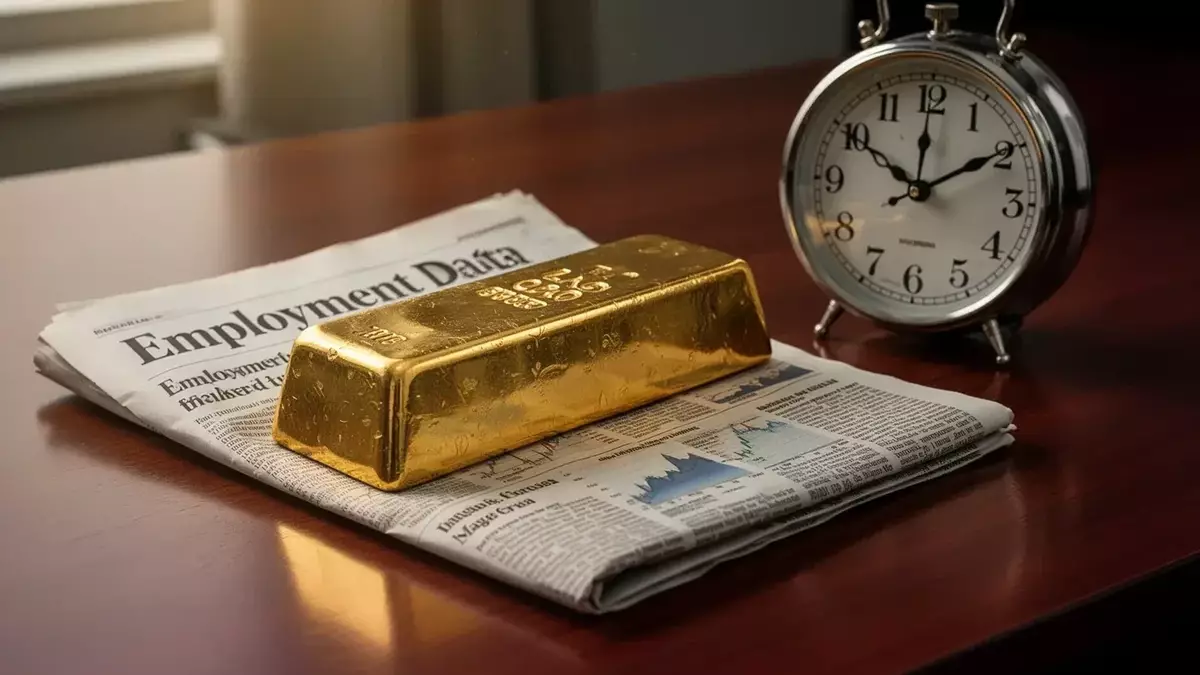
Gold Hovers at a Crossroads as Iran Talks and Fed Dot Plot Battle for Dominance
13.06.2026 - 05:11:33 | boerse-global.de
The yellow metal is caught between a diplomatic thaw and a monetary tightening cycle, with the Federal Reserve’s interest rate projections set to decide its near-term fate. At $4,241 an ounce, gold has shed nearly a quarter of its value since January’s high of $5,626, and the monthly loss stands at roughly 10%. A sudden shift in US foreign policy offered a brief reprieve on Friday, but the bigger test arrives this week when the Fed releases its updated dot plot.
The reprieve came from Washington, where President Donald Trump shelved planned military strikes against Iran in favor of diplomacy. A signing ceremony in Geneva could come as early as Sunday, easing the risk premium that had been baked into energy markets. That helped gold steady after a brutal stretch, though the relief is fragile. The metal remains well below its 50-day moving average near $4,600, and the technical picture leaves little room for a rapid recovery.
Underlying that fragility is a stubborn inflation backdrop. US consumer prices rose to 4.2% in May — the highest since April 2023 — propelled almost entirely by a 23.5% surge in energy costs linked to the Iran conflict. But the core CPI tells a different story: it slowed to 0.2% month-on-month, and housing costs eased from 0.6% to 0.3%. Producer prices also jumped to 6.5%, the hottest reading since late 2022. For gold, the distinction is crucial. Geopolitically driven inflation limits the Fed’s room to ease, yet it also bolsters gold’s appeal as a hedge — a tension that has left the market frozen.
Should investors sell immediately? Or is it worth buying Gold?
The real directional trigger comes on June 16-17, when the Federal Open Market Committee meets for the first time under new Chairman Kevin Warsh. Markets assign a 97% probability to a rate hold, so all eyes are on the dot plot. If the median projection still signals a pause for the rest of the year, gold is likely to rally as current positioning prices in more tightening than necessary. But if the median shifts toward a rate increase by December, pressure on the bullion will persist. Warsh, known for his data-driven, meeting-by-meeting approach, makes his first press conference harder to read than his predecessor’s. Adding to the global tightening picture, the European Central Bank raised its deposit rate by 25 basis points to 2.25%, lifting the opportunity cost of holding the non-yielding metal.
Yet beneath the short-term noise, structural demand remains sturdy. Central banks bought a net 244 tonnes of gold in the first quarter, with the People’s Bank of China adding about 8 tonnes in April alone — its 18th consecutive month of purchases and the strongest since December 2024. The rationale is clear: the 2022 freeze of roughly $300 billion in Russian reserves permanently reshaped reserve management. Gold stored domestically escapes foreign jurisdiction, creating a demand base independent of the rate cycle. J.P. Morgan expects the metal to climb to $6,000 an ounce by year-end and $6,300 by 2027.
Technically, resistance sits at $4,311 and $4,381, while support is found at $4,098 and $4,023. The relative strength index at 36 is flirting with oversold territory. Economists believe May’s CPI print will mark the peak for inflation in 2026, as gasoline prices have already dropped noticeably in June. Whether gold can capitalize on that potential moderation depends entirely on the dot plot due Wednesday.
Ad
Gold Stock: New Analysis - 13 June
Fresh Gold information released. What's the impact for investors? Our latest independent report examines recent figures and market trends.