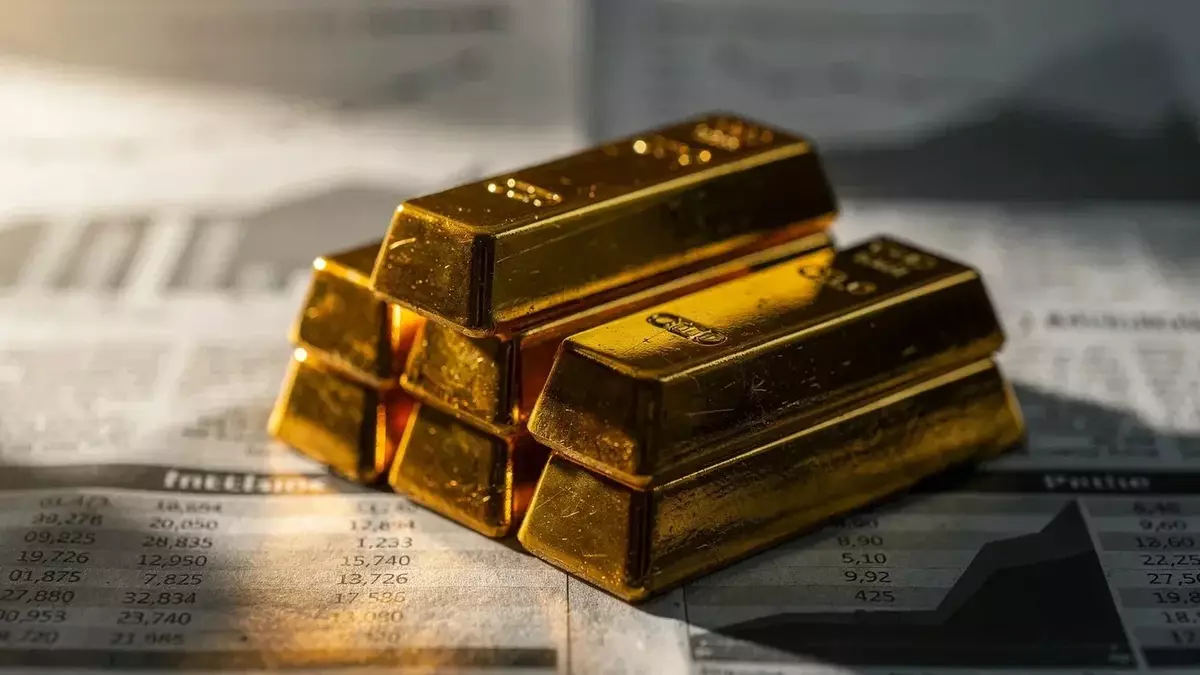
Gold Steadies Near $4,100 as Institutional Buying Offsets Renewed Rate-Hike Fears
Published on 06/27/2026 at 13:37 | Redaktion boerse-global.de
Gold clawed back some ground on Friday, advancing 1.5% to settle at $4,103.70 an ounce, but the reprieve did little to erase a bruising week. The metal still ended the period down 1.66%, and its year-to-date deficit stands at 5.48%. Even with the bounce, the path of least resistance remains downward as long as the Federal Reserve keeps tightening in the crosshairs.
The catalyst for Friday’s snapback came from Washington, where the core PCE price index — the Fed’s preferred inflation gauge — rose 3.4% year-over-year in May, exactly in line with forecasts. The monthly core reading of 0.3% was lower than many had feared, offering a sliver of relief to markets that had been bracing for an upside surprise. Odds of a Fed rate hike at the September meeting promptly slipped from 70% to roughly 62%, while the yield on the 10-year Treasury fell 14 basis points to 4.374%. For a zero-yielding asset like gold, falling bond yields translate directly into a more favorable competitive landscape.
Yet the headline PCE index painted a different picture, climbing to 4.1% — its highest since 2023. That stark figure put Minneapolis Fed President Neel Kashkari on the defensive, with the policymaker publicly warning that further rate increases are now a live option and that any talk of cuts in 2026 is off the table. The contradictory messages from the two inflation metrics underscore the uncertainty dogging the gold market.
The sell-off in technology stocks added urgency to the flight into havens. Shares of Western Digital, Sandisk, and SoftBank slumped as much as 12.5% on the week, accelerating a rotation out of risk assets that benefited gold. This safe-haven bid dovetails with structural demand from the world’s central banks, which continue to hoard bullion at an unprecedented pace.
Should investors sell immediately? Or is it worth buying Gold?
A new survey from the World Gold Council, conducted among 76 central banks, shows that 89% of respondents expect global gold reserves to rise, while a record 45% plan to buy more themselves. In the first half of 2026 alone, central banks have already added roughly 850 tonnes, led by institutions in China, India, and Turkey. Analysts see this institutional accumulation, especially among BRICS nations seeking to diversify away from dollar-denominated reserves, as a solid price floor that makes deep sell-offs less likely — even as ETF outflows occasionally weigh on sentiment.
Technically, the recovery is still on shaky ground. The relative strength index sits at 37.3, firmly in bearish territory, and the 50-day moving average of $4,481 is 8.4% above Friday’s close. A death cross formed back in June, adding to the bearish signals. The critical support at $4,000 has held so far, but if it gives way, chart watchers warn of a potential slide toward $3,600. Resistance around $4,100 was briefly tested at the weekly close and will be the first hurdle for any sustained rebound.
The coming days bring a trio of events that could amplify volatility. Tuesday’s U.S. non-farm payrolls report for June will be the main event — a strong number would embolden the Fed’s hawkish wing and put gold under fresh pressure. Also on the docket are the ISM manufacturing index and a congressional hearing where Fed Chairman Kevin Warsh is slated to discuss liquidity policy. Each could tilt the narrative on the interest-rate outlook.
Gold at a turning point? This analysis reveals what investors need to know now.
Adding a wildcard, two regulatory shifts take effect from July 1. In Florida, a new law (HB 1311) classifies gold and silver coins as legal tender and exempts them from state sales taxes — a symbolic move that could stoke demand from retail investors. Meanwhile, Ghana has ordered mining companies to hand over one-third of their gold output to the state, a measure that may tighten physical supply on the open market in the near term. Both developments reinforce the same theme: the gold market is increasingly split between a paper-driven macro environment and a physical market underpinned by unrelenting demand.
Ad
Gold Stock: New Analysis - 27 June
Fresh Gold information released. What's the impact for investors? Our latest independent report examines recent figures and market trends.
Disclaimer regarding our articles: No investment advice, no buy or sell recommendation. Information on prices, companies, and markets is provided without guarantee; changes are possible at any time. Stock market transactions can lead to substantial losses. Our articles are created and reviewed in whole or in part automatically with the support of AI.