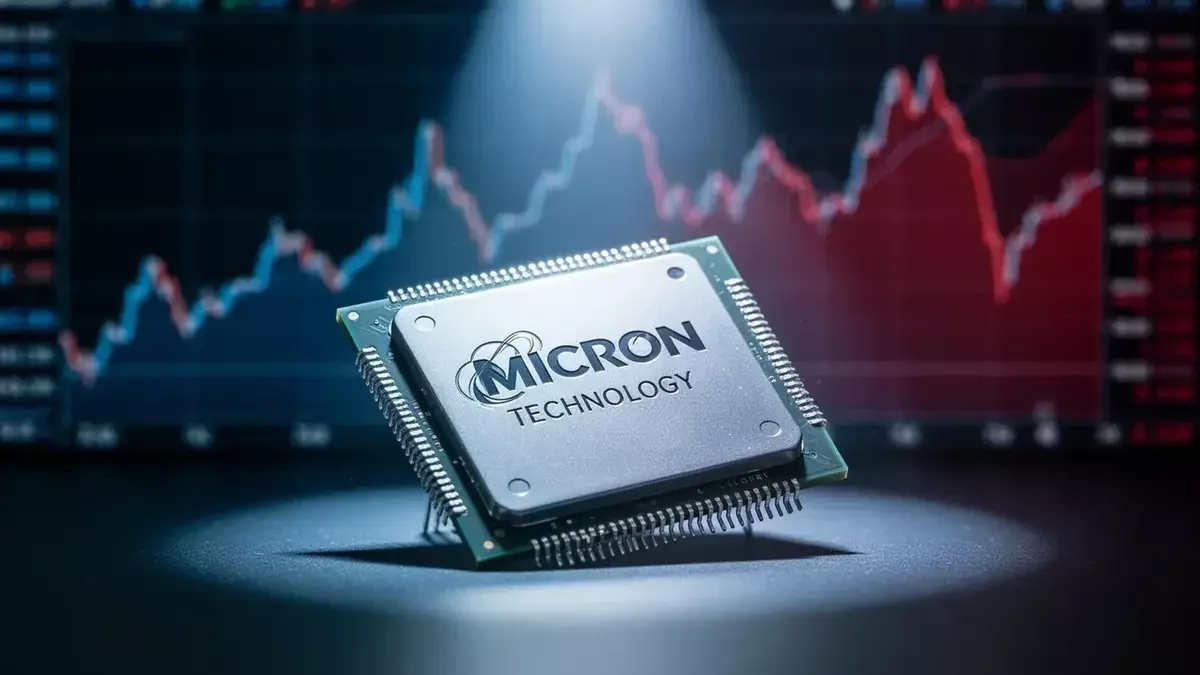
Micron’s $1.3 Trillion Bet: How Strategic Contracts and HBM4 Could Rewrite the Memory Cycle
Published on 07/01/2026 at 05:58 | Redaktion boerse-global.de
The stock market’s love affair with Micron Technology has reached a point where the old rules no longer seem to apply. Shares have tacked on roughly 889% over the past twelve months and 277% since the start of the year, lifting the company’s market capitalisation to about $1.32 trillion — a valuation that would have been unthinkable for a memory supplier in any previous upcycle. The debate now is whether this rally reflects a genuine structural transformation or simply the hottest phase of a boom that, like all booms before it, will end in bust.
Micron’s management is betting the answer is structural. The company has been shifting away from the commodity-like spot market and toward multi-year “Strategic Customer Agreements” (SCAs) with hyperscale cloud operators. These long-term supply contracts for AI infrastructure are designed to bring predictability to a business historically plagued by violent price swings and inventory gluts. If the SCAs deliver what they promise — stable margins that survive the next capacity wave — then Micron’s valuation premium may be here to stay. If they fail, the stock risks reliving the cyclical nightmare it has tried to escape.
The bottle-neck that turned memory into a must-have
The bull case begins with a simple observation: supply cannot keep up with demand for high-bandwidth memory (HBM) and specialised DRAM. Management sees no realistic timetable for the industry to close that gap, with shortages potentially persisting into 2027 or 2028. That scarcity has given Micron exceptional pricing power, especially for its HBM4 chips, which are already in mass production for Nvidia’s upcoming Vera Rubin platform. As Qualcomm’s new AI architecture confirms, moving data efficiently has become the defining constraint in AI infrastructure — and memory is the bottleneck that matters.
That narrative has turned Micron from a cyclical component supplier into a strategic asset. Investors now treat the stock less as a memory play and more as a leveraged bet on the entire AI build-out. The annualised 30-day volatility has surged past 108%, underscoring how aggressively the momentum trade has taken hold. The stock sits roughly 166% above its 200-day moving average, a gap that signals extreme conviction — and extreme fragility.
Should investors sell immediately? Or is it worth buying Micron?
The cost of building the future
Yet the bear case is equally powerful, and it hinges on the sheer scale of Micron’s capital spending. The company is ramping mega-fabs in Idaho and New York, backed by CHIPS Act subsidies, to meet the demand that its SCAs lock in. Those investments create a fixed-cost structure that could become a millstone if the AI capex cycle pauses. History shows what happens when Samsung, SK Hynix and Micron all fire up new production lines at the same time: new capacity tends to arrive just as demand normalises, triggering a margin collapse.
There is also a secondary drag from rising memory prices. Expensive DRAM makes PCs and smartphones costlier, potentially crimping consumer demand just when Micron needs broad utilisation to absorb its new factories’ output. The very pricing power that benefits the stock today could undermine the volumes it will need tomorrow.
A technical pause and a date to watch
On the chart, the stock’s Relative Strength Index sits at 60.8 — not yet overbought, despite a 14% gain over the past 30 days. The 50-day moving average near €733 provides a potential support level if a broader tech correction materialises. But the technical picture is secondary to the business question: can the industry maintain “utilisation discipline”? If Samsung and SK Hynix continue to prioritise pricing over market share, Micron’s premium remains defensible. If they flood the market with capacity, the valuation will snap.
Micron at a turning point? This analysis reveals what investors need to know now.
That brings the timeline into focus. December 9, 2026, marks the second anniversary of the CHIPS Act agreement with Micron — the earliest window for the company to launch share buybacks. Until then, the stock’s fate rests on whether the SCAs deliver the margin stability they promise. If they do, a further re-rating is likely. If they do not, the momentum that drove Micron above €1,000 could reverse just as violently as it began.
For now, the market has priced in the assumption that memory has permanently moved up the AI hierarchy — from a peripheral component to a strategic bottleneck. That is a bet on scarcity, not on cycles. And as any veteran of the memory industry knows, scarcity is never permanent. The test comes when new fabs go live. Micron’s $1.3 trillion valuation will either look prescient or premature. There is no middle ground.
Ad
Micron Stock: New Analysis - 1 July
Fresh Micron information released. What's the impact for investors? Our latest independent report examines recent figures and market trends.
Disclaimer regarding our articles: No investment advice, no buy or sell recommendation. Information on prices, companies, and markets is provided without guarantee; changes are possible at any time. Stock market transactions can lead to substantial losses. Our articles are created and reviewed in whole or in part automatically with the support of AI.