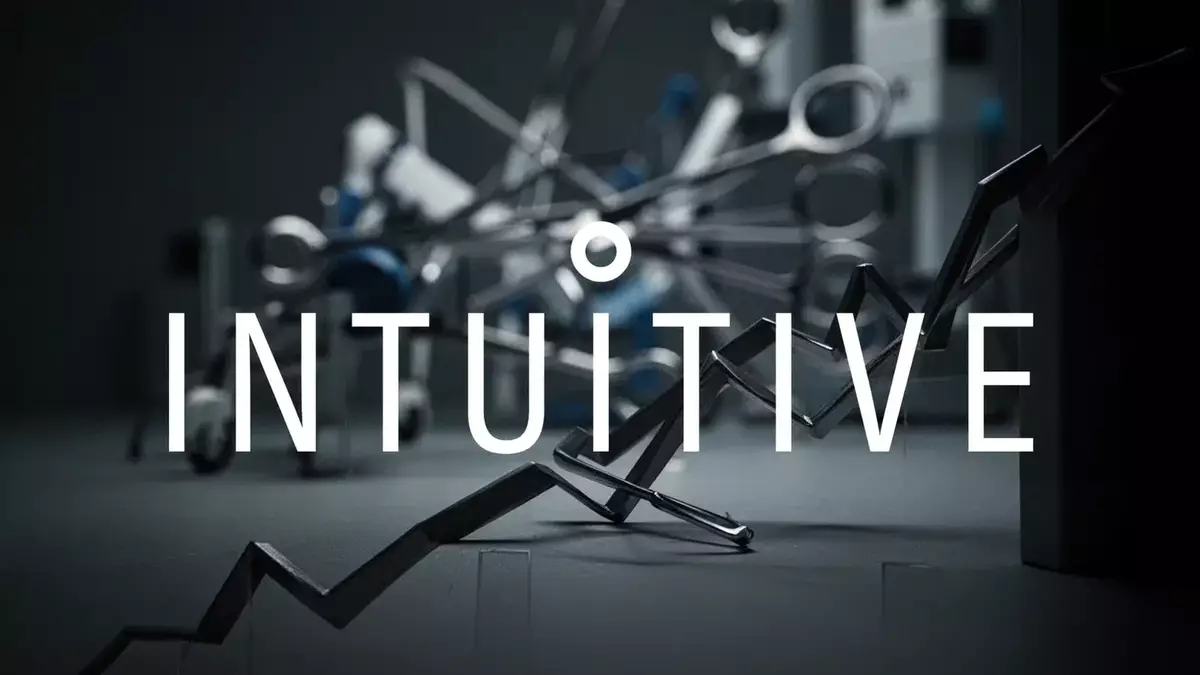
Intuitive Surgical: The Hardest Lesson in a Decade of Market Leadership
Published on 08/01/2026 at 18:07 | Redaktion boerse-global.de
For a company that spent years as one of medtech's most dependable compounders, the past month has delivered a brutal reality check. Intuitive Surgical's shares closed Friday at €306.80, a weekly gain of 3.37% — but that modest rebound does little to mask the scale of the damage. The stock remains down 37.28% since the start of the year, and sits more than 40% below its January peak of €516.50.
The trouble began in mid-July, when the robotics pioneer delivered quarterly results that, on paper, looked like another routine beat. Revenue climbed 18.54% to $2.89 billion, while adjusted earnings per share of $2.80 came in comfortably ahead of the $2.50 consensus. It marked the fifth consecutive quarter of outperformance. The market's response? A fresh 52-week low, touched on July 23 at €289.05.
A Guidance Cut That Changed the Conversation
The disconnect between the numbers and the share price reaction comes down to one thing: forward guidance. Management trimmed its 2026 growth forecast for da Vinci procedures to a range of 13.5% to 15.5%, down from 18% in 2025. More than a dozen Wall Street firms slashed their price targets in response, with a combination of slowing US procedure growth and insurance-related headwinds cited as the primary culprits.
What makes this episode particularly striking is that the bear case has now acquired a tangible, competitive dimension. On July 22, the FDA granted De-Novo clearance to Johnson & Johnson's Ottava surgical robot for ten general surgery procedures in the upper abdomen. After two decades of effective monopoly — da Vinci accounts for roughly 70% of revenue and over 10,000 installed systems worldwide — Intuitive finally has a credible challenger.
For investors navigating this kind of volatility, risk management isn't just a financial discipline — it's a workplace essential. A free toolkit with 41 ready-to-use templates helps you document and control operational risks before they become liabilities. Download the free Risk Assessment Toolkit
Yet several analysts argue the market's reaction to Ottava's approval is disproportionate to the actual threat. The key buffer: switching costs. Intuitive generated 85% of its latest quarterly revenue from recurring streams tied to procedures performed on already-installed machines. Surgeons trained on da Vinci don't casually migrate platforms — a switch means retraining entire operating teams. J.P. Morgan's Robbie Marcus notes that his physician conversations continue to show Intuitive as the clear preference, with entrenched clinical relationships providing meaningful insulation.
Wall Street Splits, But the Bull Case Holds
The analyst community has responded to the sell-off with notable divergence. Morgan Stanley upgraded the stock to Buy, UBS initiated coverage with a Buy rating, and Mirae Asset also moved to the upside. Only HSBC cut to Hold. William Blair, while acknowledging near-term pressures — weaker procedure numbers tied to the Affordable Care Act, intensifying competition in China, and pricing initiatives that could squeeze margins — maintained its Outperform rating, pointing to the company's industry-leading earnings growth.
The optimists are strikingly bullish. Piper Sandler sees substantial untapped potential in soft-tissue robotics following a sector conference. Bernstein holds the most aggressive stance, with a price target of $685 implying upside of nearly 92%. According to CNN Business data, 71% of Wall Street analysts rate the stock a Buy, with a median price target of $485 — roughly 43% above current levels. The average analyst target across all firms stands at €415.91, implying 35.6% upside from Friday's close.
Insider Activity Tells a Different Story
While analysts debate the growth trajectory, those closest to the company have been voting with their feet. EVP Mark Brosius sold 56 shares on July 30 and 31 at prices between $346.83 and $351, following earlier disposals in the same week at prices ranging from $344 to $365.58. The pattern extends across the past twelve months: GuruFocus data shows 38 insider sales and not a single insider purchase.
When leadership signals caution, prudent operators double down on compliance fundamentals. Over 37,000 UK businesses use a free Health & Safety toolkit to stay ahead of regulatory obligations — with ready-made risk assessments and checklists that keep operations running smoothly. Get the free Health & Safety Toolkit
A Technical Picture That Suggests Exhaustion, Not Collapse
The charts offer a nuanced read. The stock trades 11.58% below its 50-day moving average and 26.25% below its 200-day average — a clear sign of persistent weakness. But the 14-day RSI of 39.3 signals a market that is neutral to slightly oversold, far from panic territory. Annualized 30-day volatility of nearly 58% confirms this remains a high-conviction, high-swing story. The 6.14% buffer above the July low offers limited comfort if sentiment sours again, but it also suggests sellers are struggling to push the stock to new depths.
The recent rebound has been aided by a curious dynamic: Ottava's approval has generated fresh sector-wide enthusiasm for surgical robotics, lifting Intuitive alongside its new competitor. The company's market capitalization of €110.21 billion now reflects a business that must defend its moat rather than simply expand it.
The central tension is hard to resolve. The fundamentals remain solid — double-digit revenue growth, a dominant installed base, and recurring revenue that cushions competitive shocks. Yet insider selling persists, guidance has been trimmed, and the stock trades well below its long-term averages. For investors willing to stomach the volatility, the risk-reward calculus may favor patience over capitulation. But the era of Intuitive Surgical as a risk-free compounder is definitively over.
Disclaimer regarding our articles: No investment advice, no buy or sell recommendation. Information on prices, companies, and markets is provided without guarantee; changes are possible at any time. Stock market transactions can lead to substantial losses. Our articles are created and reviewed in whole or in part automatically with the support of AI.