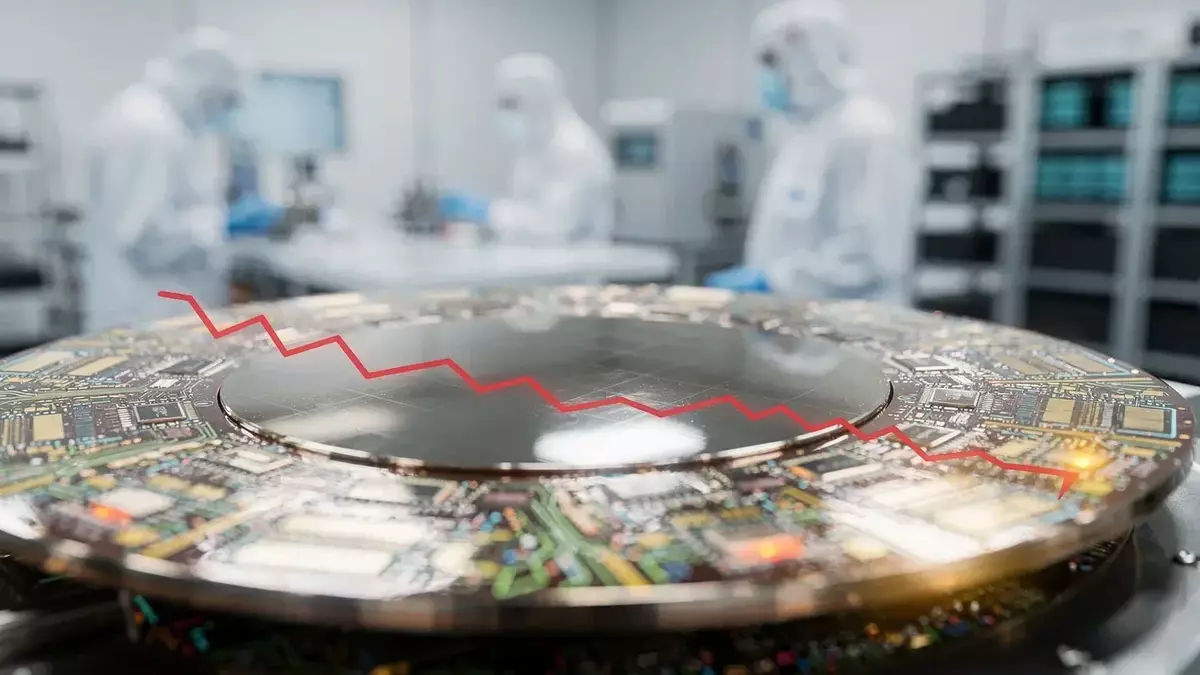
Semiconductor ETF Catches Its Breath as Cloud Giants Double Down on AI Spending
Published on 08/01/2026 at 16:31 | Redaktion boerse-global.de
The chip trade has spent the past month getting beaten up. On Friday, a single number from Amazon's earnings call was enough to stop the bleeding.
The VanEck Semiconductor UCITS ETF closed at EUR 89.23, up 0.92 percent on the day. That modest gain masks a brutal stretch: the fund is still down 4.45 percent on the week and has shed 13.75 percent over the past 30 days. Friday's bounce reads more like a pause than a pivot.
Cloud capex promises rekindle the AI narrative
Amazon's quarterly report did the heavy lifting. The company lifted its 2026 capital expenditure plan to USD 220 billion, with the bulk earmarked for AI infrastructure. AWS revenue grew 37 percent year-over-year — the fastest clip in four years. The message to the market was unambiguous: the hyperscalers aren't tapping the brakes on AI investment, they're pressing the accelerator.
That followed Microsoft's own earnings surprise on Thursday, when Azure growth blew past expectations and sent the stock up 16 percent. Amazon jumped 11 percent on Friday. Both reports landed just days after Microsoft and Alphabet had already signaled higher hardware budgets.
Should investors sell immediately? Or is it worth buying VanEck Semiconductor UCITS ETF?
The ripple effect hit chip stocks directly. Nvidia climbed 2.9 percent to roughly USD 200.75, reclaiming its title as the world's most valuable company with a market capitalization of USD 4.86 trillion, edging past Apple. Reports of a potential deal involving Alibaba and Chinese AI firm Moonshot for 20,000 chips added further tailwind.
The relief rally came despite Treasury yields pushing to multi-year highs — a sign that investors were willing to look past macro headwinds when the AI spending story is this explicit.
A portfolio built differently than you'd expect
The fund's internal architecture explains some of its recent behavior. AMD leads the portfolio at 10.33 percent, followed by Broadcom at 9.57 percent and Micron at 9.39 percent. TSMC accounts for 8.75 percent. Nvidia, despite its towering market cap, sits at just 8.40 percent — a cap imposed by the index methodology rather than manager discretion.
That construction has paid off this year. Micron has exploded 223 percent on HBM memory-chip shortages, while AMD has climbed 144 percent following a major Meta order. The fund has run hard without Nvidia as its primary engine.
But concentration risk lurks beneath the surface. TSMC and ASML together represent nearly 17 percent of the portfolio, meaning a single headline out of the Taiwan Strait can move a sizable chunk of the fund in one session.
Restructuring and dealmaking in the background
Not everything moved in lockstep on Friday. Intel continued its restructuring, launching another round of layoffs in its data-center and AI division as CEO Lip-Bu Tan pursues a 15 percent reduction in the global workforce — an effort to lighten a balance sheet weighed down by years of costly fab construction.
Meanwhile, NXP Semiconductors is reportedly in talks to acquire chip designer Ambarella, aiming to bolster its software-defined vehicle capabilities. Ambarella shares jumped roughly 19 percent on the news, suggesting consolidation appetite is returning to the sector.
The selloff that preceded the bounce
The recent turbulence didn't come out of nowhere. The iShares Semiconductor ETF had fallen around 25 percent from its June 22 high, while the leveraged Direxion Daily Semiconductor Bull 3X Shares lost nearly two-thirds of its value over the same stretch.
SK Hynix's earnings triggered the sharpest leg down. South Korea's Kospi index briefly plunged 13 percent before bargain hunters trimmed the loss to 6 percent. The US-listed VanEck Semiconductor ETF dropped more than 2 percent on Monday alone.
Standard Chartered's head of equity strategy attributed part of the early-week pressure to media reports about China's ambitions in memory chips and lithography equipment. The long-term outlook, he argued, remains intact: "The market is large enough for multiple players to profit simultaneously and coexist."
Flows tell a different story than prices
The relationship between chips and software has also shifted. The iShares Expanded Tech-Software ETF and the iShares Semiconductor ETF moved in opposite directions on 32 of the past 60 trading days — the highest divergence since both funds launched in 2001. Their 60-day correlation has fallen from a long-run average around 0.75 to nearly zero.
None of the volatility has scared capital away. US semiconductor ETFs have absorbed over USD 46 billion in fresh inflows in 2026 — a new annual record that roughly doubles the cumulative inflows from all years since 2017 combined.
The VanEck fund now trades about 27 percent above its 200-day average of EUR 70.14, yet sits nearly 9 percent below its 50-day average of EUR 98.00. It remains almost 20 percent shy of its 52-week high of EUR 111.18, set on June 30.
The numbers frame the tension neatly. The fund is up 67.51 percent year-to-date, and VanEck's own data shows a 112.33 percent gain over the past twelve months. A month of pain hasn't undone a year of gains — but it has reminded investors how violently this theme can swing.
Nvidia's August earnings will be the next test. That report will show whether the chipmaker can back up its customers' aggressive spending promises with growth numbers of its own.
Ad
VanEck Semiconductor UCITS ETF Stock: New Analysis - 1 August
Fresh VanEck Semiconductor UCITS ETF information released. What's the impact for investors? Our latest independent report examines recent figures and market trends.
Disclaimer regarding our articles: No investment advice, no buy or sell recommendation. Information on prices, companies, and markets is provided without guarantee; changes are possible at any time. Stock market transactions can lead to substantial losses. Our articles are created and reviewed in whole or in part automatically with the support of AI.