BYD's Multi-Front Push: 100,000 Datang Orders, a $5.5 Billion Brazil Plant, and a $13.8 Billion Autonomy Bet
01.06.2026 - 11:41:02 | boerse-global.de
For a company that logged a 26% sales decline in the first four months of 2026, BYD is acting anything but defensive. The Chinese electric-vehicle giant is simultaneously rolling out a flagship SUV to revive its home market, sinking billions into a Brazilian factory, and pouring triple-digit yuan sums into self-driving technology. The common thread: a determination to break out of the volume trap and claim territory in premium, global, and autonomous arenas.
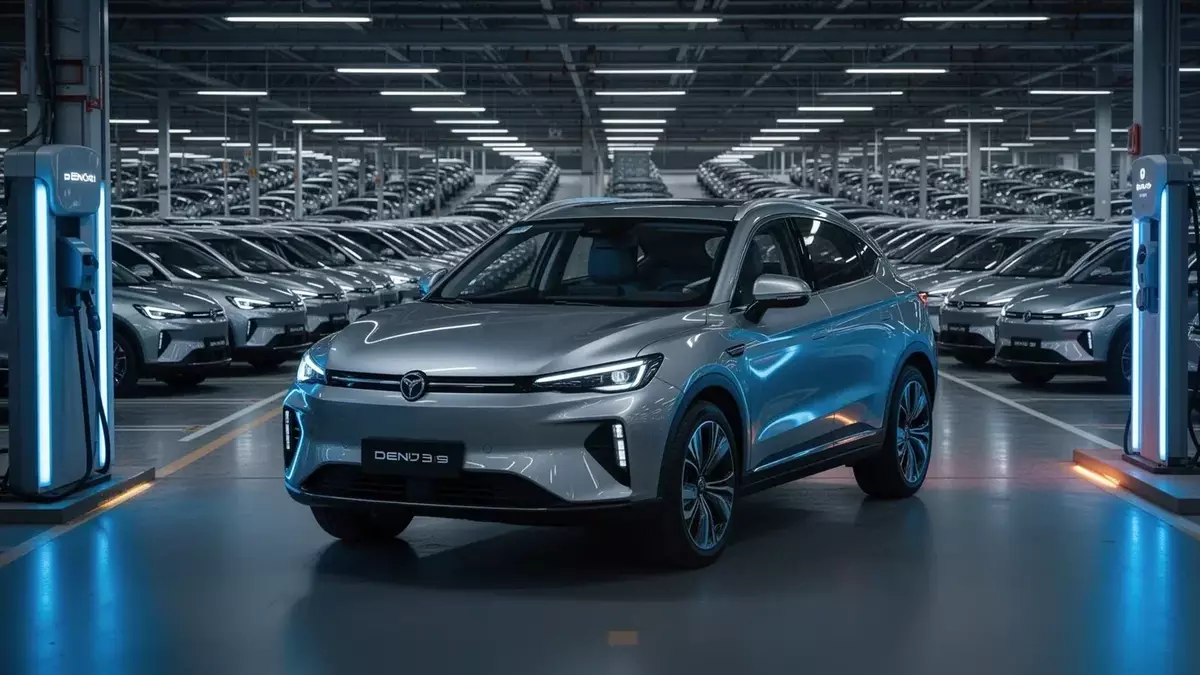
The Datang SUV, launched for pre-order at the Beijing auto show in April, has already notched more than 100,000 orders in its first two weeks — including 30,000 within the first 24 hours. BYD is positioning the model firmly in the premium bracket, with prices ranging from 250,000 to 320,000 yuan. According to JPMorgan, higher-priced vehicles could account for over 30% of BYD's China sales by the fourth quarter of 2026, making the Datang a critical lever for improving product mix.
The SUV also serves as a showcase for the company's latest hardware. The all-electric version uses a second-generation Blade battery and delivers up to 950 kilometers of range under China's CLTC standard. A 1,000-volt architecture supports charging rates of up to 1,000 kilowatts at 1,000 amperes. The platform can sprint from 0 to 100 km/h in 3.9 seconds and comes with DiSus-A air suspension, rear-axle steering, and a crab-walk mode — technology the company hopes will establish it as a serious contender in the luxury segment, not merely a cut-price alternative.
Yet the Datang alone cannot fix BYD's near-term math. Between January and April, the group sold roughly 1.02 million vehicles, well below the pace needed to hit its full-year target of 5.0 to 5.5 million new-energy vehicles. To close the gap, monthly deliveries for the rest of 2026 must average 500,000 to 560,000 units — a steep climb that puts a premium on stable production and rapid fulfillment of those 100,000 pre-orders.
Should investors sell immediately? Or is it worth buying BYD?
Outside China, BYD is laying the groundwork for a vastly larger presence. In Camaçari, Brazil, the company is converting a former Ford factory into a full-production site at a cost of about 5.5 billion reais. Scheduled to begin complete manufacturing in 2026, the plant will cover body pressing, welding, and painting, with an initial capacity of 150,000 vehicles a year, expandable to 300,000. It will produce the world's first plug-in hybrid with flex-fuel capability, running on either ethanol or gasoline. The project is expected to create around 20,000 jobs and operate entirely on renewable energy.
Further capacity is coming online in Hungary, where test production at BYD's first European passenger-car plant began in January, with series production slated for the second quarter of 2026. Factories in Thailand and Indonesia are also part of the global push that targets 1.5 million overseas sales this year, with a long-term ambition of 10 million vehicles annually worldwide.
Alongside its physical expansion, BYD is making a massive bet on software. The company has allocated 100 billion yuan (approximately $13.8 billion) to research and development in autonomous driving — a shift Morgan Stanley has noted across the Chinese EV industry, away from aggressive price wars and toward AI-driven systems. BYD's in-house "God's Eye" driver-assistance platform is already active in 3 million vehicles spanning more than 60 models. The company says severe accidents have dropped to one-sixth the rate of human drivers, with systems processing 190 million kilometers of driving data daily and updating algorithms every three days.
BYD is intent on keeping such capabilities in-house. Although it partnered with Huawei on the ADS 3.0 system for the Fangchengbao Bao 8, that collaboration remains a one-off. The company's own "DiPilot" technology takes strategic priority, as BYD seeks to maintain control over its software ecosystem and pursue a long-term "zero accident" standard through integrated electronic and powertrain architectures.
BYD at a turning point? This analysis reveals what investors need to know now.
On June 5, BYD will launch the refreshed Atto 3 in Malaysia, including an "Evo" variant with an 800-volt architecture, a 74.8 kWh battery, 510 kilometers of WLTP range, and 220 kW DC charging capability. The move underscores that even as BYD scales up premium models and autonomous systems, it continues to refresh its core global lineup.
The months ahead will test whether BYD can convert pre-order buzz into delivery momentum, turn its Brazilian factory from investment into output, and demonstrate that its autonomy bet delivers a competitive edge — all at once. The company has laid out the pieces; now it has to make them fit.
Ad
BYD Stock: New Analysis - 1 June
Fresh BYD information released. What's the impact for investors? Our latest independent report examines recent figures and market trends.