
Acadia National Park’s granite coast and carriage roads
Published on 08/15/2026 at 14:19 | Editorial responsibility: Rafael Müller, Editor-in-Chief AD HOC NEWS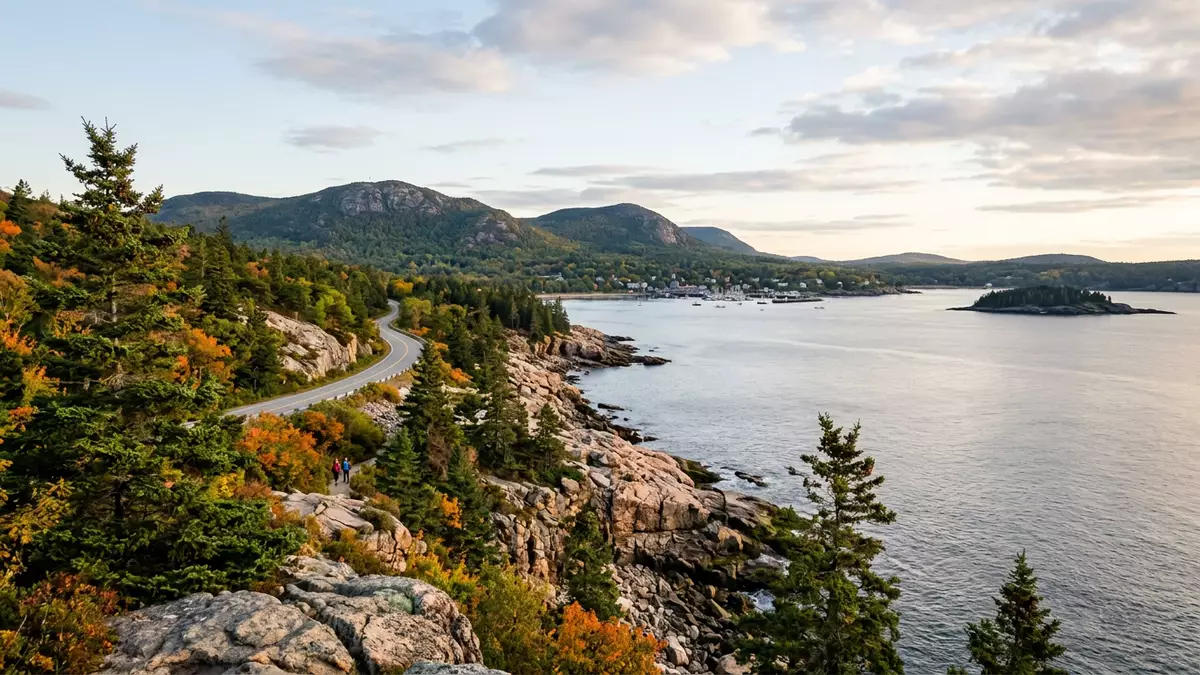
Acadia National Park on Mount Desert Island, near Bar Harbor in Maine, brings together exposed granite peaks, forested hillsides and a fractal coastline of bays and inlets in a relatively compact area. The park’s landscape is shaped by ancient bedrock such as the Bar Harbor Formation and Cadillac Mountain granite, giving Acadia a distinct rocky character beside the Atlantic Ocean.
Granite, schist and an Atlantic island landscape
The underlying geology of Acadia National Park reaches back hundreds of millions of years, with Mount Desert Island underlain largely by granite and older sedimentary and metamorphic rocks. One of the key units is the Bar Harbor Formation, a sequence of brown to grey sandstone and siltstone layers that record marine deposition before they were buried and hardened into rock.Bar Harbor Formation sandstone and siltstone The island also exposes Ellsworth Schist, a Middle Cambrian unit identified as some of the oldest rock on Mount Desert Island.Middle Cambrian Ellsworth Schist
Above these older strata, Silurian age granite rose and crystallised to form the bedrock that defines much of the park’s relief. Cadillac Mountain granite, part of the Coastal Maine Magmatic Province, is a coarse-grained intrusive rock whose perthite crystals give it a pinkish colour.Cadillac Mountain granite in the Coastal Maine Magmatic Province At the contact between this granite and the older Bar Harbor Formation, geologists describe a shatter zone where fragments of stratified rocks are enclosed within the igneous mass, visible in places on the eastern side of Cadillac Mountain.shatter zone between granite and Bar Harbor Formation Together, granite ridges, schist outcrops and sedimentary layers frame the park’s cliffs, coves and interior valleys.
Cadillac Mountain and the high ground above the Atlantic
Rising above the island, Cadillac Mountain is Acadia National Park’s most prominent summit and a defining feature of its skyline. The peak reaches about 466 m (1,530 ft) and forms part of the large granite body that occupies the central portion of Mount Desert Island.Cadillac Mountain summit at 466 m This height makes Cadillac Mountain the highest point in Acadia National Park and the highest terrain on the immediate Atlantic coast of the United States within many kilometres of shoreline.highest peak in Acadia and on the U.S. East Coast
The mountain’s upper slopes expose expanses of pinkish granite, intersected by fractures and patches of vegetation that cling to shallow soils. The summit area provides wide views across the surrounding bays, islands and the broader Gulf of Maine, with Mount Desert Island’s interior hills and lakes spread out below. Because Cadillac Mountain granite is part of the Coastal Maine Magmatic Province associated with the Acadian Orogeny, the peak carries the signature of tectonic and magmatic processes that reshaped this portion of North America during the Palaeozoic, linking a single accessible summit to a much larger geological story.Cadillac Mountain granite and Acadian Orogeny
Rockefeller’s carriage roads through forest and granite
Alongside its bedrock and peaks, Acadia National Park is marked by a network of historic carriage roads funded and directed by philanthropist John D. Rockefeller Jr. From 1913 to 1940 Rockefeller worked with the National Park Service to construct an elaborate system of horse-drawn carriage routes on Mount Desert Island, laid out across some of its most scenic terrain.Rockefeller’s 57-mile carriage road system The system ultimately extended for more than 50 miles, with a substantial portion lying inside what became Acadia National Park, and was later recognised on the National Register of Historic Places.carriage roads, bridges and gatehouses listed in 1979
Within the park boundaries there are around 45 miles of rustic carriage roads, typically about 16 ft (4.9 m) wide and surfaced as broken-stone roads using three layers of rock of progressively smaller size.forty-five miles of rustic carriage roads They incorporate granite coping stones as guardrails, colloquially known as “Rockefeller’s teeth”, and a series of steel-reinforced concrete bridges faced with hand-hewn, locally quarried granite.carriage road widths, coping stones and bridges The roads wind through forests, along ponds and up mountain slopes, with two Tudor Revival style gatehouses, designed by Grosvenor Atterbury, controlling access at key junctions.Tudor Revival gate lodges and carriage road design
Visiting Acadia National Park: what travellers from Western Europe should know
- Acadia National Park occupies much of Mount Desert Island on the coast of Maine in the United States, with Bar Harbor lying on the island’s north-eastern shore as a principal gateway town.
- The terrain combines granite peaks such as Cadillac Mountain, forested interior valleys and a rocky shoreline, with many paths and carriage roads involving gradients and extended sections on foot.
- The main road network reaches trailheads and viewpoints on Mount Desert Island, while additional park lands lie on the Schoodic Peninsula and Isle au Haut, each with their own access routes.
- English is the official language and the currency is the United States dollar.
- Entry requirements depend on your nationality; UK travellers can check the FCDO travel advice at gov.uk/foreign-travel-advice, Irish travellers the Department of Foreign Affairs at ireland.ie.
Searching for Acadia National Park on social platforms
These links open searches for Acadia National Park on each platform.
Frequently asked questions about Acadia National Park
Where is Acadia National Park located?
Acadia National Park is on the coast of Maine in the United States, centred on Mount Desert Island near the town of Bar Harbor.
What should visitors expect on a first visit?
Visitors encounter granite peaks, forested valleys, lakes and a rugged Atlantic shoreline, with an established network of trails and historic carriage roads.
What makes Acadia National Park distinctive among coastal parks?
Acadia combines accessible high ground such as Cadillac Mountain with a historic system of Rockefeller-funded carriage roads set amid pink granite bedrock and island coves.


