
Addo Elephant National Park and its thicket of elephants, sea and scrub
Published on 08/24/2026 at 19:33 | Editorial responsibility: Rafael Müller, Editor-in-Chief AD HOC NEWS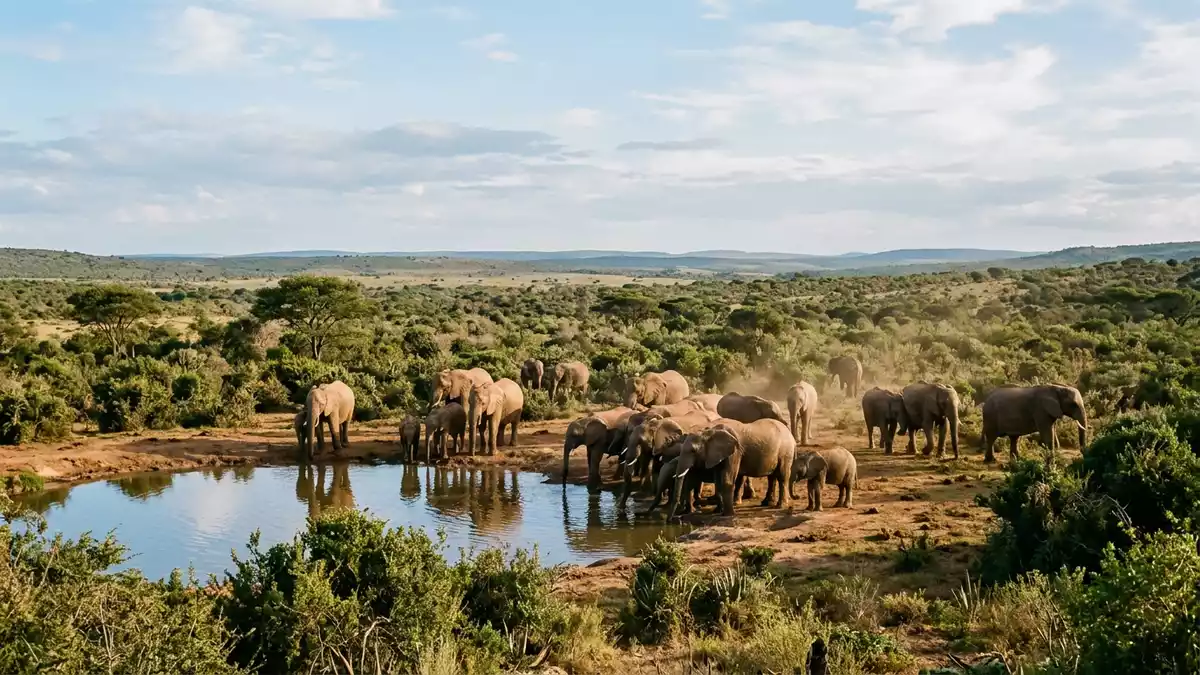
Addo Elephant National Park in South Africa’s Eastern Cape wraps elephants, thicket and coastline into a single protected landscape that keeps expanding beyond its original boundaries. Established in 1931 to safeguard the last surviving elephants in the Addo bush, it has grown from a compact core into a park that now links the Sundays River valley with mountains and the marine world off Algoa Bay.
From 11 survivors to a vast Eastern Cape reserve
The story of Addo Elephant National Park begins with a crisis. By the early twentieth century, elephant herds in the Eastern Cape had been reduced by hunting and conflict with farmers to a remnant that hovered on the brink of local extinction.The park was formally proclaimed in 1931 to protect the last elephants in the Addo bush, marking a turning point from extermination campaigns to conservation.
When the national park was declared, only eleven elephants in the region were recognised as surviving in the wild.The first reserve covered about 2,270 hectares of dense thicket between the Sundays River and the Zuurberg range, enclosed step by step with an elephant-proof fence developed in the 1950s. From that modest beginning, successive extensions have added surrounding farmland, mountain slopes and coastal sections, turning Addo into a broad mosaic of habitats rather than a single valley enclave.
Thicket, elephants and the dense heart of Addo
At the centre of Addo Elephant National Park lies the thick, tangled vegetation of the Sundays River valley, dominated by evergreen shrubs such as spekboom that grow into a continuous mass of foliage. This thicket creates a visually dense landscape, with twisting tracks threading between walls of green where elephants, buffalo and antelope appear and disappear at close range.The southern part of the park occupies this valley south of the Suurberg Range, north of the coastal city of Gqeberha, and still reads as the historic heart of the reserve.
The elephant population that once stood at eleven animals has increased over decades of protection to several hundred individuals that move through this core section and the adjoining areas.The park is now recognised as holding one of the largest elephant concentrations in South Africa, and game drives focus on the interplay between these herds and the surrounding thicket, open clearings and artificial waterholes. In places, short grass plains open out from the scrub, creating broader views with scattered animals against low ridges.
Greater Addo: from bush to mountains and sea
Beyond the original Addo section, the protected area now stretches across a varied landscape that includes the Zuurberg mountains, coastal dunes and offshore islands. Higher slopes north of the valley carry a different vegetation, with grassland patches and scattered trees replacing the dense thicket below, while the coastal sector near Algoa Bay brings in wind-shaped dunes and fynbos shrubland.
The expansion of the park has also taken protection offshore. In 2005 the Greater Addo Elephant National Park concept came into force, adding a marine protected area around islands in Algoa Bay and connecting them administratively to the land-based sections.This enlarged park includes the Birds Island group and a stretch of sea frequented by marine mammals and seabirds, making Addo one of the few African national parks to link large land mammals with a formally protected marine environment.
Visiting Addo Elephant National Park: what travellers from Western Europe should know
- Addo Elephant National Park lies in South Africa’s Eastern Cape, inland from Algoa Bay and north of the coastal city of Gqeberha, with the main rest camp near the town of Addo.
- The terrain in the central section consists of undulating ground with vehicle tracks on compacted earth or gravel and viewpoints on low rises that look across thicket and open clearings.
- Some areas of the park reach into the Zuurberg mountains, where roads climb to higher elevations with steeper gradients and occasional tight bends along the ridges.
- The official language is Afrikaans and English is widely used, and the currency is the South African rand.
- Entry requirements depend on your nationality; UK travellers can check the FCDO travel advice at gov.uk/foreign-travel-advice, Irish travellers the Department of Foreign Affairs at ireland.ie.
Searching for Addo Elephant National Park on social platforms
These links open searches for Addo Elephant National Park on each platform.
Frequently asked questions about Addo Elephant National Park
Where is Addo Elephant National Park?
Addo Elephant National Park lies in South Africa’s Eastern Cape province, inland from Algoa Bay and north of the coastal city of Gqeberha, near the town of Addo.
What can visitors expect to see in Addo Elephant National Park?
Visitors encounter a mix of dense thicket, open clearings and waterholes with elephants, buffalo and antelope, along with mountain and coastal scenery in the wider park.
What makes Addo Elephant National Park distinctive among African reserves?
Addo combines a dense elephant-inhabited thicket core with highland, coastal and marine protected areas, bringing land mammals, seabirds and marine habitats under a single national park administration.


