
Ahramat al-Giza: stone geometry on the edge of the desert
Published on 08/22/2026 at 19:24 | Editorial responsibility: Rafael Müller, Editor-in-Chief AD HOC NEWS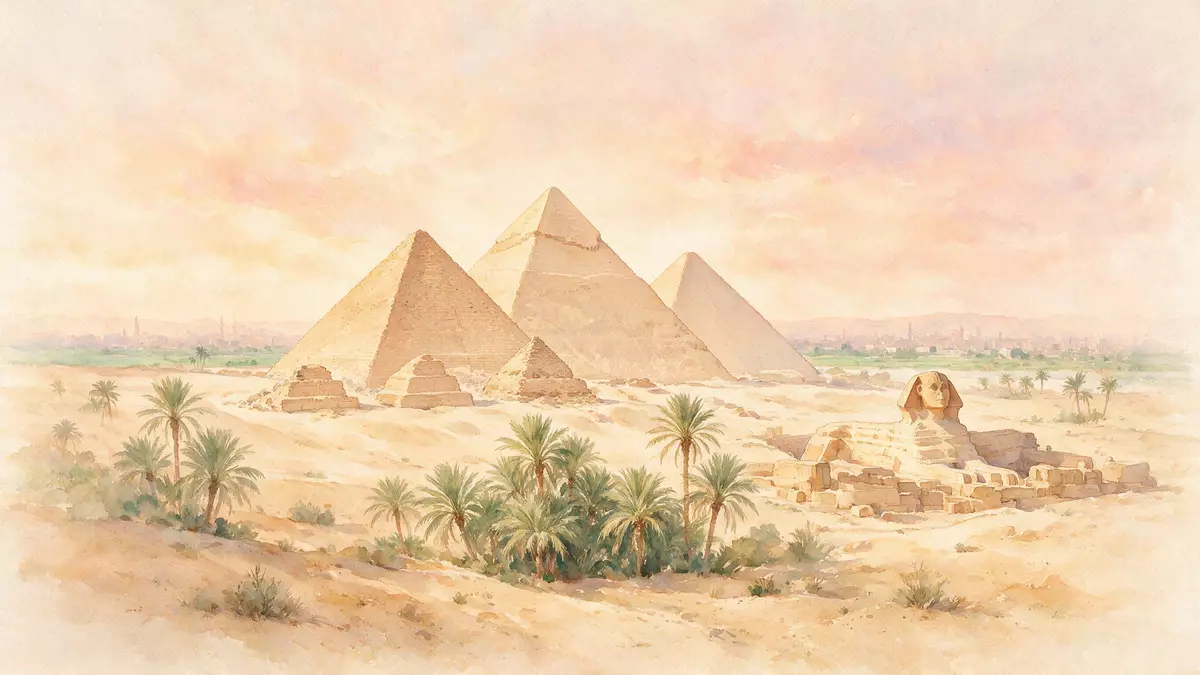
Ahramat al-Giza, better known in English as the Pyramids of Giza, forms a vast stone ensemble on the Giza Plateau west of the Nile, where the desert meets the urban edge of Gizeh. Across this plateau, the pyramids of Khufu, Khafre and Menkaure stand with their funerary complexes, forming a necropolis that dates to Egypt’s Fourth Dynasty in the twenty-sixth century BC.
A stone plateau turned into a royal horizon
The Giza Plateau is a natural limestone rise on the western bank of the Nile, and Ahramat al-Giza occupies its brow like a man?made extension of the geology. The plateau itself provides the broad, level base on which the massive structures could be set out, with the Great Pyramid of Khufu taking a central position among the monuments of the Fourth Dynasty rulers.Giza Plateau From the stone fields of mastaba tombs around the pyramids to the quarry faces cut into the bedrock, almost every surface here speaks of limestone as both ground and building material.
Within this necropolis the three principal pyramids create a stepped horizon of masonry, with Khufu’s Great Pyramid rising highest, Khafre’s pyramid slightly lower but raised on higher ground, and Menkaure’s smaller pyramid completing the sequence.Giza pyramid complex Each pyramid is part of a wider complex with mortuary temples, processional causeways and subsidiary pyramids, giving the plateau the character of a carefully planned royal cemetery rather than a single isolated monument.
The Great Pyramid of Khufu: scale, proportion and stone
At the heart of Ahramat al-Giza stands the Great Pyramid of Khufu, the largest of the three pyramids and one of the most precisely laid out stone structures of the ancient world.Great Pyramid of Khufu Built during Khufu’s reign in the Fourth Dynasty, around 2580–2560 BC, it originally stood at roughly 147 m (about 482 ft) before the loss of its outer casing stones and uppermost blocks reduced its height slightly.original height and date
The footprint of the Great Pyramid is a near?square of about 230 m (755 ft) on each side, laid out so that the sides align closely with the cardinal directions.base dimensions Its bulk is composed of millions of stone blocks, many of them local limestone, with harder granite used for selected internal elements, and the overall mass has been estimated at around 5.9 million tons.estimated mass The pyramid’s sides rise in a continuous slope from the desert floor, forming a crisp geometric volume that dominates the surrounding plateau.
Pyramids, temples and the wider necropolis
Although Khufu’s Great Pyramid is the most recognisable single form at Ahramat al-Giza, it is only one element in a broader necropolis that includes Khafre’s and Menkaure’s pyramids, the Great Sphinx and extensive cemeteries.necropolis elements Khafre’s pyramid stands on slightly higher ground and retains some of its original limestone casing near the top, while Menkaure’s pyramid is smaller but distinguished by granite in parts of its lower courses.Khafre and Menkaure
East and south of the main pyramids lie fields of mastabas, low rectangular tomb structures for officials and relatives, laid out in rows that mirror the order of the royal monuments. Near Khufu’s pyramid, three subsidiary queen’s pyramids and a smaller satellite pyramid complete his immediate complex, alongside mortuary temples linked by a stone causeway towards the former floodplain of the Nile.Khufu complex Taken together, these elements give Ahramat al-Giza the character of a stone city of the dead, structured around the axes and alignments defined by the royal pyramids.
Visiting Ahramat al-Giza: what travellers from Western Europe should know
- Ahramat al-Giza stands on the Giza Plateau on the west bank of the Nile, on the south?western edge of the Greater Cairo urban area, reached by road transport from central Cairo.
- The terrain around the pyramids consists of uneven limestone and packed sand, with low rises and sections of exposed rock; walking between monuments involves stretches over this rough ground.
- The plateau lies within Egypt, where the official language is Arabic and the currency is the Egyptian pound.
- Entry requirements depend on your nationality; UK travellers can check the FCDO travel advice at gov.uk/foreign-travel-advice, Irish travellers the Department of Foreign Affairs at ireland.ie.
Searching for Ahramat al-Giza on social platforms
These links open searches for Ahramat al-Giza on each platform.
Frequently asked questions about Ahramat al-Giza
Where is Ahramat al-Giza located?
Ahramat al-Giza lies on the Giza Plateau on the western bank of the Nile in Gizeh, forming part of the Greater Cairo region in Egypt.
What should visitors expect when exploring the site?
Visitors encounter large stone monuments spread across a limestone plateau, with sandy and rocky ground between pyramids, mastabas, temples and the Great Sphinx.
What makes Ahramat al-Giza distinctive among ancient sites?
The combination of Khufu’s Great Pyramid, Khafre’s and Menkaure’s pyramids, the Great Sphinx and extensive cemeteries on a single plateau makes Ahramat al-Giza a concentrated landscape of Old Kingdom royal architecture.


