
Alcatraz Island and the layered history of the Rock
Published on 08/24/2026 at 12:59 | Editorial responsibility: Rafael Müller, Editor-in-Chief AD HOC NEWS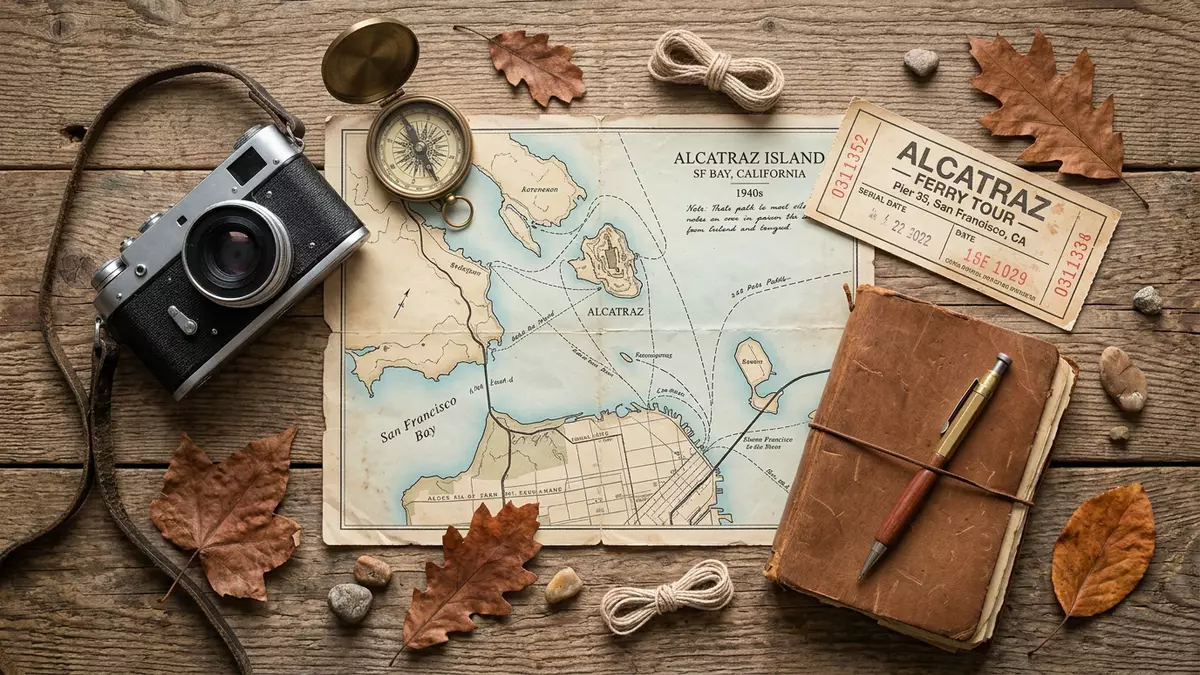
Alcatraz Island in San Francisco Bay is a compact rocky outcrop where a lighthouse, fortress works and prison buildings sit together above the water, creating one of the most concentrated historic sites on the West Coast. Its story reaches from an eighteenth-century Spanish chart to twentieth-century federal prison blocks and Native American activism, all held within the boundaries of a single island.
From Isla de los Alcatraces to a fortified outpost
The documented European history of Alcatraz begins in 1775, when Spanish naval officer Juan Manuel de Ayala mapped San Francisco Bay and recorded the island as “La Isla de los Alcatraces”, a name referring to pelicans and other seabirds on the bare rock.Spanish explorer Juan Manuel de Ayala Long before any fortifications rose, Alcatraz functioned as a natural bird habitat, with sparse vegetation and exposed stone overlooking the strait.
In 1850 President Millard Fillmore reserved Alcatraz for United States military use, and by the mid nineteenth century the island had acquired earthwork defences and masonry buildings as part of a wider scheme to protect the bay approaches.a presidential order set aside the island The Alcatraz lighthouse entered service in 1854 as the first lighthouse on the Pacific Coast, guiding ships towards San Francisco while standing beside the growing fortress.the Alcatraz lighthouse begins service in 1854 By 1859, a permanent garrison occupied the upper plateau, and Alcatraz soon operated as a military prison as well as a coastal stronghold.
Military prison, federal penitentiary and decaying cellblocks
Alcatraz functioned as a military prison from the late 1850s through the early twentieth century, holding army offenders and, at certain points, Native American prisoners and other detainees within its guarded structures.used to hold Civil War and Indian prisoners In 1907 it was designated the Pacific Branch of the United States Military Prison, consolidating its role as a detention site alongside the artillery works that still rim parts of the shore.Pacific Branch U.S. Military Prison designation The island’s confined area, surrounded by strong tides and cold bay water, made it an austere posting for both garrison and inmates.
In 1934 Alcatraz shifted from military control to the Federal Bureau of Prisons and became a federal penitentiary for civilian inmates, housing some of the most widely reported prisoners in United States history, including Al Capone, George “Machine Gun” Kelly and Robert Stroud, the “Birdman of Alcatraz”.famous denizens such as Al Capone Concrete cellblocks rise on the island’s spine, their long corridors and multi-storey wings forming a stark contrast with the surrounding water. The penitentiary closed in 1963 after concerns about costs and infrastructure, and the unheated buildings have since weathered, leaving flaking surfaces, exposed reinforcement and roofless shells alongside more intact structures.
Native American activism and a national recreation area
Alcatraz figures prominently in the history of Native American activism in the United States. On 20 November 1969, a group of Native American protesters occupied the island, asserting Indigenous rights and drawing attention to treaty obligations, with the action continuing into 1971.occupation from November 1969 to June 1971 This episode forms part of a longer story in which Alcatraz held American Indian prisoners during its military and federal prison phases and later became associated with the American Indian Red Power movement.birthplace of the American Indian Red Power movement
In 1972 Alcatraz joined the newly created Golden Gate National Recreation Area under National Park Service management, and in 1973 the island opened as a public park site.Alcatraz becomes a national recreation area in 1972 Visitors now explore the layered remains: the lighthouse still functions beside ruined service buildings, artillery positions overlook the water, cellhouses stand with metal bars and narrow walkways, and nesting seabirds reclaim cliffs and ledges. The contrast between decaying prison fabric and active conservation makes Alcatraz a rare combination of military engineering, penal architecture and coastal ecology on a single site.
Visiting Alcatraz Island: what travellers from Western Europe should know
- Alcatraz lies offshore in San Francisco Bay, reached by passenger ferries that depart from the San Francisco waterfront and berth at the island’s pier.
- The landing area gives way to steep asphalt paths and stairways leading up to the cellhouse and parade ground, with significant gradients and several flights of steps.
- Weather on the island can be cooler and more humid than inland parts of San Francisco, with exposed positions above the water and limited shelter between buildings.
- The official language is English and the currency is the United States dollar.
- Entry requirements depend on your nationality; UK travellers can check the FCDO travel advice at gov.uk/foreign-travel-advice, Irish travellers the Department of Foreign Affairs at ireland.ie.
Searching for Alcatraz Island on social platforms
These links open searches for Alcatraz Island on each platform.
Frequently asked questions about Alcatraz Island
Where is Alcatraz Island located?
Alcatraz Island lies in San Francisco Bay off the coast of California, positioned roughly between the San Francisco waterfront and the Marin Headlands.
What can visitors expect on a visit to Alcatraz Island?
Visitors encounter ferry crossings, steep approaches, historic military structures, former prison cellhouses and viewpoints over the bay, together with seabird colonies on cliffs and roofs.
What makes Alcatraz Island distinctive among historic sites?
Alcatraz combines an eighteenth-century charted island, nineteenth-century fortifications, twentieth-century prison architecture and Native American protest history within the confines of a single small rock.


