
Alcazaba de Malaga, a Moorish citadel above the city
Published on 09/05/2026 at 13:22 | Editorial responsibility: Rafael Müller, Editor-in-Chief AD HOC NEWS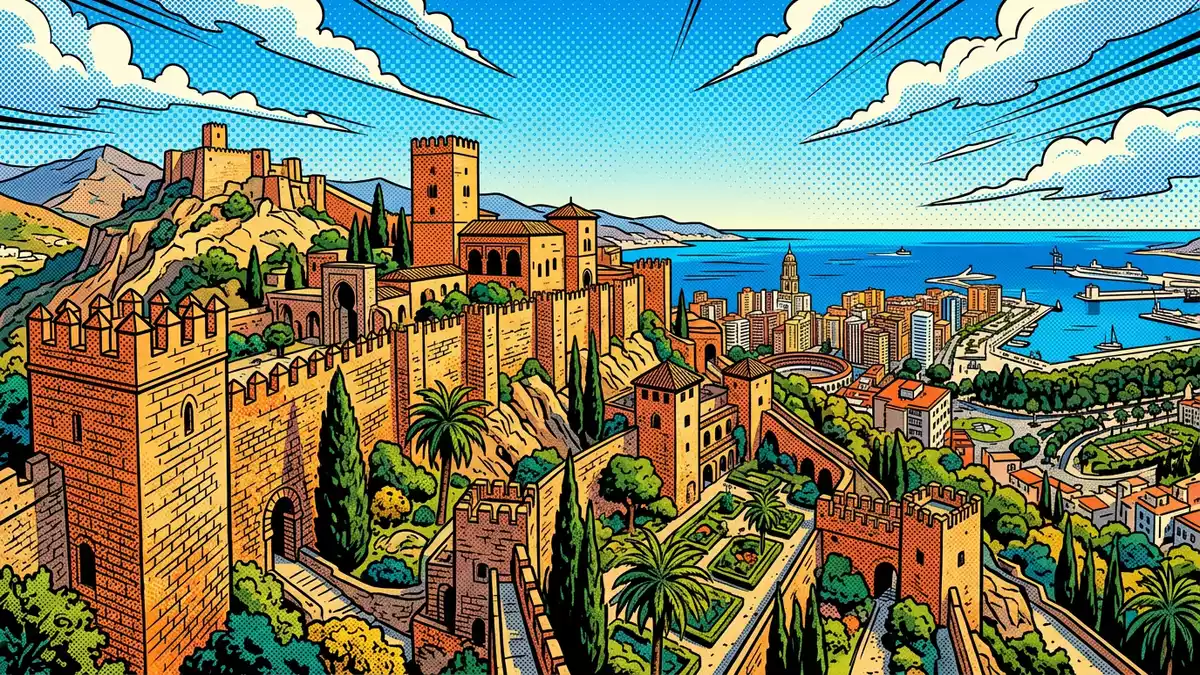
Alcazaba de Malaga is a Moorish palace-fortress on the hillside above Malaga’s historic centre, tying the city to Mount Gibralfaro through stone walls, gateways and planted terraces. Built in the eleventh century under the Muslim rulers of Al-Andalus, it combines defensive ramparts with an inner world of courtyards and chambers that overlook both the bay and the Roman theatre at its foot.
A hillside citadel between city and Mount Gibralfaro
The Alcazaba occupies the lower slopes of Mount Gibralfaro, a limestone hill that rises immediately behind Malaga’s old quarter and port. The complex forms a stepped enclosure that climbs from the street level by the Roman theatre up through successive defensive walls towards the ridge connecting it with the Castle of Gibralfaro.
This position at the foot of Mount Gibralfaro gives the Alcazaba extensive views over Malaga’s harbour and the broader city. Inside the enclosure, paths and stairways lead past towers and ramparts, with breaks where visitors can look down towards the Roman theatre and across to the waterfront.
Moorish fortification and palace architecture
Architecturally, Alcazaba de Malaga is a fortified palatial complex from the period of Muslim-ruled Al-Andalus, with construction concentrated in the eleventh century under the Berber Taifa king Badis ibn Habus. Its plan combines an outer defensive system of walls and towers with an inner core of palace buildings, gardens and water features arranged around courtyards.
The fortress was built between 1057 and 1063 under the orders of Badis, who ruled Granada, creating one of the key Muslim citadels of the Taifa period. Its architecture includes horseshoe arches, stucco decoration and tilework characteristic of Moorish design, while the defensive elements reflect military needs of the time, with gate systems arranged in a zigzag pattern and towers punctuating the walls.
Layers of history: Phoenician origins and later restorations
The site of Alcazaba de Malaga carries traces of earlier civilisations, with the Moorish fortress raised over remains of a Phoenician or Roman fortification that occupied the hillside above the ancient port. The Roman theatre immediately below the citadel underscores this continuity of use between classical and Islamic periods along the same slope.
After the capture of Malaga by the Catholic Monarchs in 1487, the Alcazaba’s role as a royal fortress waned and the complex declined, with houses later built within parts of the enclosure. Systematic restoration began in 1933 under architect Leopoldo Torres Balbás, who oversaw the removal of later dwellings and the conservation of the mediaeval structures, shaping much of the present form of the monument.
Visiting Alcazaba de Malaga: what travellers from Western Europe should know
- Alcazaba de Malaga stands beside the Roman theatre in central Malaga, at the eastern edge of the historic quarter, and is reached on foot from surrounding streets.
- The approach inside the fortress involves stone paths, stairways and slopes on the hillside, with sections of uneven surfaces and climbs between terraces and towers.
- The official language is Spanish and the currency is the euro.
Searching for Alcazaba de Malaga on social platforms
These links open searches for Alcazaba de Malaga on each platform.
Frequently asked questions about Alcazaba de Malaga
Where is Alcazaba de Malaga located?
Alcazaba de Malaga stands on the hillside above the Roman theatre in central Malaga, on the lower slopes of Mount Gibralfaro close to the historic quarter and port.
What can visitors expect inside the Alcazaba?
Visitors move through gateways, stone paths and stairways into an enclosure of walls, towers, courtyards and gardens, with views over the city, harbour and surrounding hills.
What makes Alcazaba de Malaga distinctive among Spanish fortresses?
Alcazaba de Malaga combines an eleventh-century Moorish defensive system with palace architecture, Roman remains at its base and extensive twentieth-century restoration on the same hillside.


