Alcazar de Segovia: a royal fortress above Segovia’s rivers
Published on 08/20/2026 at 13:34 | Editorial responsibility: Rafael Müller, Editor-in-Chief AD HOC NEWS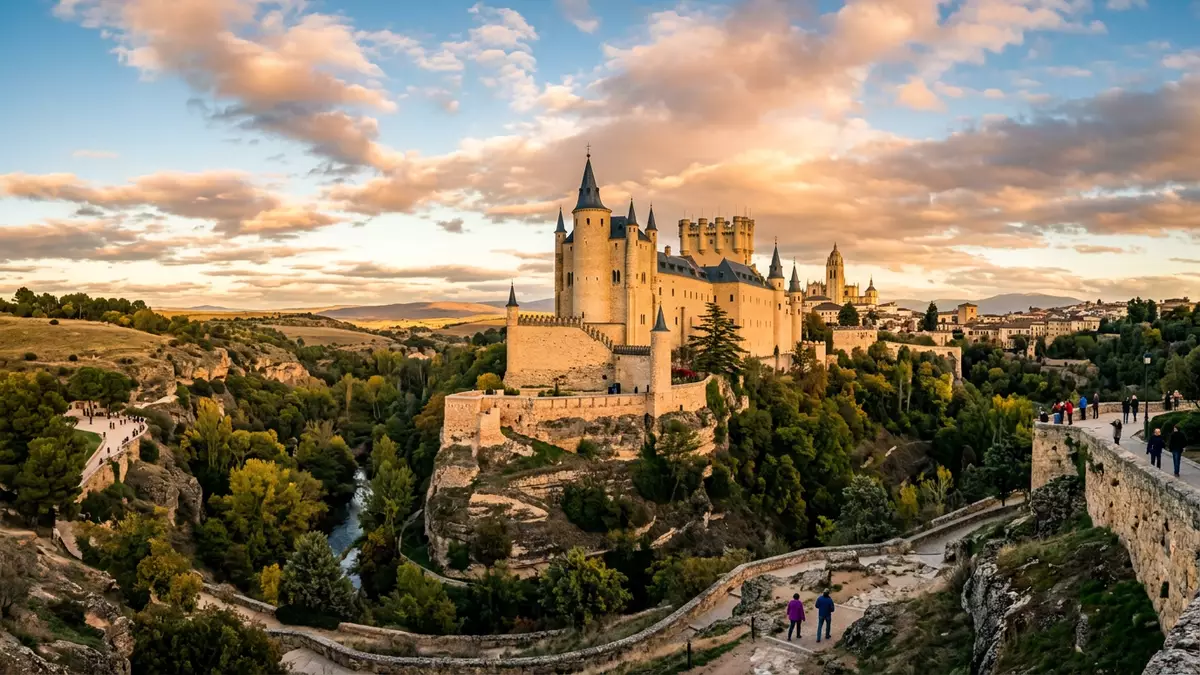
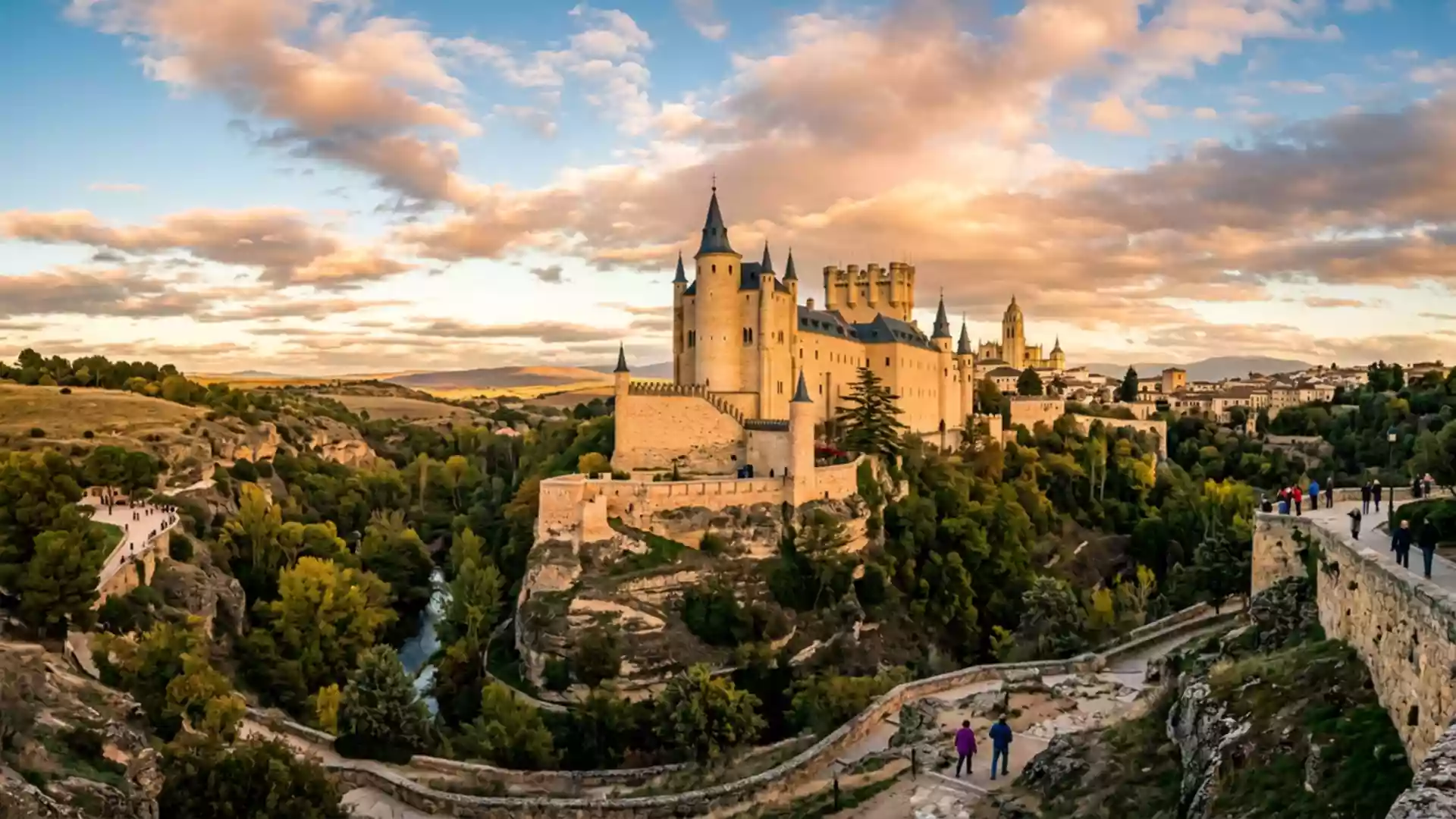
Alcazar de Segovia is a stone fortress and former royal palace that crowns a rocky spur above the old town of Segovia in Spain, with Gothic halls and slate?roofed towers set between two river valleys. It stands within the historic fabric of the Old Town of Segovia, which was inscribed as a UNESCO World Heritage site in 1985, and its documented history as a castle begins in the twelfth century.
A castle shaped by centuries of royal power
Alcazar de Segovia occupies a promontory at the meeting of the Eresma and Clamores rivers, so its walls drop away towards water on more than one side while the approach from the city arrives along higher ground. The position reflects its origin as a fortress, built on rock above the surrounding landscape, and later adapted into a palace where the monarchs of Castile spent extended periods. Christian records from the twelfth century refer to the place as a castle and “Alcázar”, a term derived from Arabic for a royal residence, and the site formed part of the defence and administration of the reconquered city.Christian records from the twelfth century Monarchs such as Alfonso VIII used the castle as a residence, and by the thirteenth century the complex combined fortified outer works with state rooms that served for ceremonies and day?to?day government of the realm.Alfonso VIII used the castle as a residence
From the fifteenth century onward the castle’s silhouette and interiors were reshaped as royal power and taste changed. Under the Trastámara kings, especially John II and Henry IV, the Alcazar gained richly decorated halls and a more emphatically Gothic character, with towers enlarged and a defended moat marking the outer line of the fortress.John II and Henry IV In December 1474 Isabella I left the Alcazar to be proclaimed Queen of Castile and León in Segovia’s main square, a moment that tied the fortress directly to the story of the Catholic Monarchs and the political consolidation of the Spanish kingdoms.Isabella I was proclaimed Queen of Castile
From Gothic palace to slate?roofed fairy?tale silhouette
The fabric of Alcazar de Segovia reflects successive construction campaigns between the thirteenth and sixteenth centuries, and walking through the castle shows how different styles coexist in one compact site. The core of the palace includes Gothic halls with high, decorated ceilings and stone tracery, while Mudéjar influences – a blend of Christian and Islamic artistic language – appear in some of the ornamental details recorded by architectural historians.Gothic and Mudéjar influences In the sixteenth century the architect Francisco de Mora, working in the orbit of Juan de Herrera, completed later phases of the complex, including a main courtyard and additional honour spaces that align the palace with Renaissance ideas about order and representation.Francisco de Mora and Juan de Herrera
One of the most distinctive features of the Alcazar’s profile is the system of steep slate roofs and pointed spires that crown its towers. These were added in the second half of the sixteenth century under Philip II, whose interventions replaced earlier roof forms with sharp slate coverings and finials that lend the castle a silhouette more reminiscent of certain Central European fortresses than other Castilian strongholds.sharp slate spires providing the Central European castle look A fire in 1862 destroyed much of the roofing and damaged parts of the upper structure, leading to extensive reconstruction in the later nineteenth century that reinstated the towers, roofs and battlements in a more romantic version of their earlier forms.fire in 1862 and later rebuilding
A military role and a museum within a World Heritage town
Alcazar de Segovia has long had a military dimension alongside its role as a royal residence. After the royal court shifted its main seat to Madrid in the seventeenth century, the fortress was used as a state prison for more than two centuries, its secure halls and towers adapted to confine high?status detainees.used as State Prison for over two centuries In 1764 Charles III founded the Royal College of Artillery and chose the Alcazar as its seat, so classrooms, drill spaces and storage for equipment occupied parts of the castle until the fire of 1862 forced a move.Charles III founded the Royal College of Artillery Military functions never disappeared entirely, and the complex now also houses the General Military Archive of Segovia alongside exhibition rooms.
The Alcazar sits within the Old Town of Segovia, whose Roman aqueduct, cathedral and ensemble of streets and plazas together form the World Heritage listing granted by UNESCO in 1985.Old Town of Segovia and Its Aqueduct The fortress itself functions as a museum space where visitors move through restored halls, armour displays and royal chambers, while exterior viewpoints look out along the Eresma valley and across to other parts of Segovia’s defensive circuit. The combination of preserved medieval and early modern architecture, evidence of changing uses from palace to prison to artillery college, and its setting above two rivers gives the Alcazar a layered character that is rooted in both military and ceremonial history.
Visiting Alcazar de Segovia: what travellers from Western Europe should know
- Alcazar de Segovia stands at the western edge of Segovia’s old town on a rocky spur between the Eresma and Clamores rivers, and is reached on foot from the historic streets.
- The approach runs across cobbled areas and includes gradients and stairways inside the fortress, where towers are accessed by narrow stone staircases with many steps.
- Segovia lies in central Spain north of Madrid, with rail links from the capital; the official language is Spanish and the currency is the euro.
- Roads and paths around the Alcazar drop towards the river valleys, so viewpoints from the fortress look down on wooded slopes and up towards Segovia’s cathedral and aqueduct.
Searching for Alcazar de Segovia on social platforms
These links open searches for Alcazar de Segovia on each platform.
Frequently asked questions about Alcazar de Segovia
Where is Alcazar de Segovia located?
Alcazar de Segovia stands at the edge of the old town of Segovia in central Spain, on a rocky spur between the Eresma and Clamores river valleys.
What can visitors expect inside the fortress?
Visitors encounter restored Gothic halls, towers with steep slate roofs, military displays and royal chambers, alongside viewpoints looking over the surrounding countryside and Segovia’s historic skyline.
What makes Alcazar de Segovia distinctive among Spanish castles?
The combination of its promontory site above two rivers, its role as both royal palace and military stronghold, and its slate?roofed spires shaped under Philip II gives Alcazar de Segovia a distinctive profile.