
Amfiteatre de Tarragona and its sea-facing Roman arena
Published on 09/08/2026 at 14:27 | Editorial responsibility: Rafael Müller, Editor-in-Chief AD HOC NEWS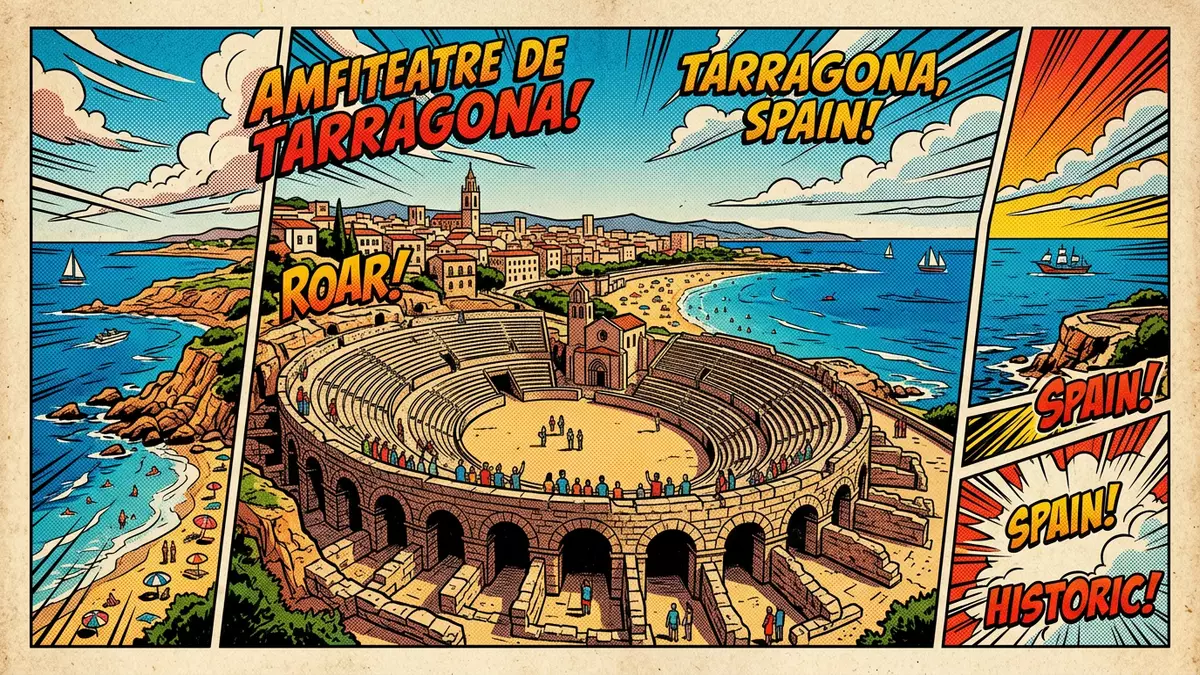
Amfiteatre de Tarragona is a Roman amphitheatre on the coastal slope of Tarragona in Spain, where a long stone arena opens towards the Mediterranean Sea. Built in the second century AD in the former Roman colonia of Tarraco, it formed part of a wider ensemble of Roman monuments that has been recognised as a World Heritage Site by UNESCO.
A Roman arena above the Mediterranean
Amfiteatre de Tarragona stands on the seaward side of the historic city, set into the slope below the modern promenade known as the Balcó del Mediterrani and close to the Parc de l'Amfiteatre romà. From the higher ground above, the overall footprint of the amphitheatre is clearly visible, with the arena and surrounding terraces enclosed within a distinct perimeter of masonry.Roman amphitheatre in Tarragona
The amphitheatre was constructed in the second century AD when Tarraco served as the capital of the Roman province of Hispania Citerior, giving it a central role in the public life of the colony.2,000 years facing the sea Set close to the shoreline, its plan follows the elongated form associated with large Roman amphitheatres, with the outer structure measuring roughly 130 by 102 metres and the arena itself occupying the central portion of the site.Anfiteatro de Tarraco dimensions
Structure, arena and later layers of history
The shape of Amfiteatre de Tarragona reflects the standard arrangement of Roman amphitheatres, with an enclosed arena surrounded by tiers of seating rising on the northern and southern sides. Under the arena, there are auxiliary pits that once supported the staging of spectacles, forming a narrow undercroft that is still legible in the exposed stonework.pits under the arena The surviving terraces show the tiered organisation typical of Roman public buildings, even though only parts of the original stands remain in place along the perimeter.
Gladiatorial contests and other public spectacles were held at the amphitheatre during the Roman period, with the arena providing the central space for combat and performance. In the central zone of the site lie the foundations of a Visigothic basilica dating from the sixth century, over which the later medieval church of Santa Maria del Miracle was established in the twelfth century.Visigoth basilica and medieval church These remains add distinct architectural layers to the amphitheatre, demonstrating how the site was reused over successive periods.
From provincial capital to World Heritage ensemble
In Roman times Tarraco held a prominent administrative role as capital of Hispania Citerior, and Amfiteatre de Tarragona formed part of the entertainment infrastructure of that provincial centre.Roman Amphitheatre of Tarraco The amphitheatre belongs to the Archaeological Ensemble of Tarraco, an extensive group of Roman remains in and around Tarragona that was inscribed on the UNESCO World Heritage List in 2000.Archaeological Ensemble of Tarraco
Within this broader context, Amfiteatre de Tarragona highlights the relationship between monumental Roman architecture and the coastal landscape of Catalonia. The amphitheatre’s position near the sea and below the later city fabric means that the outlines of the arena, the remaining terraces and the traces of later religious buildings can all be read against the backdrop of the Mediterranean, giving the site a layered character that combines civic, religious and maritime associations.
Visiting Amfiteatre de Tarragona: what travellers from Western Europe should know
- Amfiteatre de Tarragona stands on the coastal side of Tarragona on the Catalan coast of Spain, below the Balcó del Mediterrani and close to Parc de l'Amfiteatre romà, reached on foot from the central streets and nearby Rambla Nova.
- The monument occupies an inclined coastal slope, with paths and stone steps connecting different levels; accessing the surviving terraces involves walking over uneven surfaces and negotiating changes in height.
- The amphitheatre lies near the Parc del Miracle and the Mediterranean shoreline, with the railway and main road corridors set further inland, so urban noise and coastal views form part of the wider setting.
- Tarragona is in Catalonia, where the official languages are Catalan and Spanish and the currency is the euro.
Searching for Amfiteatre de Tarragona on social platforms
These links open searches for Amfiteatre de Tarragona on each platform.
Frequently asked questions about Amfiteatre de Tarragona
Where is Amfiteatre de Tarragona located?
Amfiteatre de Tarragona is located on the coastal slope below central Tarragona in Catalonia, Spain, close to Parc de l'Amfiteatre romà and the Mediterranean shoreline.
What can visitors expect at Amfiteatre de Tarragona?
Visitors encounter the outline of a Roman amphitheatre with an arena, surviving terraces and visible foundations of later religious buildings, set within an open archaeological park near the sea.
What makes Amfiteatre de Tarragona distinctive among Roman sites?
Its position facing the Mediterranean, its integration into the UNESCO-listed Archaeological Ensemble of Tarraco and the superimposed Visigothic and medieval structures distinguish the site within the Roman heritage of Spain.


