
Ananda Pahto, Bagan’s white cruciform temple of four Buddhas
Published on 09/15/2026 at 19:54 | Editorial responsibility: Rafael Müller, Editor-in-Chief AD HOC NEWS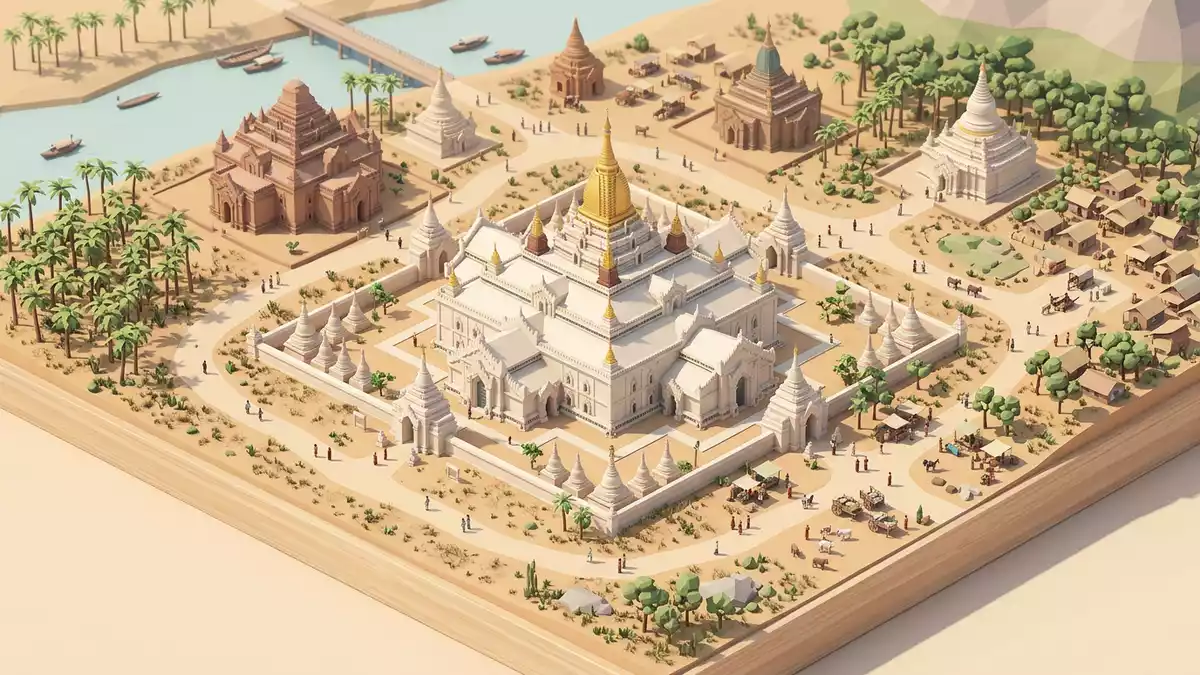
Ananda Pahto in Bagan is a Buddhist temple from the Pagan Dynasty, completed in 1105 during the reign of King Kyanzittha and laid out on a cruciform plan around four standing Buddhas.completed in 1105 Its white exterior, brick core and central tower rising over intersecting corridors make Ananda Pahto one of the most legible large temples in the Bagan Archaeological Zone.
Brick, stucco and a white tower in Old Bagan
Ananda Pahto stands in Old Bagan within the wider Bagan Archaeological Zone on the Ayeyarwady River plain in central Myanmar, southeast of Tharabar Gate and close to other major temples.Old Bagan location The temple is built from brick masonry bonded with mortar and finished with stucco, which is painted white so that the mass of the building reads as a single pale volume rising from the flat river plain.stucco exterior
Above the square central core, the structure rises in diminishing terraces to a tower in a North Indian Nagara style, often described as a shikhara, giving Ananda Pahto a vertical accent visible from across the surrounding plain.Nagara-inspired tower At ground level, large vestibules project from each side of the central block, each one containing a doorway and forming the arms of the cross-shaped plan, while the outer walls are lined with terraces and reliefs that mark the transition between the base and the tower.
A cruciform plan centred on four standing Buddhas
The ground plan of Ananda Pahto is a square broken on each side by gabled vestibules, so that the building takes the form of a Greek cross with four devotional halls facing the cardinal directions.cross-shaped ground plan Inside, corridors run around the central mass, giving access to shrines and niches, while at the very core stand four tall Buddha images aligned with the north, south, east and west entrances.four central Buddhas
The four principal Buddhas represent Kakusandha, Konagamana, Kassapa and Gautama, each facing a different direction and carved as a standing figure so that visitors encounter them progressively as they move through the interior.directional Buddha figures The north- and south-facing figures retain early workmanship, while the east and west images follow a later Mandalay style, reflecting changes in sculptural taste while preserving the temple’s original spatial concept.Mandalay-style images
From Pagan Dynasty monument to restored World Heritage temple
Ananda Pahto was constructed under King Kyanzittha during the Pagan Dynasty and is traditionally dated to the early twelfth century, a period when Bagan’s temple architecture shifted from the Early to the Middle Bagan style.Early to Middle Bagan Mon and Indian influences are visible in its layout and decorative programme, with sculpted tiles and stucco reliefs depicting Jataka tales and other narrative scenes along the outer corridors.Mon and Indian influences
Ananda Pahto suffered structural damage in the 1975 earthquake that affected Bagan’s monuments but has since been repaired, with its terraces, tower and white exterior restored so that the proportions and cruciform outline remain clear.earthquake damage and restoration The temple now stands within a landscape of stupas and other shrines recognised as a World Heritage site, and its blend of brick construction, white stucco and directional Buddhas gives a concise view of Pagan-period religious architecture in central Myanmar.Bagan World Heritage zone
Visiting Ananda Pahto: what travellers from Western Europe should know
- Ananda Pahto stands in Old Bagan within the Bagan Archaeological Zone in central Myanmar’s Mandalay Region, south-west of Mandalay on the Ayeyarwady River plain.
- The temple interior is arranged as intersecting corridors around a central core, with long walks on stone floors and several stairways connecting different levels.
- The surrounding terrain is largely flat river plain dotted with other brick temples and pagodas, and approaches to Ananda Pahto run along compacted earth and paved paths.
- The official language is Burmese and the currency is the Myanmar kyat.
- Entry requirements depend on your nationality; UK travellers can check the FCDO travel advice at gov.uk/foreign-travel-advice, Irish travellers the Department of Foreign Affairs at ireland.ie.
Searching for Ananda Pahto on social platforms
These links open searches for Ananda Pahto on each platform.
Frequently asked questions about Ananda Pahto
Where is Ananda Pahto located within Bagan?
Ananda Pahto stands in Old Bagan within the Bagan Archaeological Zone in Myanmar’s Mandalay Region, on the Ayeyarwady River plain southeast of Tharabar Gate.
What should visitors expect inside Ananda Pahto?
Visitors walk through intersecting corridors around a central core, encountering four tall standing Buddha images aligned with the cardinal directions and narrative reliefs on the walls.
What makes Ananda Pahto distinctive among Bagan’s temples?
Ananda Pahto is distinctive for its white stucco exterior over a brick core, cruciform ground plan, Nagara-style central tower and the four directional Buddhas at the heart of the building.


