
Archaia Olympia and the ancient sanctuary of Zeus
Published on 08/14/2026 at 14:10 | Editorial responsibility: Rafael Müller, Editor-in-Chief AD HOC NEWS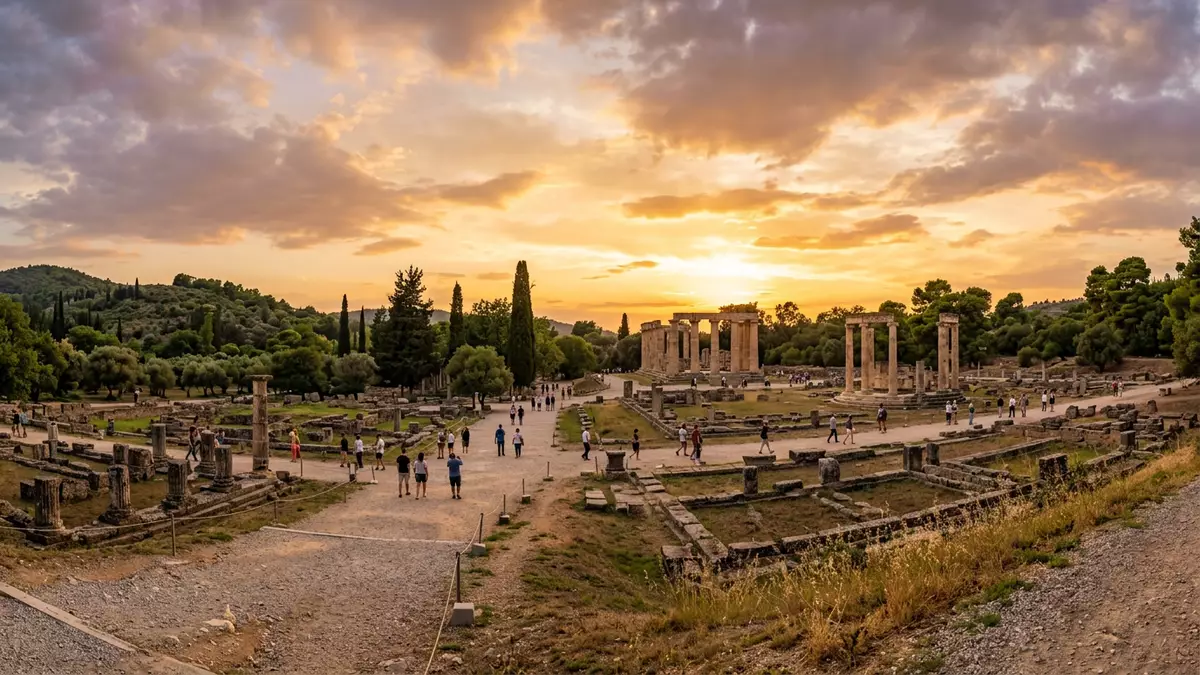
Archaia Olympia is the modern town beside the archaeological site of ancient Olympia in western Greece, where a sanctuary of Zeus and the stadium of the ancient Olympic Games lie in a river valley framed by low hills. The site is part of a wider landscape in the north-western Peloponnese and has been inscribed as the Archaeological Site of Olympia on the UNESCO World Heritage List since 1989, recognising both its religious role and its sporting history.
The sanctuary of Zeus in the Altis
The heart of Archaia Olympia is the sacred precinct known as the Altis, a sanctuary of Zeus set in a flat expanse at the foot of a wooded hill. Within this walled enclosure stood major temples, altars and treasuries, arranged around open spaces that once held crowds of pilgrims and athletes.The Altis precinct occupies an area beside the hill of Cronus and was bounded on three sides by walls, giving the sanctuary a distinct spatial frame.
The most prominent building in this sacred area was the Temple of Zeus, a Doric temple completed in the fifth century BC and regarded as the largest and most important building at Olympia.The Temple of Zeus housed a monumental cult statue of the god made of ivory and gold, attributed to the sculptor Pheidias, which stood among the canonical wonders of the ancient world. Nearby stood the Heraion, a temple dedicated to Hera built in the late seventh or early sixth century BC, marking an earlier phase of monumental construction inside the sanctuary.The Heraion at Olympia introduced substantial stone architecture to the site and remained an important cult building beside the later temple of Zeus.
Sporting grounds of the ancient Olympic Games
The Altis formed only part of the complex at Archaia Olympia; stretching beyond it are the athletic facilities that gave the site its enduring name. A stadium was laid out east of the sanctuary, with a running track marked by stone starting lines and earth embankments where spectators once stood to watch races and contests.The stadium of Olympia hosted the Olympic Games, which took place every four years from 776 BC until the late fourth century AD, making the sanctuary a Panhellenic meeting place for athletes and city representatives.
Close to the stadium lay training grounds and ancillary buildings that supported the games over successive generations. These included a gymnasion for athletic exercises and a palaestra, a specialised court for wrestling and similar events, arranged around colonnaded courts and rooms for preparation.Athletic premises around the sanctuary formed part of a wider ensemble that also encompassed administrative structures, baths and lodging houses, illustrating how the festival combined religious observance with organised sport.
Landscape, town and museum at Archaia Olympia
Archaia Olympia sits in the fertile valley created by the Alpheios and Kladeos rivers, with the archaeological site spreading across gently sloping ground at the foot of Mount Kronios.The sanctuary occupies a Peloponnesian valley that combines river terraces, patches of woodland and open meadows, a setting that frames ruined columns and stone foundations against green surroundings. The town itself, officially named Archaia Olympia, lies just beyond the archaeological area and serves as a base for visitors, with streets and accommodation clustered along the access roads.
Alongside the open-air remains, the Archaeological Museum of Olympia presents finds from excavations within the Altis and the surrounding grounds, tracing the development of the sanctuary from prehistoric occupation through to the Early Christian period.The Archaeological Museum of Olympia displays architectural fragments, bronzes, inscriptions and sculptural groups, including pedimental sculptures from the Temple of Zeus. Together, the museum and the site provide a sequence of spaces: wooded paths among foundations outdoors and enclosed galleries where delicate objects are held.
Visiting Archaia Olympia: what travellers from Western Europe should know
- Archaia Olympia lies in the region of Elis in western Greece, in the north-western Peloponnese, reached by road connections from nearby towns such as Pyrgos and from the port of Katakolon.
- The archaeological site consists of open ground with uneven surfaces, stone blocks and low level changes in height, and visiting the stadium and sanctuary involves walking along unshaded paths.
- The official language is Greek and the currency is the euro.
- Entry requirements depend on your nationality; UK travellers can check the FCDO travel advice at gov.uk/foreign-travel-advice, Irish travellers the Department of Foreign Affairs at ireland.ie.
Searching for Archaia Olympia on social platforms
These links open searches for Archaia Olympia on each platform.Frequently asked questions about Archaia Olympia
Where is Archaia Olympia?
Archaia Olympia is in the regional unit of Elis in the north-western Peloponnese in Greece, in a valley formed by the Alpheios and Kladeos rivers.
What should visitors expect at the site?
Visitors encounter the Altis sanctuary with its temple foundations, the stadium and training grounds, and an archaeological museum displaying sculpture and artefacts from the excavations.
What makes Archaia Olympia distinctive among ancient sites?
Archaia Olympia combines a major sanctuary of Zeus with the birthplace of the Olympic Games, preserving both religious architecture and sporting grounds in a single river valley setting.


