
Archaia Olympia and the sanctuary where the Olympic Games began
Published on 09/09/2026 at 13:21 | Editorial responsibility: Rafael Müller, Editor-in-Chief AD HOC NEWS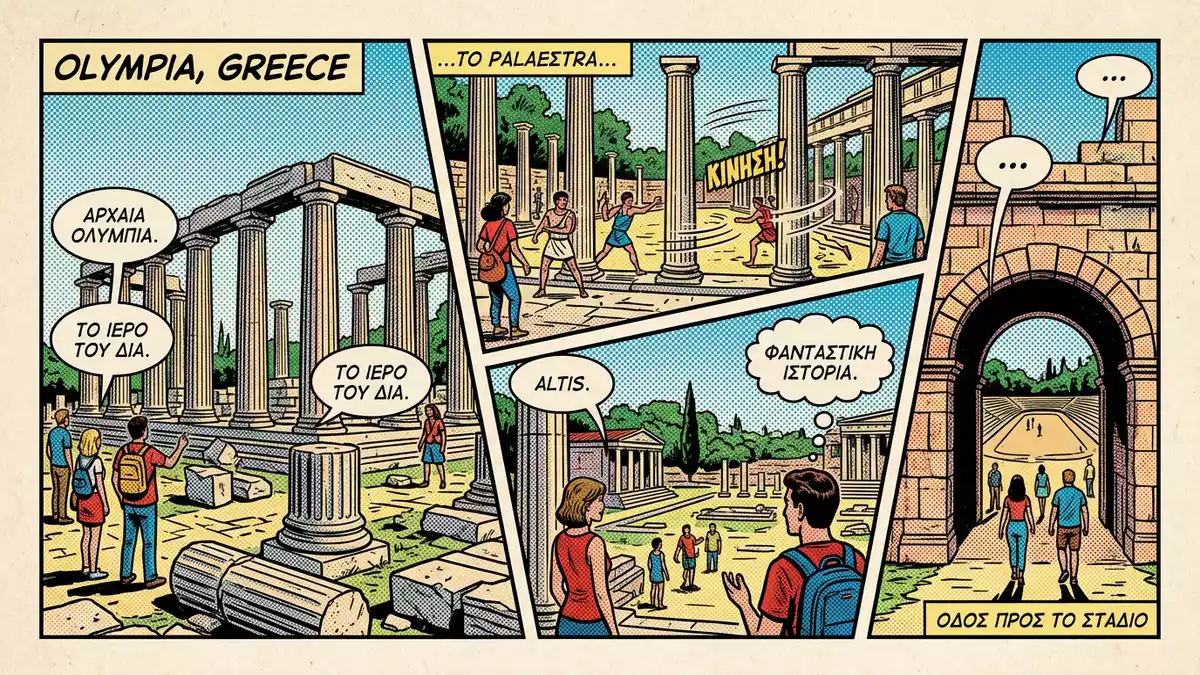
Archaia Olympia is a small town in western Greece beside the archaeological remains of ancient Olympia, where a sanctuary of Zeus and the original Olympic stadium lie in a low river valley framed by hills. The ancient site developed in the western Peloponnese in the region of Elis, at the confluence of the Alpheios and Kladeos rivers, and became one of the most important religious and athletic centres of the Greek world in the first millennium BC.
The river valley setting of Archaia Olympia
Archaia Olympia stands in a fertile valley in the western Peloponnese, in the regional unit of Elis, surrounded by low, wooded hills and farmland. The archaeological site occupies ground near where the Alpheios and Kladeos rivers meet, giving the sanctuary and the town a setting of watercourses and tree-lined banks that contrast with the stone remains around them.valley of the Alpheios river The core of the ancient sanctuary, known as the Altis, lay within a sacred enclosure that occupied the central part of this landscape, with the hill of Kronios rising to the north and a wall on other sides.
The wider area around Archaia Olympia belongs to the western side of the Peloponnese peninsula in Greece, facing towards the Ionian Sea. The town itself is modest in scale, but it is closely associated with the surrounding ruins, which carry the name Archaeological Site of Olympia on the UNESCO World Heritage List, recognising their outstanding cultural significance and the long history of ritual and competition that took place there.UNESCO World Heritage site
Sanctuary of Zeus and temples within the Altis
The ancient sanctuary at Archaia Olympia was primarily dedicated to Zeus, the chief deity of the Greek pantheon, and developed into a major Panhellenic religious centre over many centuries. Within the Altis, the sacred enclosure, stood temples, cult buildings and treasuries, including the Temple of Zeus and the Temple of Hera, alongside principal altars and administrative structures for managing the sanctuary’s affairs.Altis with temples of Zeus and Hera The remains visible on site today include columns, foundations and blocks from these buildings, giving a sense of the scale and layout of the sacred precinct.
The Temple of Zeus, constructed in the fifth century BC, was the largest and most important building at Olympia and one of the largest Doric temples in Greece, attributed to the architect Libon of Elis.Temple of Zeus built about 460 BCE It was built using local shell conglomerate stone, with exposed surfaces covered by a fine white stucco, creating a contrast between robust structural material and a refined outer finish. Nearby, the Temple of Hera preserved an earlier phase of the sanctuary’s history, with elements that date back to at least the eighth century BC, showing how worship at Olympia long predated the classical era.
The ancient Olympic Games and athletic structures
Archaia Olympia is closely associated with the ancient Olympic Games, which were held in honour of Zeus at Olympia every four years from 776 BC to 393 AD. These contests drew athletes and spectators from many Greek city-states, turning the sanctuary into a shared meeting place that combined ritual observance with athletic competition.Olympic Games from 776 BCE to 393 CE The remains at the site include the stadium, training grounds and other sports structures that formed part of this programme.
The ancient stadium at Olympia is set on the eastern side of the sanctuary, with long earth banks for spectators lining a straight running track on packed soil. Visitors can see the starting line blocks, the course and the gentle rise of the surrounding banks, which together outline the space where the main races took place. Beyond the stadium, the palaestra and the gymnasion formed training areas for athletes, providing open courts and colonnaded rooms for preparation and exercise.athletic premises used for the Olympic Games Administrative buildings and structures for judges and officials complemented these facilities, underlining that the Olympic Games at Archaia Olympia were organised within a defined architectural and ritual framework.
Visiting Archaia Olympia: what travellers from Western Europe should know
- Archaia Olympia lies in the regional unit of Elis in the western Peloponnese in Greece, in a valley formed by the Alpheios and Kladeos rivers, reached primarily by road connections from nearby towns such as Pyrgos and from the port of Katakolon.
- The archaeological site includes open ground and uneven surfaces among ruins, with paths that cross low gradients and areas of stone blocks and earth banks, particularly around the stadium and the Altis.
- The wider landscape combines cultivated fields with stands of trees and low hills, and parts of the site are exposed to the weather with limited shelter among the ruins.
- The official language is Greek and the currency is the euro.
Searching for Archaia Olympia on social platforms
These links open searches for Archaia Olympia on each platform.
Frequently asked questions about Archaia Olympia
Where is Archaia Olympia?
Archaia Olympia is in the regional unit of Elis in the western Peloponnese in Greece, in a valley near the meeting point of the Alpheios and Kladeos rivers.
What can visitors expect at Archaia Olympia?
Visitors encounter a modest modern town beside extensive archaeological remains, including temples, the sacred Altis enclosure, the ancient stadium and training grounds set among low hills and riverbanks.
What makes Archaia Olympia distinctive among ancient sites?
Archaia Olympia combines a major sanctuary of Zeus with the original venue of the Olympic Games, preserving both religious architecture and athletic structures within a single river valley landscape.


