
Arco de Santa Catalina and Antigua’s yellow street crossing
Published on 09/23/2026 at 04:00 | Editorial responsibility: Rafael Müller, Editor-in-Chief AD HOC NEWS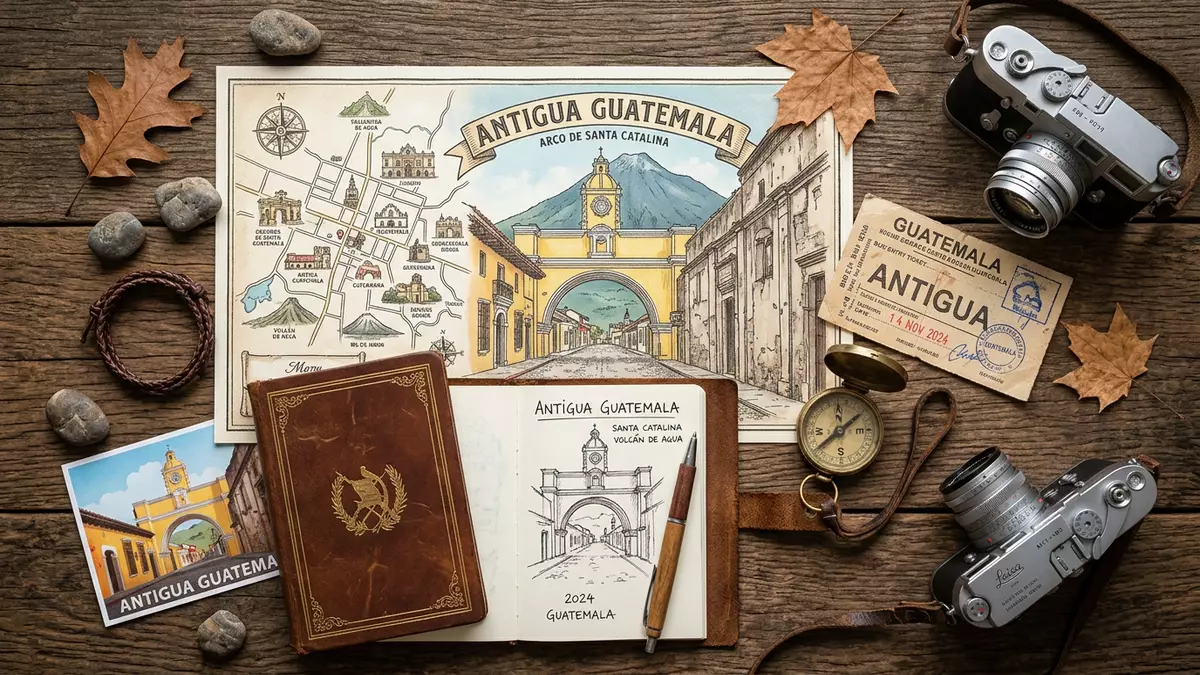
Arco de Santa Catalina spans 5a Avenida Norte in Antigua Guatemala as a yellow Baroque passage above the street. The structure joins the former Santa Catalina convent complex and carries a clock tower added in the nineteenth century.
Its visible form brings together colonial religious architecture, a public street and the volcanic landscape of Guatemala’s highlands. The arch belongs to Antigua Guatemala’s historic cityscape, inscribed as a UNESCO World Heritage Site in 1979.
A passage above 5a Avenida Norte
The arch stands in the historic centre of Antigua Guatemala, north of Parque Central, and crosses 5a Avenida Norte. Calle del Arco takes its name from the structure, while the surrounding streets retain the low-rise form associated with the colonial city.
Rendered walls rise above the roadway, with white trim outlining the yellow façade. The passage is enclosed within the upper part of the structure, and a small clock tower sits above it. The road continues beneath the arch as part of the city’s street network.
Arco de Santa Catalina is linked with Antigua’s World Heritage setting, which includes colonial buildings, churches, ruins and the historic urban plan.
Santa Catalina convent and the seventeenth century
The arch formed part of the Convent of Santa Catalina Virgen y Mártir, associated with Dominican nuns. Construction belongs to the late seventeenth century, with the completed passage recorded in June 1694.
The passage connected buildings belonging to the convent across the public street. Its enclosed upper route is the defining architectural feature: the structure is not merely a decorative gateway, but a raised link between parts of a religious complex.
A detailed historical account places the construction proposal in 1693 and records completion in 1694. The surviving arch therefore belongs to the colonial period when Antigua’s churches and convents shaped the city’s built form.
The convent’s name remains embedded in the monument’s identity. Santa Catalina refers to Catherine of Alexandria, whose name appears in the Spanish dedication Santa Catalina Virgen y Mártir.
The arch’s 1694 completion date places it within Antigua’s late colonial architectural history.
Baroque walls beneath a nineteenth-century clock
Arco de Santa Catalina has a Baroque character, expressed through its broad wall surfaces, mouldings, pilasters and curved cornice. The composition is more compact than the elaborate façades of Antigua’s major churches.
The clock tower belongs to a later phase of the monument’s history. A small turret was added in the nineteenth century, giving the arch the silhouette visible above 5a Avenida Norte.
The clock is associated with the French maker Lamy and Lacroix. Its presence adds a civic element to a structure that began as part of a convent complex.
The earthquakes of 1773 damaged Antigua Guatemala and many of its religious buildings. Arco de Santa Catalina remained part of the city’s historic fabric, while repairs and later rebuilding contributed to its present appearance.
The combination of yellow plaster, white detailing, an enclosed passage and a clock tower makes the monument easy to recognise within Antigua’s colonial streets. The view through and beyond the arch also places architecture against the distant slopes of Volcán de Agua.
The Baroque archway remains tied to the convent buildings and the historic centre of Antigua Guatemala.
Visiting Arco de Santa Catalina: what travellers from Western Europe should know
- Arco de Santa Catalina stands on 5a Avenida Norte in Antigua Guatemala’s historic centre, north of Parque Central. The approach is through the paved streets of the old town.
- The arch crosses a public roadway, so the principal view is from street level beneath and around the passage. Its upper rooms and clock tower are viewed from outside.
- The surrounding streets include Calle del Arco, 2a Calle Poniente and 3a Calle Poniente. Volcán de Agua appears beyond the colonial streets when the landscape is visible.
- The official language is Spanish and the currency is the Guatemalan quetzal.
- Entry requirements depend on your nationality; UK travellers can check the FCDO travel advice at gov.uk/foreign-travel-advice, Irish travellers the Department of Foreign Affairs at ireland.ie.
Searching for Arco de Santa Catalina on social platforms
These links open searches for Arco de Santa Catalina on each platform.
Frequently asked questions about Arco de Santa Catalina
Where is Arco de Santa Catalina?
Arco de Santa Catalina is on 5a Avenida Norte in the historic centre of Antigua Guatemala, north of Parque Central.
What can travellers expect on a visit?
The monument is viewed from the surrounding streets and beneath its raised passage. The yellow façade, white detailing and clock tower form the main exterior features.
What makes Arco de Santa Catalina distinctive?
Its enclosed passage joins former convent buildings above a public street. The seventeenth-century Baroque structure also carries a nineteenth-century clock tower.


