
Ayutthaya Historical Park and the river island of Siam’s old capital
Published on 09/12/2026 at 12:16 | Editorial responsibility: Rafael Müller, Editor-in-Chief AD HOC NEWS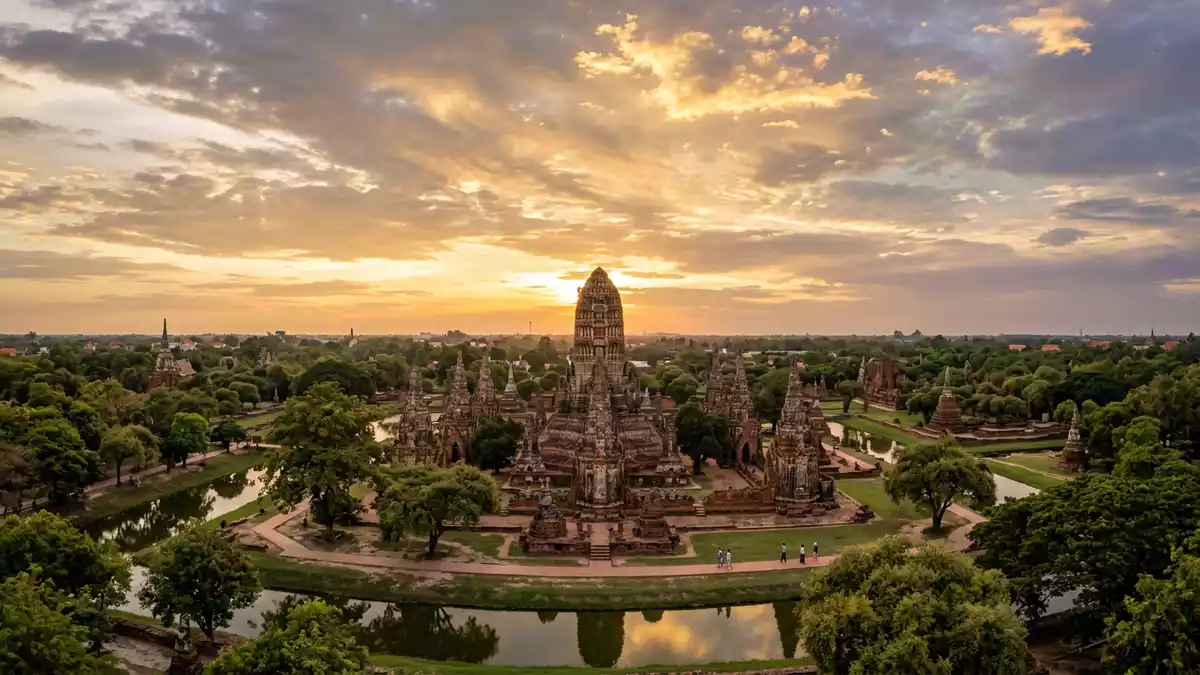
Ayutthaya Historical Park in Ayutthaya preserves the ruins of the former Siamese capital on a broad river island in central Thailand, where stone temples and palaces rise from grassy ground. The World Heritage core zone protects a dense cluster of monasteries and royal buildings from the Ayutthaya Kingdom, founded in 1350 and destroyed in 1767.
The former Siamese capital on a river island
The Historic City of Ayutthaya occupies an island formed by the Chao Phraya, Lop Buri and Pa Sak rivers, and Ayutthaya Historical Park lies at its heart. The island location gave the city a ring of waterways, which still frame the park and separate it from surrounding districts of the modern town.Historic City of Ayutthaya The Ayutthaya Kingdom used this island as its capital for more than four centuries, shaping a dense urban centre of palaces, monasteries and defensive earthworks.Ayutthaya was the capital
Within Ayutthaya Historical Park, brick platforms and prang-like towers mark the footprints of former temple compounds, and traces of city walls still appear in places. The concentration of ruins around the former Royal Palace area gives a sense of how closely royal residences and Buddhist monasteries once sat together on the island.temple sites of the Historic City
Temples, palaces and stone towers
Ayutthaya Historical Park covers the ruins of major monasteries such as Wat Mahathat, Wat Phra Sri Sanphet, Wat Ratchaburana and Wat Phra Ram, along with the site of the former Royal Palace. These compounds form a chain of brick and stucco towers, cloister walks and assembly halls that once anchored the city’s religious and political life.monuments within the core zone Many of the structures retain tall central towers and surrounding chedi-like forms, while other halls survive as lines of pillars and platforms.
The park extends across an area of about 289 ha (around 710 acres), giving space for large temple compounds separated by ponds, lawns and former roads.Ayutthaya Historical Park encompasses 289 hectares Within this area, dozens of sites are mapped, ranging from well-restored monasteries to lower platforms where only traces of foundations remain.temple sites and ruins The brick and laterite fabric is characteristic of Ayutthaya-period architecture, and surviving stucco ornament on some towers still shows floral motifs and guardian figures.
From royal court to World Heritage landscape
Ayutthaya was founded by King Ramathibodi I in 1350 as the second capital of the Siamese Kingdom, following Sukhothai. Over the following centuries, the island city grew into a major centre of trade and diplomacy, with foreign merchants and envoys visiting its palaces and monasteries.founded by King Ramathibodi I in 1350 The glory of Ayutthaya came to an abrupt end when a Burmese army sacked the city in 1767, leaving many of the temples and palaces in ruins.sacked the city in 1767
In the twentieth century, conservation efforts consolidated the central area of ruins as Ayutthaya Historical Park. In 1991 the Historic City of Ayutthaya, including the core of the park on the island, was inscribed as a UNESCO World Heritage Site under cultural criterion (iii), recognising its testimony to the development of national Thai art.UNESCO inscription in 1991 Subsequent mapping has identified numerous temple sites within the World Heritage boundaries, comprising restored ruins, active monasteries and locations where religious complexes once stood but have disappeared under later urban fabric.82 temple sites within WHC boundaries
Visiting Ayutthaya Historical Park: what travellers from Western Europe should know
- Ayutthaya Historical Park sits in the centre of Ayutthaya on the island formed by the Chao Phraya, Lop Buri and Pa Sak rivers, reached by road and rail connections from Bangkok.
- Within the park, many temple compounds include uneven brick surfaces, stepped platforms and tall terraces, and moving between sites involves walking on open ground.
- The official language is Thai and the currency is the baht.
- Entry requirements depend on your nationality; UK travellers can check the FCDO travel advice at gov.uk/foreign-travel-advice, Irish travellers the Department of Foreign Affairs at ireland.ie.
Searching for Ayutthaya Historical Park on social platforms
These links open searches for Ayutthaya Historical Park on each platform.Frequently asked questions about Ayutthaya Historical Park
Where is Ayutthaya Historical Park?
Ayutthaya Historical Park lies in central Thailand within the city of Ayutthaya, centred on the island formed by the Chao Phraya, Lop Buri and Pa Sak rivers.
What can visitors expect inside the park?
Visitors encounter extensive temple and palace ruins in brick and stucco, including tall towers, chedi-like structures, assembly halls and open platforms set among lawns and ponds.
What makes Ayutthaya Historical Park distinctive?
The park combines the remains of a former Siamese royal capital on a river island with a recognised World Heritage landscape that preserves Ayutthaya-period architecture over hundreds of hectares.


