
Badshahi Masjid and the Mughal scale of stone and space
Published on 09/09/2026 at 14:54 | Editorial responsibility: Rafael Müller, Editor-in-Chief AD HOC NEWS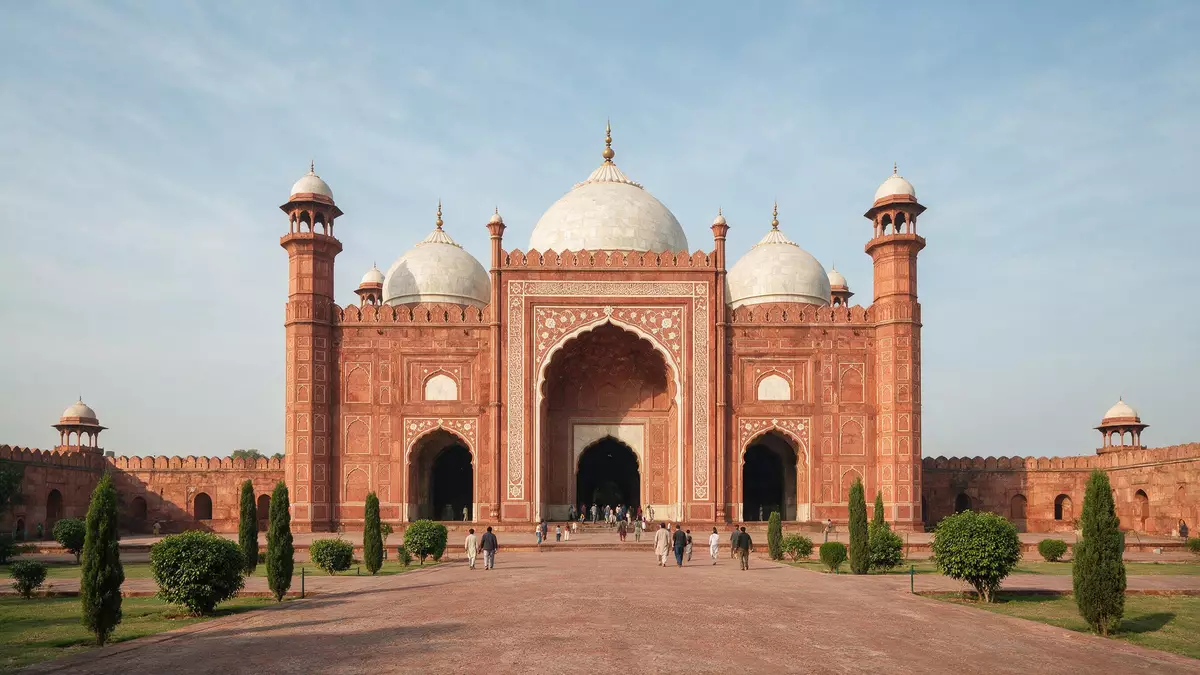
Badshahi Masjid in Lahore is a Mughal imperial mosque where sheer scale and red sandstone meet finely worked white marble, laid out around an immense open courtyard. Commissioned by Emperor Aurangzeb in the early 1670s, it is one of the last great monumental mosques of the Mughal period and a dominant presence beside Lahore Fort in the old city.
Aurangzeb’s great mosque on the edge of the Walled City
Badshahi Masjid stands on the north-western side of Lahore’s historic core, directly opposite Lahore Fort and near the former course of the Ravi River, so the mosque reads as part of a larger imperial ensemble of palace and prayer.Adjacent to Lahore Fort Construction began under Aurangzeb Alamgir around 1671, with work overseen by his foster brother and Lahore governor Fidai Khan Koka, and the mosque was completed within a few years in 1673.Commissioned in 1671 and opened in 1673
The mosque is a red sandstone and marble structure aligned on a grand axis from the main gateway through the courtyard to the prayer hall, following the established vocabulary of Mughal mosque planning. Its creation under Aurangzeb marks a late phase of Mughal architecture, when the empire’s political reach was wide and its architectural language was fully formed.
Stone, marble and an immense courtyard
The dominant impression at Badshahi Masjid comes from materials and scale: the outer walls and many structural elements are built in carved red sandstone, while the three large domes of the prayer hall and extensive inlay work use white marble in contrast.Sandstone and marble mosque Four tall minarets define the corners of the main enclosure, rising above the city and emphasising the mosque’s presence in the Lahore skyline.
Between the monumental entrance and the prayer hall lies a vast open courtyard paved in stone, laid out to accommodate very large congregations and framed by arcades on several sides.Courtyard for tens of thousands of worshippers The main prayer hall itself rises on a plinth with multiple bays, and its façade carries carved panels, recessed arches and marble detailing, combining repetition and fine craftsmanship in characteristic Mughal fashion.
From Mughal imperial mosque to heritage landmark
Badshahi Masjid began as an imperial mosque of the Mughal court, commissioned during Aurangzeb’s reign when Lahore held a central position in the empire’s network of cities.Built under Aurangzeb in 1673 In later centuries, particularly after the decline of Mughal authority, the mosque saw military uses under Sikh and British rule, which left their mark on both the fabric and the perception of the building.Later Sikh and British military use
Restoration campaigns in the twentieth century returned Badshahi Masjid to its role as a working place of worship and a central monument in Lahore’s urban landscape, and it is recognised as a major example of Mughal religious architecture. The site has been on Pakistan’s Tentative List for UNESCO World Heritage status since 1993, underlining both its architectural significance and its place in a broader heritage context.UNESCO Tentative List entry from 1993
Visiting Badshahi Masjid: what travellers from Western Europe should know
- Badshahi Masjid stands in Lahore’s old urban fabric close to Lahore Fort, reachable by road from other parts of the city and often combined with visits to the fort and surrounding historic districts.
- The mosque complex includes large paved areas and stairs leading up to the main courtyard and prayer hall, so a visit involves walking on stone surfaces and climbing broad steps.
- The official language is Urdu and the currency is the Pakistani rupee.
- Entry requirements depend on your nationality; UK travellers can check the FCDO travel advice at gov.uk/foreign-travel-advice, Irish travellers the Department of Foreign Affairs at ireland.ie.
Searching for Badshahi Masjid on social platforms
These links open searches for Badshahi Masjid on each platform.Frequently asked questions about Badshahi Masjid
Where is Badshahi Masjid and what surrounds it?
Badshahi Masjid is in Lahore, in Pakistan’s Punjab province, beside Lahore Fort and not far from the former course of the Ravi River.
What should visitors expect during a visit?
Visitors encounter a large stone gateway, extensive paved courtyard areas and stairs up to the main prayer hall, with red sandstone and marble architecture on a monumental scale.
What makes Badshahi Masjid distinctive among Mughal mosques?
Its combination of vast courtyard capacity, red sandstone walls, white marble domes and its setting alongside Lahore Fort makes Badshahi Masjid a defining Mughal imperial mosque.


