
Bagan’s plain of temples and the legacy of a Buddhist empire
Published on 08/24/2026 at 09:13 | Editorial responsibility: Rafael Müller, Editor-in-Chief AD HOC NEWS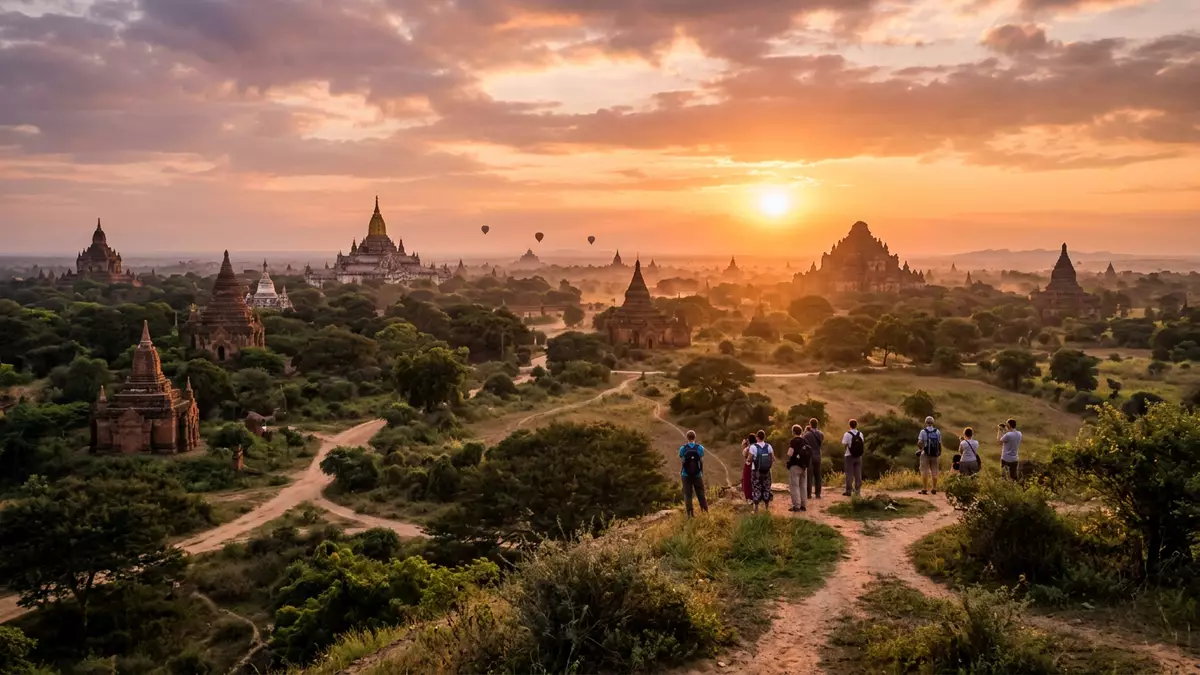
Bagan in central Myanmar is a vast archaeological landscape where thousands of Buddhist temples, stupas and monasteries rise from the plains along the Ayeyarwady River. At its height between the eleventh and thirteenth centuries, Bagan was the capital of the Pagan Kingdom, the first dynasty to unify much of the territory that later became Myanmar, and its religious architecture still defines the horizon.
A sacred landscape on the Ayeyarwady River
Bagan lies on a broad bend of the Ayeyarwady River in central Myanmar, with religious monuments scattered across the dry plain and low hills on the river’s eastern bank. The area recognised as the Bagan Archaeological Area and Monuments covers a wide zone where temples and stupas stand among fields, tracks and small settlements, forming a continuous cultural landscape.Bagan Archaeological Area and Monuments The river provides a clear western boundary, and many of the larger monuments stand within sight of the water, creating long perspectives across the plain from their terraces.
The site’s structures range from brick temples with interior space for devotion to solid stupas whose religious relics are enclosed within masonry. Together they form an ensemble of monumental Buddhist architecture that demonstrates the importance of Theravada Buddhist practice in the region during the Bagan period.ensemble of monumental Buddhist architecture From ground level, the skyline is marked by towers and spires at varying heights, and by terraces that step up to shrines and image halls.
The Bagan Kingdom and its temples
From the ninth to the thirteenth centuries Bagan served as the capital of the Pagan Kingdom, the first kingdom that unified major regions along the Ayeyarwady into a single polity that later underpinned the emergence of Myanmar as a country.capital of the Pagan Kingdom During this period, monarchs and donors commissioned temples and stupas at a remarkable pace, creating a religious centre that attracted monks, craftsmen and pilgrims from across the region.
Historical and archaeological studies describe the Bagan period, broadly from the eleventh to the thirteenth centuries, as the era when Theravada Buddhism became closely tied to royal authority and merit-making, with the king and court acting as major patrons of construction.Bagan period, 11th–13th centuries At the height of building activity, more than 10,000 Buddhist temples, stupas and monasteries were constructed on the Bagan plains, and the remains of several thousand structures are still visible, ranging from large brick temples with multiple storeys to small votive shrines standing beside tracks.
From royal capital to World Heritage Site
Although the Pagan Kingdom declined after the thirteenth century, the religious monuments of Bagan remained a focus of Buddhist practice and continued to be maintained and visited over generations. The ensemble of surviving structures, murals and sculptures demonstrates the reach and continuity of Buddhist culture in Myanmar from the Bagan era onwards.continuity of Buddhist culture in Myanmar Pagodas and temples stand amid cultivated land, and monastic communities continue to use some complexes as places of learning and worship.
Bagan’s significance was formally recognised when it was inscribed on the UNESCO World Heritage List in 2019 as a cultural site under the name “Bagan Archaeological Area and Monuments”.inscribed on the UNESCO World Heritage List in 2019 The inscription acknowledges the outstanding testimony the landscape provides to the Bagan civilisation and to the Buddhist traditions of merit-making that generated the dense concentration of monuments across the plain.
Visiting Bagan: what travellers from Western Europe should know
- Bagan lies in central Myanmar on the eastern bank of the Ayeyarwady River; travellers commonly reach the area via Nyaung-U Airport or long-distance road links from other major cities.
- The archaeological zone stretches across a wide plain where approaches to major temples involve walking along uneven paths, climbing brick stairways and moving between structures in open terrain.
- The climate in central Myanmar brings strong sunshine for much of the year, and the exposed nature of the temple plain means that many routes between monuments lack shade.
- The official language is Burmese and the currency is the kyat.
- Entry requirements depend on your nationality; UK travellers can check the FCDO travel advice at gov.uk/foreign-travel-advice, Irish travellers the Department of Foreign Affairs at ireland.ie.
Searching for Bagan on social platforms
These links open searches for Bagan on each platform.
Frequently asked questions about Bagan
Where is Bagan and what kind of place is it?
Bagan is an ancient city and archaeological area in central Myanmar on the eastern bank of the Ayeyarwady River, containing a wide landscape of Buddhist temples and stupas.
What can visitors expect when exploring Bagan?
Visitors encounter numerous brick temples, stupas and monasteries spread across a dry river plain, with paths, stairways and terraces linking religious structures that vary in size and form.
What makes Bagan distinctive among historic sites?
Bagan is distinctive for the density and variety of its surviving Buddhist monuments from the eleventh to thirteenth centuries and for its recognition as the “Bagan Archaeological Area and Monuments” on the UNESCO World Heritage List.


