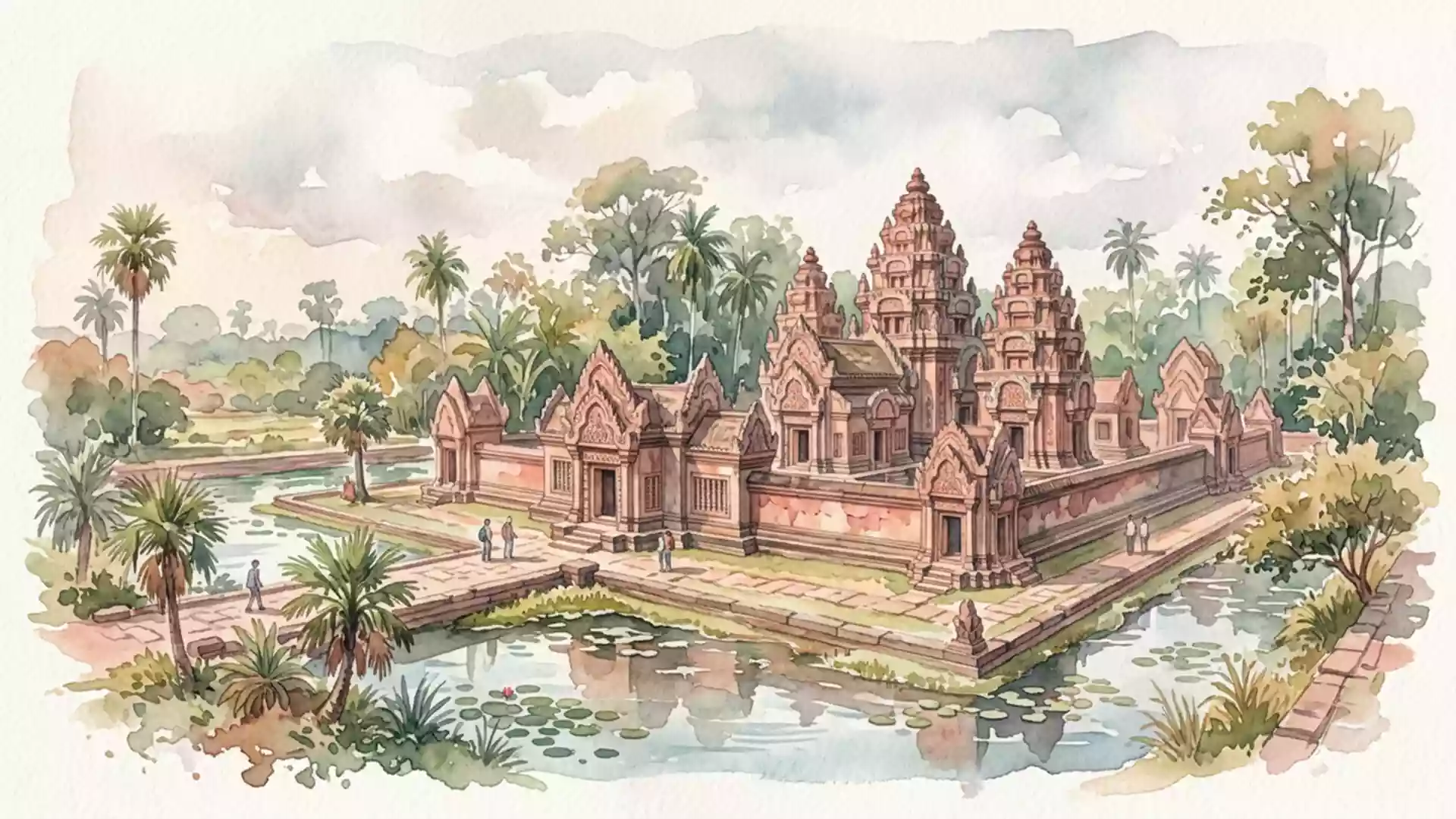
Banteay Srei and its pink sandstone carvings near Siem Reap
Published on 08/13/2026 at 14:12 | Editorial responsibility: Rafael Müller, Editor-in-Chief AD HOC NEWS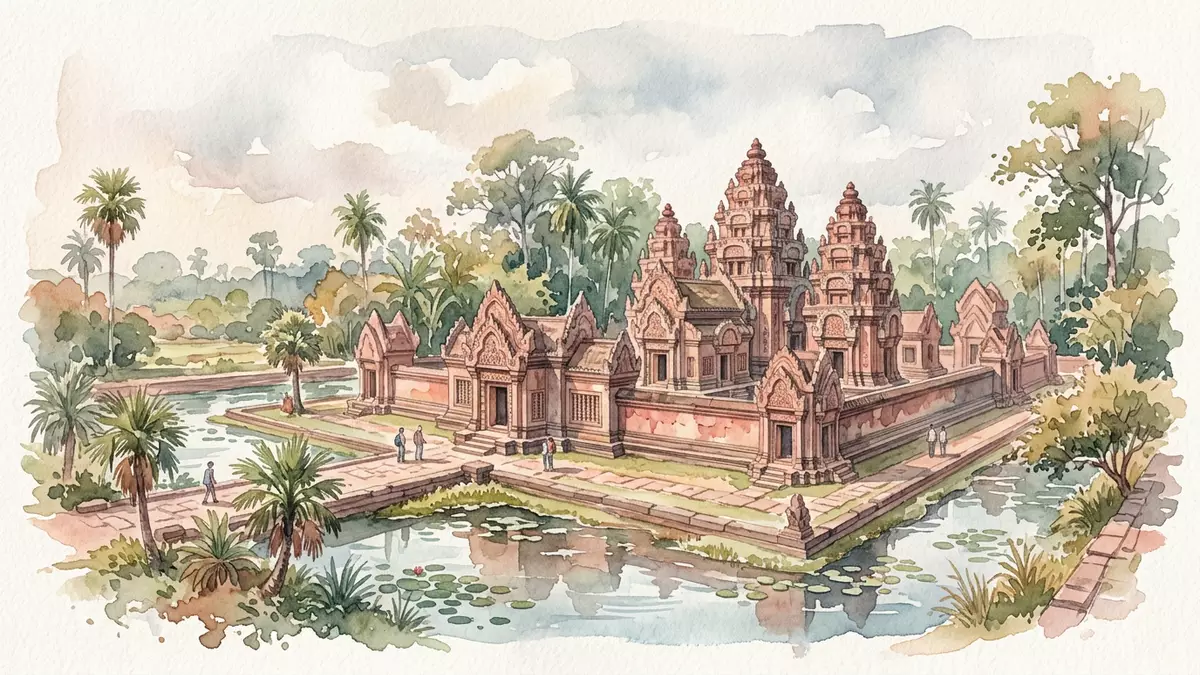
Banteay Srei in Cambodia’s Siem Reap Province is a compact tenth-century Hindu temple where pink sandstone walls are covered with remarkably fine carvings, turning a small complex into a dense stone gallery of myth and ornament. Built during the Angkor period and consecrated in 967 CE under King Jayavarman V, it stands north-east of the main Angkor temple group near the low hill of Phnom Dei, on the road that leads towards the Kulen Mountain range.Consecrated in 967 CE The temple’s builders, the Brahmin brothers Yajñavar?ha and Vi??ukum?ra, created a foundation dedicated above all to Shiva, and Banteay Srei later became part of the wider Angkor Archaeological Park inscribed as a World Heritage Site.
Pink sandstone and small-scale architecture
Banteay Srei stands out in the Angkor landscape through its material and scale: the core buildings are constructed in red or pink sandstone, which weathers to warm tones distinct from the greyer stone used in many larger Angkor temples.Sandstone and laterite construction The temple occupies a relatively modest footprint compared with Angkor Wat or Bayon, with low gopuras, compact sanctuary towers and a tight sequence of enclosures that keep the visitor close to the carved surfaces rather than at a distant monumental scale.
The site follows the typical east-facing orientation of many Khmer temples, with a processional causeway leading to successive enclosures and a central sanctuary set within a moat-ringed inner court.Angkor-period temple layout Laterite is used for the outer enclosure walls and some structural elements, while the decorative zones—lintels, pediments, pilasters and false doors—are predominantly in the finer-grained sandstone that allows deep relief carving. The result is a series of small buildings whose proportions feel almost domestic in height, yet whose surfaces carry a density of detail usually associated with far larger monuments.
Carved narratives in tenth-century stone
The carvings of Banteay Srei are its defining feature: figures step forward from pediments in three-dimensional relief, scrollwork runs along doorframes, and narrative scenes from Hindu mythology fill the space above entrances.Fine decorative work and bas-reliefs Shiva’s presence dominates the programme, but the complex also incorporates shrines and imagery linked to Vishnu, reflecting the broader pantheon of Angkor-period religion and the scholarly interests of its Brahmin patrons.
Within the inner enclosure, three central shrines rise over the temple’s heart, two associated with Shiva and one with Vishnu, marking the site as both a Shaivite foundation and a place where different strands of Khmer Hindu practice intersect.Three central shrines within a moat Surviving inscriptions at Banteay Srei, recorded on steles and doorjambs, span several decades and document phases of patronage from the brothers Yajñavar?ha and Vi??ukum?ra through subsequent custodians under rulers such as S?ryavarman I.Epigraphic corpus across three phases Together, these texts and carvings fix the temple firmly in the intellectual and artistic life of the late tenth-century Khmer Empire.
Banteay Srei within the Angkor landscape
Geographically, Banteay Srei lies north-east of the main Angkor cluster, in Banteay Srei District of Siem Reap Province, with the temple set among village land and fields below the Kulen range.Location in Banteay Srei District It sits roughly 25 km or more from Angkor Wat and Angkor Thom, far enough that a visit tends to be a distinct excursion rather than a short detour within the central park circuit.North-east of the main group of temples
The temple complex forms part of Angkor Archaeological Park, which was designated as a World Heritage Site by UNESCO in 1992.Angkor World Heritage inscription Within that wider protected area, Banteay Srei is often linked with journeys towards Kbal Spean and Phnom Kulen, forming a route that traces the relationship between the lowland temple zone and the sandstone plateau where some of the stone for Angkor-era building was quarried.
Visiting Banteay Srei: what travellers from Western Europe should know
- Banteay Srei lies north-east of the main Angkor temple group and can be reached by road from Siem Reap, with routes running through Angkor Archaeological Park and village areas.
- The temple is a ground-level complex with laterite paths and stone steps; within the inner enclosure, the approach to the sanctuary towers involves short but sometimes uneven stairways.
- The official language is Khmer and the currency is the Cambodian riel.
- Entry requirements depend on your nationality; UK travellers can check the FCDO travel advice at gov.uk/foreign-travel-advice, Irish travellers the Department of Foreign Affairs at ireland.ie.
Searching for Banteay Srei on social platforms
These links open searches for Banteay Srei on each platform.
Frequently asked questions about Banteay Srei
Where is Banteay Srei located?
Banteay Srei is in Banteay Srei District of Siem Reap Province in Cambodia, north-east of Angkor Wat and the main Angkor temple group.
What can visitors expect at Banteay Srei?
Visitors encounter a compact Angkor-period temple complex of pink sandstone, with dense carvings, successive enclosures, a moat-ringed inner court and sanctuary towers dedicated to Hindu deities.
What makes Banteay Srei distinctive among Angkor temples?
The temple’s distinction lies in its warm-toned sandstone, small-scale architecture and unusually deep, well-preserved carvings created under Brahmin patrons in the tenth century.