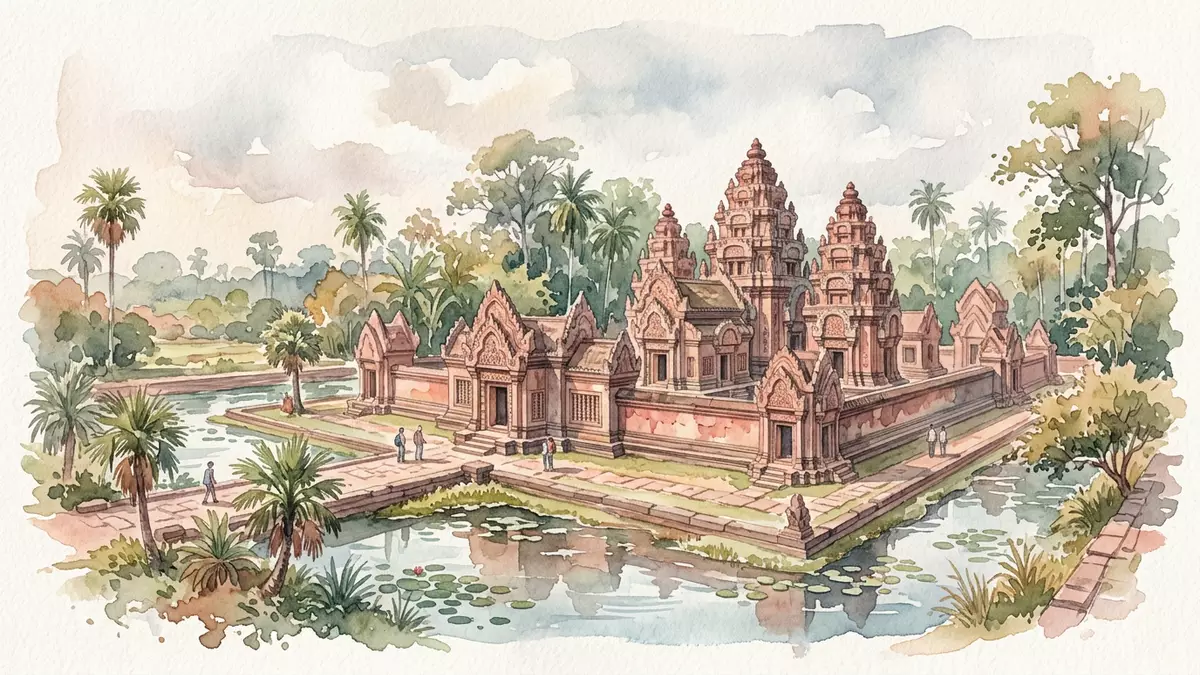
Banteay Srei’s rose sandstone carvings in Siem Reap
Published on 08/11/2026 at 15:15 | Editorial responsibility: Rafael Müller, Editor-in-Chief AD HOC NEWS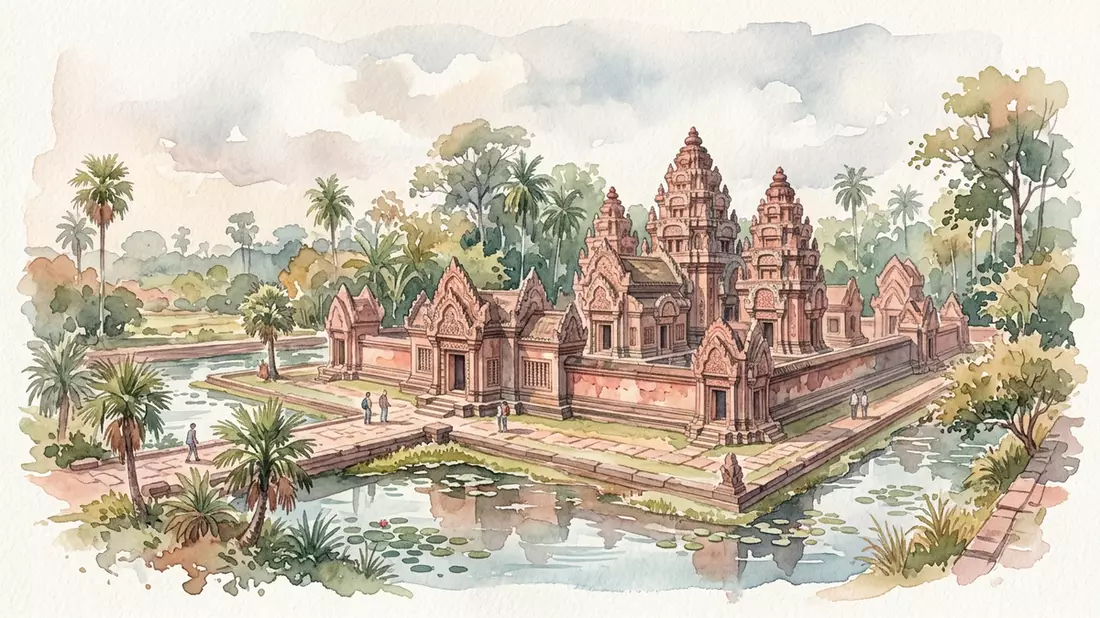
Banteay Srei is a tenth-century Khmer temple in the Siem Reap region of Cambodia, known for its rose sandstone and sharply cut reliefs. It belongs to the wider Angkor landscape, yet it reads on a smaller, more intimate scale than many of the better-known monuments nearby.
Rose sandstone and fine relief carving
The temple’s walls carry carved scenes, borders and decorative bands in unusually dense detail. The pinkish stone gives the whole complex a warm colour, especially in strong daylight.
Its layout includes towers, enclosure walls and gateways, with the central sanctuary forming the core of the site. The surviving decoration makes the temple especially valued by visitors interested in Khmer sculpture and ornament.
The tenth-century Khmer world
Banteay Srei dates from the reign of Rajendravarman II and the early Khmer period in Angkor. Its inscriptions and decorative programme place it within the courtly and religious culture of medieval Cambodia.
The temple is associated with Hindu imagery, including figures and narrative scenes from the Indian epics that appear across Khmer art. That combination of local stone, court patronage and learned iconography gives the site its distinctive character.
A compact temple with a close-up reading
Compared with the larger temple complexes of Angkor, Banteay Srei invites a close view of surfaces rather than long processional routes. The carvings are legible at short distance, and the smaller scale makes individual panels easier to read.
For travellers interested in architecture, sculpture and medieval religious art, the site offers a concentrated example of Khmer craftsmanship. Its appeal lies in the density of the carving, the colour of the stone and the clarity of the surviving form.
Visiting Banteay Srei: what travellers from Western Europe should know
- Banteay Srei lies in the Siem Reap region and is reached by road from Siem Reap.
- Admission arrangements and opening hours are set by the site's operator and change with the season; the official website is the only binding source.
- The site is often best visited in softer daylight, when the carved surfaces are easier to study.
- The approach includes walking on uneven ground, and the temple grounds have steps and worn stone.
- Local payment practice may vary, so carrying some Cambodian riel and US dollars is practical.
- Entry requirements depend on your nationality. UK travellers should check the FCDO travel advice at gov.uk/foreign-travel-advice; Irish travellers the Department of Foreign Affairs at ireland.ie; EU and EEA citizens their own national foreign ministry.
Searching for Banteay Srei on social platforms
These links open searches for Banteay Srei on each platform.
Frequently asked questions about Banteay Srei
Where is Banteay Srei?
It is in the Siem Reap region of Cambodia, within the wider Angkor area associated with Khmer temple building.
What should visitors expect?
A temple of red-rose sandstone, carved surfaces and a compact layout. The site rewards slow viewing and close attention to detail.
What makes it distinctive?
The density of the carving and the quality of the stonework set it apart within Khmer temple architecture. Its tenth-century origins add historical depth to the decorative programme.