
Basilica de Guadalupe and its twin sanctuaries in Mexiko-Stadt
Published on 09/09/2026 at 09:06 | Editorial responsibility: Rafael Müller, Editor-in-Chief AD HOC NEWS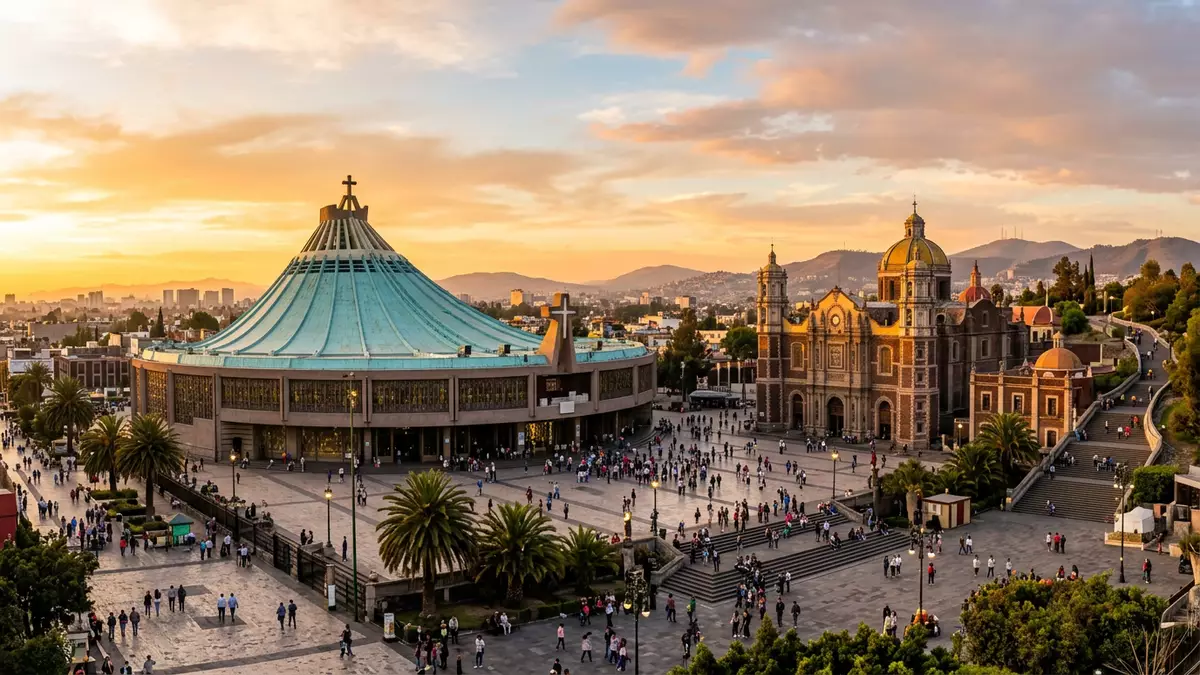
At the northern edge of Mexiko-Stadt, Basilica de Guadalupe brings two very different churches together around a single Marian image that has shaped Mexican Catholicism since the sixteenth century. The sanctuary complex on Tepeyac Hill combines an 18th-century Baroque basilica with a circular, high modernist church completed in 1976, both focused on the agave-fibre cloak associated with Saint Juan Diego in 1531.
Two basilicas facing the same image
Basilica de Guadalupe is formally dedicated to Our Lady of Guadalupe and occupies a site at the foot of Tepeyac Hill, long associated with apparitions experienced by the indigenous convert Juan Diego Cuauhtlatoatzin in December 1531.Tepeyac Hill apparitions The focus of devotion is Juan Diego’s cloak, or tilma, woven from agave fibre and bearing the image of the Virgin of Guadalupe.
For centuries the tilma was housed in what is now called the Old Basilica of Guadalupe, an 18th-century church designed by the architect Pedro de Arrieta. Work on this basilica began in 1695 and the sanctuary was inaugurated on 1 May 1709, establishing a monumental Baroque focus for Marian pilgrimage on the northern fringe of the city.Pedro de Arrieta’s basilica Over time, structural problems in the soft ground beneath the Old Basilica led to concerns about stability, and the decision was taken in the 1970s to create a new building capable of receiving large liturgical gatherings while protecting the image.
The circular New Basilica and its modernist form
The New Basilica of Guadalupe stands beside the older church and presents a strikingly different architectural language. Construction began in 1974 and was completed in 1976 under the direction of Mexican architect Pedro Ramírez Vázquez, working with José Luis Benlliure, Alejandro Schoenhofer, Fray Gabriel Chávez de la Mora and Javier García Lascuráin.team of architects Ramírez Vázquez is also known for major projects in Mexiko-Stadt such as the National Museum of Anthropology and the Aztec Stadium, and brings the same large-scale modernist confidence to this sanctuary.
The new church takes the form of a broad circular hall constructed in reinforced concrete, its roof structure spanning roughly 100 m (330 ft) in diameter and clad with green oxidised copper that gives the building a distinct colouration.copper-clad circular roof Inside, the plan allows worshippers to gather around the sanctuary without internal supporting walls interrupting lines of sight. The tilma hangs above the main altar on the far side of the circular space, and the arrangement of floor levels and balustrades means that the image can be seen from many points around the hall.
Baroque, modernism and the wider sanctuary
Across the plaza from the New Basilica, the Old Basilica of Guadalupe retains its Spanish Colonial Baroque presence despite centuries of alterations. The church, sometimes referred to as the Templo Expiatorio a Cristo Rey, shows the layered history of the site: an 18th-century façade and plan from Pedro de Arrieta, later reworking of the interior in a neoclassical idiom, and signs of measures taken to stabilise the building after subsidence in the underlying former lakebed.Baroque and neoclassical layers The contrast with the neighbouring modernist sanctuary gives visitors a direct visual sense of architectural change from the colonial period to the late twentieth century.
Around these two principal churches, the sanctuary at Tepeyac includes chapels, courtyards and processional routes up the slope of the hill, where devotional structures mark episodes from the Guadalupe story. The site is recognised as a national shrine of Mexico and holds the original tilma at its heart, making Basilica de Guadalupe a major centre of Catholic pilgrimage and a prominent symbol of religious identity in the country.national shrine of Mexico
Visiting Basilica de Guadalupe: what travellers from Western Europe should know
- Basilica de Guadalupe lies in the northern part of Mexiko-Stadt, in the Gustavo A. Madero area near Tepeyac Hill, and is reached by city streets and public transport links.
- The sanctuary complex covers a sizeable urban site, with broad paved plazas between the Old and New Basilicas and routes that climb the slope of Tepeyac Hill on foot.
- The terrain includes exterior stairways and inclined paths up the hill, and the interior of the Old Basilica is accessed by steps leading from the plaza level.
- Spanish is the official language and the currency is the Mexican peso.
- Entry requirements depend on your nationality; UK travellers can check the FCDO travel advice at gov.uk/foreign-travel-advice, Irish travellers the Department of Foreign Affairs at ireland.ie.
Searching for Basilica de Guadalupe on social platforms
These links open searches for Basilica de Guadalupe on each platform.
Frequently asked questions about Basilica de Guadalupe
Where is Basilica de Guadalupe located?
Basilica de Guadalupe stands in the Gustavo A. Madero borough in the northern part of Mexiko-Stadt, at the base of Tepeyac Hill.
What can visitors expect when they arrive?
Visitors encounter a broad plaza framed by the circular New Basilica and the historic Old Basilica, with devotional chapels and paths rising up Tepeyac Hill.
What makes Basilica de Guadalupe distinctive?
The sanctuary brings together an 18th-century Baroque basilica and a 1970s modernist circular church, both centred on Juan Diego’s tilma bearing the image of Our Lady of Guadalupe.


