
Basilica di San Francesco and its two painted churches
Published on 09/23/2026 at 20:56 | Editorial responsibility: Rafael Müller, Editor-in-Chief AD HOC NEWS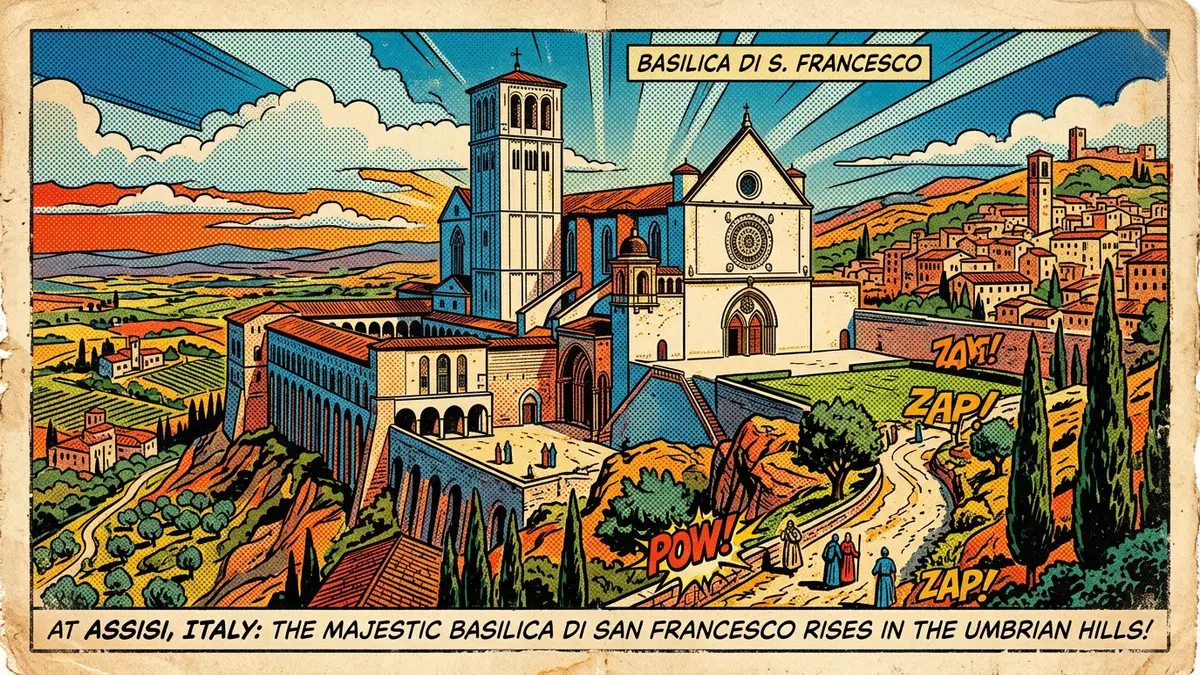
Basilica di San Francesco rises on the western side of Assisi as a layered stone complex with two churches placed one above the other. Begun in 1228, it combines Romanesque and Gothic forms with frescoes by Giotto, Cimabue, Simone Martini and Pietro Lorenzetti.
Two churches within Basilica di San Francesco
The basilica is formed by the Lower Church, the Upper Church and a crypt containing the tomb of Saint Francis. Their stacked arrangement gives the building a distinctive vertical presence on the slope of Assisi, where pale limestone links the monument to the hill town around it.
The Lower Church dates from 1228 to 1230. Its entrance opens from a square bordered by a fifteenth-century portico, while the interior follows a Latin-cross plan with chapels and transepts covered by medieval wall paintings.
Stairs descend from the Lower Church to the crypt. The sanctuary contains the stone coffin of Francis, whose life and death shaped the religious identity of Assisi. The crypt in its present form includes work associated with Ugo Tarchi from the twentieth century.
Giotto, Cimabue and the medieval frescoes
The Upper Church was constructed between 1230 and 1253. Its single nave has a gabled façade, a Gothic portal, a rose window and large stained-glass windows, while frescoes cover the walls and vaults.
Giotto’s cycle of twenty-eight scenes from the life of Saint Francis occupies the lower part of the nave. The paintings present episodes from Francis’s life in a sequence of figures, buildings, landscapes and gestures that became central to the history of Italian painting.
Cimabue painted works in the transept and contributed to the visual programme of the basilica. Simone Martini decorated the Chapel of Saint Martin, while Pietro Lorenzetti painted the left transept of the Lower Church. Their different colours, compositions and approaches appear within the same Franciscan complex.
The building therefore functions as a sequence of painted spaces rather than a single decorated hall. The Lower Church has darker, enclosed chapels and extensive frescoed surfaces, while the Upper Church presents a taller nave with windows, painted walls and a clear architectural rhythm.
Assisi, Franciscan history and World Heritage
Francis of Assisi was born in 1182 and died in 1226. The basilica was begun two years after his death, and the Lower Church was completed in 1230 for his tomb. The Upper Church followed within the same medieval building programme.
The complex belongs to the Franciscan history of Umbria and to the wider development of European religious art. Assisi’s medieval centre stands on the slopes of Mount Subasio, with Basilica di San Francesco forming a major landmark at the town’s western end.
In 2000, Assisi, the Basilica of San Francesco and other Franciscan sites entered the UNESCO World Heritage List. The designation covers a cultural landscape that includes the medieval town, Franciscan buildings and associated sites around Assisi. UNESCO World Heritage listing
The basilica’s significance rests on the combination of architecture, burial place and painting. The basilica’s painted churches preserve works connected with several leading artists of the thirteenth and fourteenth centuries.
Visiting Basilica di San Francesco: what travellers from Western Europe should know
- Basilica di San Francesco is in Assisi’s historic centre, at Piazza Inferiore di San Francesco, near Porta San Giacomo and Piazza Giovanni Paolo II.
- Assisi Railway Station is in Santa Maria degli Angeli below the hill town. Bus Line C connects the station with Assisi.
- The complex contains stairs between the Lower Church and the crypt. The historic centre itself occupies a hillside, with sloping streets and stone paving.
- The official language is Italian and the currency is the euro.
Searching for Basilica di San Francesco on social platforms
These links open searches for Basilica di San Francesco on each platform.
Frequently asked questions about Basilica di San Francesco
Where is Basilica di San Francesco?
The basilica stands in the historic centre of Assisi in Umbria, central Italy. It occupies the western side of the medieval hill town below Mount Subasio.
What can visitors expect inside?
The complex contains a Lower Church, an Upper Church and a crypt with the tomb of Saint Francis. Frescoes by Giotto, Cimabue, Simone Martini and Pietro Lorenzetti cover chapels, transepts and the Upper Church nave.
What makes the basilica distinctive?
Its two superimposed churches combine medieval architecture, a Franciscan burial place and major cycles of Italian fresco painting. The arrangement brings Romanesque and Gothic forms together within one hillside complex.


