
Basilica di San Francesco in Assisi and its double church above the hill
Published on 08/20/2026 at 12:22 | Editorial responsibility: Rafael Müller, Editor-in-Chief AD HOC NEWS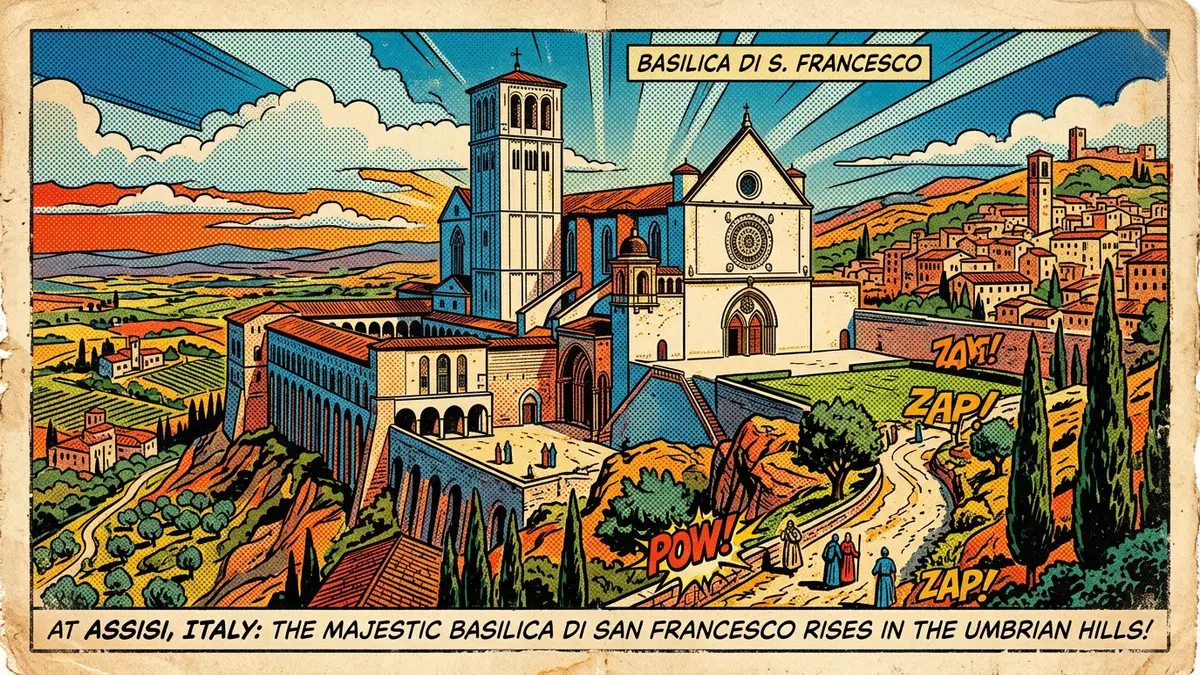
Basilica di San Francesco rises on the western flank of Assisi, built into a hillside and organised as a double church with a crypt holding the remains of Saint Francis. The complex grew in the thirteenth century under Franciscan patronage, blending Romanesque solidity with emerging Italian Gothic forms that became a reference point for religious architecture.
A double church for a single saint
The core structure of Basilica di San Francesco is unusually layered: a Lower Church, an Upper Church and, beneath them, the crypt in which the body of Francis of Assisi is interred. The arrangement developed after Francis’s death in 1226, when Pope Gregory IX ordered a special church to guard the saint’s remains and laid a foundation stone on the hillside at Assisi’s western edge.foundation stone in 1228 Construction of the complex began in 1228, the year of Francis’s canonisation, and the Lower Church reached completion in 1230 when the saint’s body was transferred there from its temporary resting place in the Church of San Giorgio.Lower Church completed in 1230
The Upper Church rose above the earlier structure over subsequent decades, with work extending into the middle of the thirteenth century and consecration in 1253 under Pope Innocent IV.construction from 1228 to 1253 This unusual vertical arrangement gives Basilica di San Francesco a compact external outline while offering two distinct interior worlds: a more enclosed, low-vaulted space below, and a taller, light-filled hall above, both built over the same hillside platform.
Romanesque walls and Italian Gothic light
Architecturally, Basilica di San Francesco stands at the transition between Umbrian Romanesque and Italian Gothic. The builders — including brother Elia da Cortona as organiser and figures such as Jacopo Tedesco named in later accountsearly architect Jacopo Tedesco — produced a structure that combines thick masonry and rounded arches with pointed vaults and taller windows characteristic of Gothic forms.synthesis of Romanesque and Gothic The church is built into the side of a hill, so its façade and long flank present a firm stone mass rising above terraces and a broad forecourt.
Inside the Lower Church, the plan follows a Latin cross, with side chapels and a nave covered by ribbed vaults that sit relatively close to the floor, emphasising painted surfaces over vertical sweep.Lower Church Latin cross plan By contrast, the Upper Church adopts a taller nave that carries the emerging Italian Gothic language more fully, with a single, elongated hall leading towards the transept and apse. Together, the two interiors show how forms associated with French Gothic were adapted in Umbria, influencing later Franciscan and mendicant churches elsewhere.
Fresco cycles and the birth of a Franciscan image
Basilica di San Francesco is renowned for its fresco decoration, which spans the thirteenth and fourteenth centuries and involves major painters from central Italy. The Lower Church walls and chapels are covered by cycles by artists such as Cimabue, Giotto, Simone Martini, Pietro Lorenzetti and Jacopo Torriti, each bringing different approaches to narrative and colour.artists decorating both churches Cimabue’s work includes a Madonna and Child with Saint Francis in the transept, while Simone Martini painted the San Martino Chapel and Pietro Lorenzetti worked in the opposite arm, creating scenes that add depth to Franciscan spirituality.
In the Upper Church, the nave carries a celebrated series of twenty-eight painted episodes from the life of Saint Francis, forming one of the earliest sustained visual biographies of the saint.twenty-eight scenes from Francis’s life These scenes sit beneath biblical narratives in the upper part of the walls, tying Franciscan stories to older scriptural cycles. The authorship of some frescoes has long been discussed, with Giotto frequently linked to the life of Francis series and other parts of the decoration, even though documentary proof is limited; the frescoes themselves, however, are central to the history of Italian painting and to the way Francis of Assisi has been imagined visually.medieval art masterpieces in Assisi
Visiting Basilica di San Francesco: what travellers from Western Europe should know
- Basilica di San Francesco stands on the western side of Assisi in central Italy, above a broad square that opens towards the surrounding Umbrian landscape; regional trains connect Assisi with other Umbrian towns and larger rail hubs.
- The approach to the basilica from the town centre involves walking along sloping streets and crossing the large stone-paved square, with further steps inside the complex between the Lower and Upper Churches.
- The official language is Italian and the currency is the euro.
Searching for Basilica di San Francesco on social platforms
These links open searches for Basilica di San Francesco on each platform.
Frequently asked questions about Basilica di San Francesco
Where is Basilica di San Francesco and what surrounds it?
Basilica di San Francesco stands on a hillside on the western edge of Assisi in central Italy, overlooking the town and the wider Umbrian countryside.
What can visitors expect inside the basilica complex?
Visitors encounter a Lower Church, an Upper Church and a crypt, with stone vaults and extensive fresco decoration from the thirteenth and fourteenth centuries across chapels, nave and transepts.
What makes Basilica di San Francesco distinctive among Italian churches?
Its double church arrangement over a hill, association with Saint Francis, and rich fresco cycles by major medieval painters together mark it as a landmark of Italian Gothic and Franciscan art.


