
Basilica di San Marco and its golden world of mosaics
Published on 08/22/2026 at 20:32 | Editorial responsibility: Rafael Müller, Editor-in-Chief AD HOC NEWS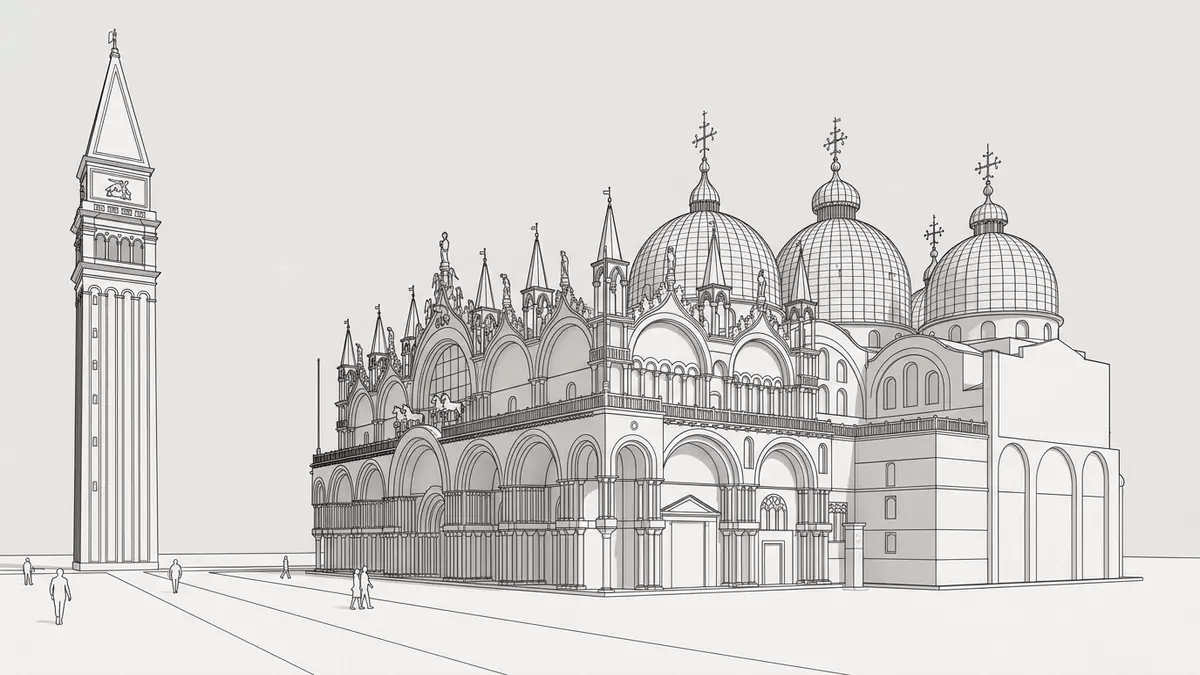
Basilica di San Marco in Venedig is a compact cathedral whose interior seems to dissolve into gold, mosaics and domes rather than solid walls. Built in the eleventh century as the state church of the Republic of Venice, it still presents a dense world of marble and images rather than a single, open nave.
A Byzantine basilica at the heart of Venedig
Basilica di San Marco stands on Piazza San Marco beside the former seat of the doges, the Palazzo Ducale, forming the ceremonial focus of Venedig’s historic centre.San Marco Basilica The church was first consecrated in 832 as a shrine for the relics of Saint Mark, whose body was brought from Alexandria to Venice in the ninth century.Consecration of the first church
The present basilica, begun in 1063 and substantially complete by the end of the eleventh century, follows a Greek-cross ground plan with a central dome and four domes over the arms.Works of the present basilica It served for centuries as the doge’s private chapel and state church of the Republic of Venice, and only became the cathedral of the Patriarch of Venice in 1807.Cathedral church of Venice
Gold mosaics and a marble skin
The most striking feature of Basilica di San Marco is its extensive cycle of mosaics, which cover the vaults, domes and many wall surfaces in gold-ground scenes.Gold mosaics in the domes Much of this mosaic work dates from the twelfth and thirteenth centuries, with subjects ranging from Old Testament narratives to scenes from the life and translation of Saint Mark.
Externally, the basilica presents a layered marble surface with columns, reliefs and panels in different colours, many of them spolia brought from the eastern Mediterranean.Byzantine style and materials The main façade facing Piazza San Marco is divided into two levels marked by arches and arcades and is punctuated by five portals whose arches are filled with mosaics depicting episodes connected with Saint Mark and the history of the basilica.Main façade with five portals
Interiors layered with relics, chapels and galleries
Inside, the floor is paved with marble intarsia in complex geometric and figurative patterns, creating a patterned surface that responds to the shifting light from above.Interior description The domes and vaults form a continuous vaulting system, so that almost every upward glance meets a mosaic surface rather than exposed masonry.
The basilica’s interior is articulated by chapels, side aisles and galleries that run above the lower level, giving views across the nave and towards the high altar where the relics of Saint Mark are kept.History of St Mark’s Basilica At the western end, a gallery opens onto the façade and provides a vantage point towards Piazza San Marco and the lagoon beyond.
Visiting Basilica di San Marco: what travellers from Western Europe should know
- Basilica di San Marco stands on the eastern side of Piazza San Marco in the San Marco sestiere of Venedig, a short walk from the city’s main vaporetto stops on the Grand Canal.
- The basilica’s interior is reached by steps from the square level, and further staircases lead to the upper galleries above the main entrance.
- The surrounding area includes the Campanile di San Marco, the Palazzo Ducale and the lagoon edge at the Molo, so a visit to the basilica easily combines with these neighbouring landmarks.
- The official language is Italian and the currency is the euro.
Searching for Basilica di San Marco on social platforms
These links open searches for Basilica di San Marco on each platform.
Frequently asked questions about Basilica di San Marco
Where is Basilica di San Marco located?
Basilica di San Marco stands on Piazza San Marco in the San Marco district of Venedig, beside the Palazzo Ducale and close to the Grand Canal.
What can visitors expect inside the basilica?
Visitors encounter extensive gold mosaics on domes and vaults, marble inlaid floors and a layered interior with chapels, galleries and views towards the high altar.
What makes Basilica di San Marco distinctive among churches in Italy?
The basilica combines an eleventh-century Greek-cross plan, five domes and richly decorated Byzantine-style mosaics and marble surfaces in a relatively compact volume.


