
Basilica di San Pietro and its vast Renaissance dome
Published on 09/09/2026 at 10:19 | Editorial responsibility: Rafael Müller, Editor-in-Chief AD HOC NEWS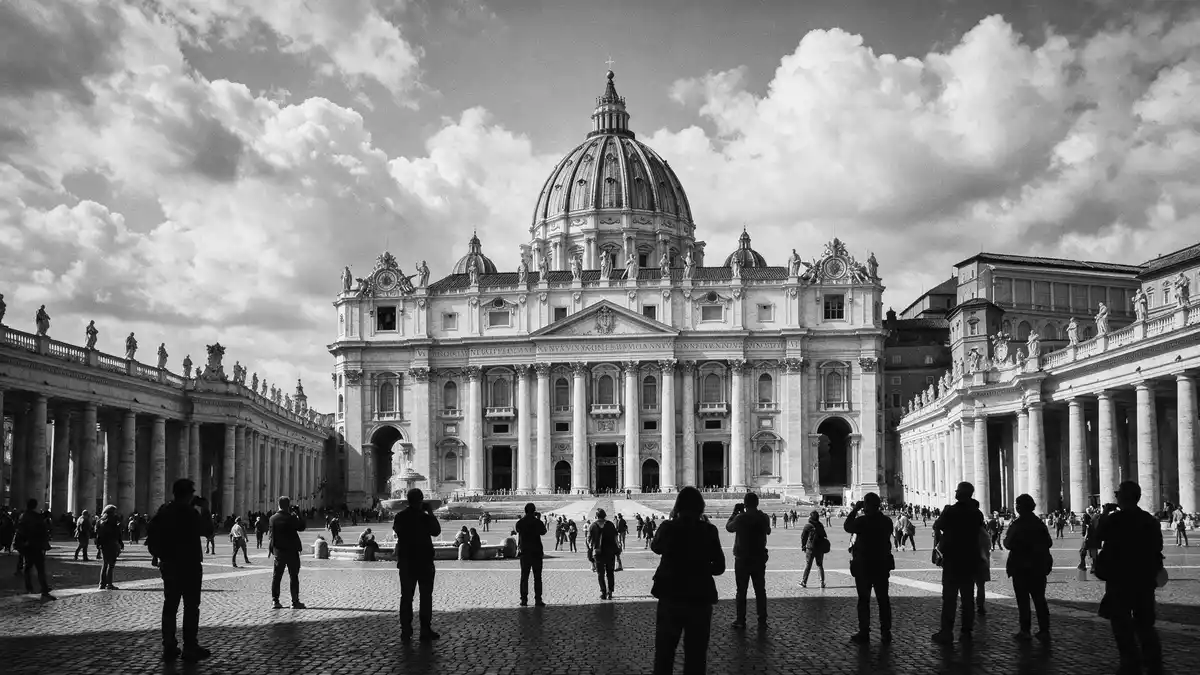
Basilica di San Pietro in Vatikanstadt, better known in English as St Peter’s Basilica, is a Renaissance church that dominates the skyline above Rome and Vatican City. Its vast dome, shaped in the sixteenth century and completed in the early seventeenth century, crowns a layered interior built over the traditional burial place of the apostle Peter.
A Renaissance basilica over an earlier Christian site
The site of Basilica di San Pietro has been associated with Christian worship since the fourth century, when Emperor Constantine ordered a church to be built over the grave of Peter on the Vatican hill outside Rome.Emperor Constantine’s basilica became the main pilgrimage church in Western Christendom and stood here for many centuries as Old St Peter’s Basilica, before being replaced by the structure that stands today.
Construction of the present Basilica di San Pietro began in 1506 under Pope Julius II, who commissioned the architect Donato Bramante to design a grand new church as the centre of papal Rome.Work on the new basilica involved a succession of Renaissance architects, including Raphael, Antonio da Sangallo the Younger and Michelangelo, each revising the plan. In the early seventeenth century Carlo Maderno extended the building into a long Latin-cross basilica and created the great façade facing Piazza San Pietro, while Gian Lorenzo Bernini later shaped the interior decoration and the monumental square outside.Renaissance architects at St Peter’s The basilica was consecrated in 1626, bringing more than a century of construction to a formal close.
The dome that anchors the skyline
The dome of Basilica di San Pietro is the feature most visible from across Rome, rising above the Tiber and the rooftops with a double shell and a tall lantern.Official measurements of the dome record an internal height of about 117 m (384 ft) from the basilica floor to the vault of the lantern and an external height of over 133 m (436 ft) from street level to the cross at its summit. The external diameter is given as about 58.9 m (193 ft), with the inner diameter close to 41.5 m (136 ft), creating a structure that dominates the building beneath it.
Michelangelo took charge of the project in 1547 and produced the design that gave the dome its recognisable silhouette, simplifying earlier plans while keeping a centralised crossing beneath the cupola.Michelangelo’s role in the dome After his death, Giacomo della Porta and Domenico Fontana completed the dome towards the end of the sixteenth century.Key dimensions of the dome Inside the basilica, the dome rests on four massive piers and is articulated with ribs and mosaic decoration that rise above the central altar, drawing the eye upward even from the far end of the nave.
Interior layers: altar, tombs and artworks
At the heart of Basilica di San Pietro, directly beneath the dome, stands the high altar, set above the traditional tomb of Saint Peter, which lies below the floor in the Vatican necropolis.The tomb of Saint Peter Around this focal point rises Bernini’s bronze baldachin, a sculpted canopy over the altar supported by spiral columns, marking the centre of the crossing. The basilica’s nave stretches away from this central space, lined with chapels, monuments and side altars, while the transepts and apse form a cruciform interior beneath the dome and barrel vaults.
The building also contains numerous tombs and artworks that trace the history of the papacy and European art. Over ninety popes are buried within Basilica di San Pietro, joined by other notable figures such as an emperor and a composer, creating a sort of stone record of ecclesiastical history.Tombs within the basilica Michelangelo’s marble “Pietà” stands in a side chapel near the entrance, while Bernini’s “Cathedra Petri”, a sculptural setting for the chair of Saint Peter, occupies the apse. These works sit within an interior of coloured stone, gilding and mosaic that reflects the long period of construction and decoration from the sixteenth to the seventeenth century.
Visiting Basilica di San Pietro: what travellers from Western Europe should know
- Basilica di San Pietro stands within Vatikanstadt, enclaved inside Rome; many visitors reach it on foot or by public transport from districts on the western side of the Tiber.
- The interior involves long distances on foot over stone floors, and access to the dome summit is by a climb that includes a narrow staircase with many steps.
- Italian is the main language used in Vatikanstadt and the surrounding city, and the currency is the euro.
- Entry requirements depend on your nationality; UK travellers can check the FCDO travel advice at gov.uk/foreign-travel-advice, Irish travellers the Department of Foreign Affairs at ireland.ie.
Searching for Basilica di San Pietro on social platforms
These links open searches for Basilica di San Pietro on each platform.
Frequently asked questions about Basilica di San Pietro
Where is Basilica di San Pietro located?
Basilica di San Pietro stands in Vatikanstadt, the small independent state within Rome on the western side of the River Tiber, forming part of Vatican City.
What should visitors expect inside the basilica?
Visitors encounter a large stone-floored nave, chapels and monuments, with the high altar and Bernini’s baldachin beneath the dome and the traditional tomb of Saint Peter below.
What makes Basilica di San Pietro distinctive among churches?
Its combination of a Renaissance Latin-cross basilica, Michelangelo’s dominant dome and a dense collection of papal tombs and artworks gives the church an unusual scale and historical depth.


