
Basilique Notre-Dame de Montreal and its neo-Gothic glow
Published on 08/17/2026 at 14:17 | Editorial responsibility: Rafael Müller, Editor-in-Chief AD HOC NEWS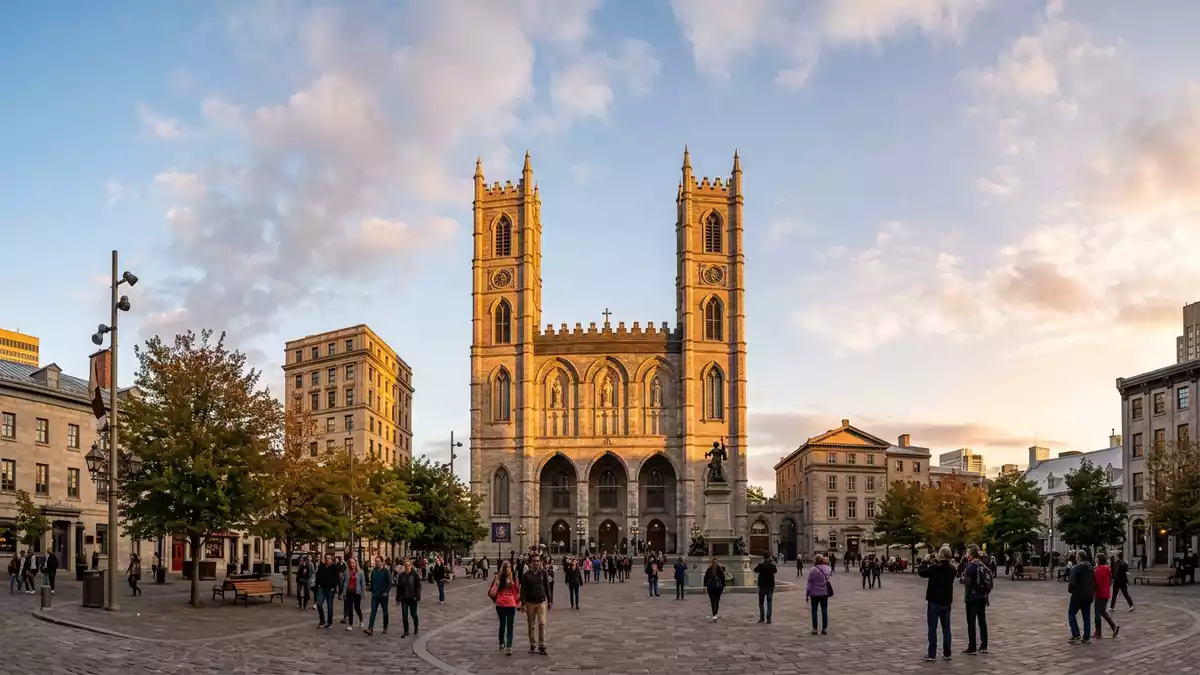
Basilique Notre-Dame de Montreal is the historic Catholic basilica that anchors Place d’Armes in Old Montreal, combining a restrained neo-Gothic stone exterior with an interior saturated in colour and carved wood. Built as a parish church in the nineteenth century and later declared a minor basilica of the Catholic Church, it remains a landmark of Gothic Revival architecture in Canada.
A neo-Gothic landmark facing Place d’Armes
The basilica stands on Notre-Dame Street West in the Old Montreal district, directly facing the urban square of Place d’Armes and alongside the historic Saint-Sulpice Seminary. Its current stone church was constructed between 1824 and 1829, replacing an earlier parish church on the same street that had served Montreal for more than a century.Construction between 1824 and 1829 The building is recognised as a National Historic Site of Canada, a designation recorded in 1989.National Historic Site designation
Designed by Irish-American architect James O’Donnell from New York, Basilique Notre-Dame de Montreal introduced the Gothic Revival style on a grand scale into Canadian church architecture.Design by James O’Donnell The exterior presents massive twin bell towers, a symmetrical facade and pointed Gothic arches worked into an otherwise regular, rectilinear composition.Massive twin towers and pointed arches These towers frame the main entrance and once marked the basilica out as one of the largest places of worship in North America.
An interior transformed by colour, carving and light
Step inside Basilique Notre-Dame de Montreal and the tone shifts from the exterior’s stone sobriety to a theatrical use of colour, carved wood and gilding. The original interior created under James O’Donnell was later extensively redeveloped by Montreal architect Victor Bourgeau from the 1870s onwards, in close collaboration with pastor Benjamin-Victor Rousselot.Interior redecoration by Victor Bourgeau Their work took inspiration from Sainte-Chapelle in Paris, introducing deep blue vaults, gold-leaf motifs and elaborate detailing on columns and cornices.
The main nave is lined with wooden galleries and filled with carved altars, pulpits and confessionals that continue the neo-Gothic vocabulary through tracery, pinnacles and sculpted figures. Stained-glass windows imported from Limoges in France depict episodes from Montreal’s religious history rather than biblical scenes, turning the city’s past into the basilica’s visual narrative.Stained-glass from Limoges Behind the high altar, an intricate reredos rises in tiers of statues, canopies and spires, giving the sanctuary a layered vertical emphasis.
A mother church with layered history
Basilique Notre-Dame de Montreal is described as Montreal’s mother church, a status reflecting its long-standing role in the city’s Catholic life.Montreal’s mother church The parish traces its roots to the seventeenth century, when a chapel dedicated to the Virgin Mary served the early settlement of Ville-Marie. A larger baroque-style church, designed by Sulpician priest François Dollier de Casson, was built on Notre-Dame Street between 1672 and 1683, and that church in turn gave way to the present basilica as Montreal expanded.Seventeenth-century parish origins
The nineteenth-century basilica was consecrated as a church in 1829, marking the completion of its main structure and interior.Consecration in 1829 On 21 April 1982 it was elevated to the rank of minor basilica, recognising its architectural and ecclesiastical significance within the Catholic Church.Elevation to minor basilica Alongside the main nave, the complex includes the chapel of Notre-Dame-du-Sacré-Cœur, which carries a more modern architectural treatment while remaining within the basilica ensemble.
Visiting Basilique Notre-Dame de Montreal: what travellers from Western Europe should know
- Basilique Notre-Dame de Montreal stands on Notre-Dame Street West in Old Montreal, facing Place d’Armes and beside the Saint-Sulpice Seminary. It is a short walk from central streets and the Old Port area.
- The nave and galleries are reached by interior staircases and aisles, with pews arranged in long rows and steps leading up towards the sanctuary and side chapels.
- The official language is French and the currency is the Canadian dollar.
- Entry requirements depend on your nationality; UK travellers can check the FCDO travel advice at gov.uk/foreign-travel-advice, Irish travellers the Department of Foreign Affairs at ireland.ie.
Searching for Basilique Notre-Dame de Montreal on social platforms
These links open searches for Basilique Notre-Dame de Montreal on each platform.
Frequently asked questions about Basilique Notre-Dame de Montreal
Where is Basilique Notre-Dame de Montreal located in the city?
It stands on Notre-Dame Street West in Old Montreal, facing Place d’Armes and close to the Saint-Sulpice Seminary and the Old Port area.
What can visitors expect on a visit to the basilica?
Visitors encounter a neo-Gothic stone exterior, then enter a nave filled with carved wooden decoration, coloured vaults, gilded details and stained-glass windows depicting Montreal’s history.
What makes Basilique Notre-Dame de Montreal distinctive among churches?
Its combination of early Gothic Revival architecture, large twin towers, a richly redeveloped interior inspired by Sainte-Chapelle and stained glass focused on Montreal’s story sets it apart within Canadian church architecture.


