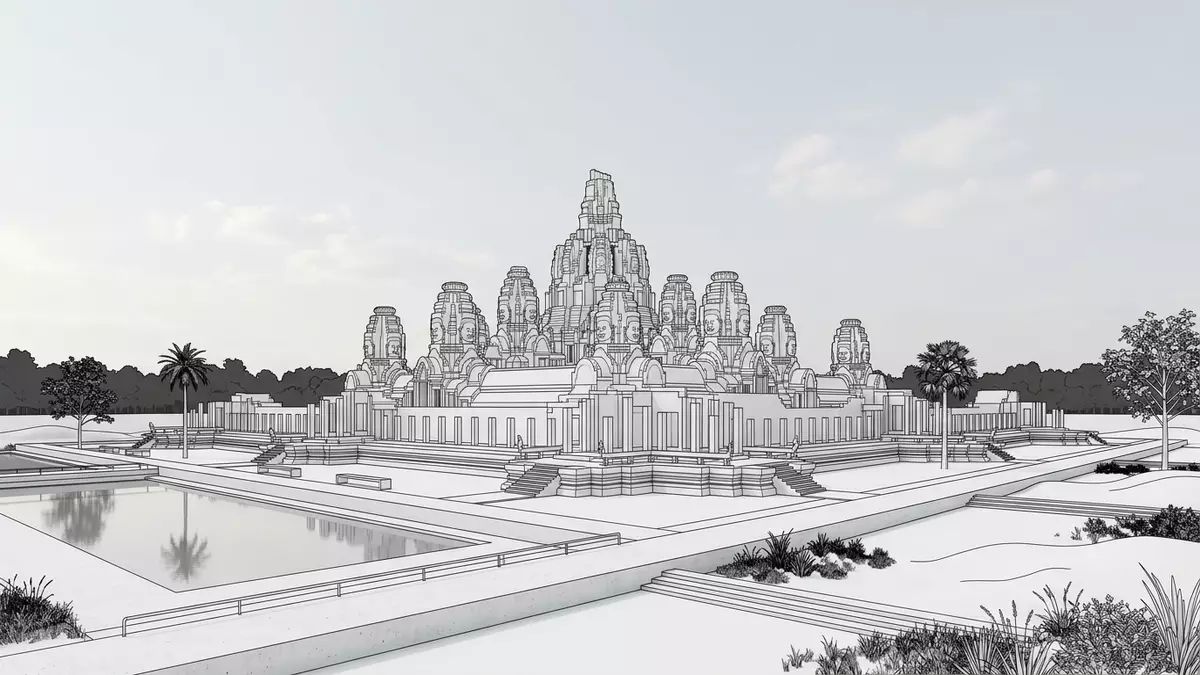
Bayon and its stone faces in the forests of Angkor
Published on 08/06/2026 at 20:28 | Editorial responsibility: Rafael Müller, Editor-in-Chief AD HOC NEWS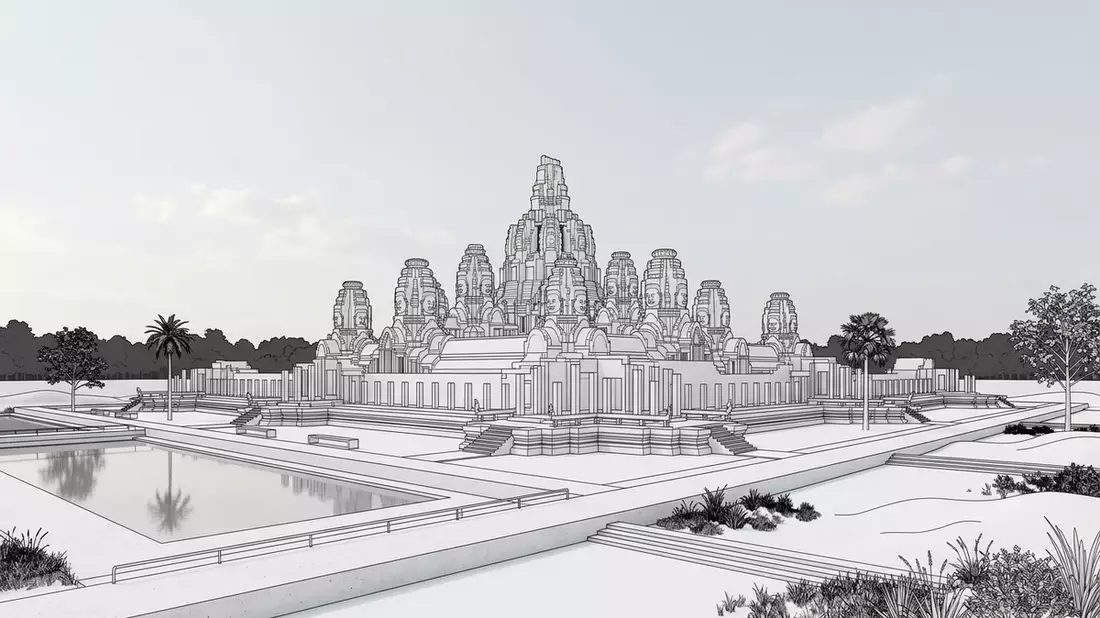
Bayon rises from the forests of Angkor near Siem Reap as a compact stone mountain wrapped in towers carved with serene faces. Built in the late twelfth and early thirteenth century as the state temple of King Jayavarman VII, it belongs to the Angkor Thom city complex and marks a shift from Hindu imagery towards Buddhism in the Khmer Empire. The experience of Bayon begins with these faces: wherever you walk, calm stone eyes seem to watch from above the galleries and terraces.
A temple mountain of many towers
At first glance Bayon looks like an irregular pile of grey stone, but from closer up it resolves into a stepped temple mountain with terraces and clustered towers. The whole structure stands on a raised base and is built largely from sandstone blocks, which weather into subtle shades of grey and brown under the tropical climate. From ground level the upper parts of the temple appear and disappear between the trees of Angkor Thom, so the towers seem to rise directly out of the surrounding forest.
The central sanctuary stands higher than the surrounding galleries and is ringed by a dense group of towers, each carrying several large faces whose lips are slightly curved and whose eyes are half closed. Many visitors recognise in these faces both the Buddhist bodhisattva Avalokiteshvara and the features of Jayavarman VII himself, a blend that reflects the close link between kingship and religion in the Khmer court of that period. The vertical effect of the towers, combined with the layered terraces, gives Bayon a striking profile when seen from the causeways that approach Angkor Thom’s gates.
The famous face towers of Bayon
The face towers are the most distinctive feature of Bayon and are visible from almost every part of the temple. Each tower carries faces on several sides, so as you move along the narrow corridors and climb the steep stairs the expressions seem to follow from different angles. The faces are carved directly into the stone blocks that form the towers, with detailed eyebrows, full lips and elaborate headdresses that frame the cheeks and forehead. Time and weather have softened some contours, yet the overall expression of calm and slight smile still reads clearly from a distance.
On the upper terrace, visitors come very close to some of these faces, standing almost level with the chins of the carvings. The surfaces here show chisel marks and patches of lichen, adding texture to the smooth modelling of the features. Photographs taken from this level often show three or four faces overlapping, framed by blue sky or canopy, which conveys the density of carving in a small footprint. From certain viewpoints the faces align with each other to form almost continuous bands around the central mass of the temple.
Bas-reliefs and the life of the Khmer Empire
While the towers of Bayon pull the eye upwards, the surrounding galleries tell a more grounded story in long bas-relief friezes. These carved panels run along the outer walls and depict scenes from battles, religious processions and everyday life in the Khmer Empire. Marching soldiers, war elephants, naval engagements and bustling market scenes appear in shallow relief, organised in horizontal bands. The variety of subject matter offers a detailed visual record of clothing, weapons, musical instruments and river craft in late twelfth-century Cambodia.
In several panels, figures sit under canopies or in pavilions, attended by servants and performers, while others cook, fish, trade or play games. The bas-reliefs also incorporate stylised vegetation and animals, from fish and crocodiles in the water scenes to monkeys in trees and birds above the crowds. These details anchor Bayon within the broader landscape of Angkor, where water management and rice cultivation supported the power of the Khmer kings. For visitors who take the time to follow the galleries, the bas-reliefs offer as much fascination as the towering faces above.
Visiting Bayon: what travellers from Western Europe should know
- Bayon stands within the Angkor Archaeological Park near Siem Reap in north-western Cambodia and is reached by road from the city, often in combination with visits to Angkor Wat and other nearby temples.
- Admission arrangements and opening hours are set by the site's operator and change with the season; the official website is the only binding source.
- The area has a tropical climate, so light clothing, sun protection and water are important, and many travellers prefer early morning or late afternoon for softer light on the stone carvings.
- Exploring Bayon involves uneven stone surfaces, steep staircases without handrails in places and a fair amount of walking within the wider Angkor complex, so sturdy footwear is advisable and those with limited mobility may need to focus on the lower galleries.
- Khmer is the main language in Cambodia, though English is widely used in Siem Reap’s tourism services; cash is common for small purchases and respectful dress that covers shoulders and knees suits the religious character of the temples.
- Entry requirements depend on your nationality. UK travellers should check the FCDO travel advice at gov.uk/foreign-travel-advice; Irish travellers the Department of Foreign Affairs at ireland.ie; EU and EEA citizens their own national foreign ministry.
Searching for Bayon on social platforms
These links open searches for Bayon on each platform.
Frequently asked questions about Bayon
Where is Bayon and how does it relate to Angkor Wat?
Bayon stands inside Angkor Thom, the walled city north of Angkor Wat, near Siem Reap in north-western Cambodia. It forms one of the key monuments of the Angkor Archaeological Park.
What should visitors expect when exploring Bayon?
Visitors can expect narrow corridors, steep stone stairs, upper terraces close to the carved faces and long galleries of bas-reliefs, all set within the wider forested landscape of Angkor Thom.
What makes Bayon distinctive among Angkor’s temples?
Bayon is distinctive for its crowded towers with large serene faces and for its extensive bas-reliefs that combine royal, military and everyday scenes, giving a vivid picture of the late twelfth-century Khmer Empire.