
Bayon’s many stone faces at the heart of Angkor Thom
Published on 09/12/2026 at 16:43 | Editorial responsibility: Rafael Müller, Editor-in-Chief AD HOC NEWS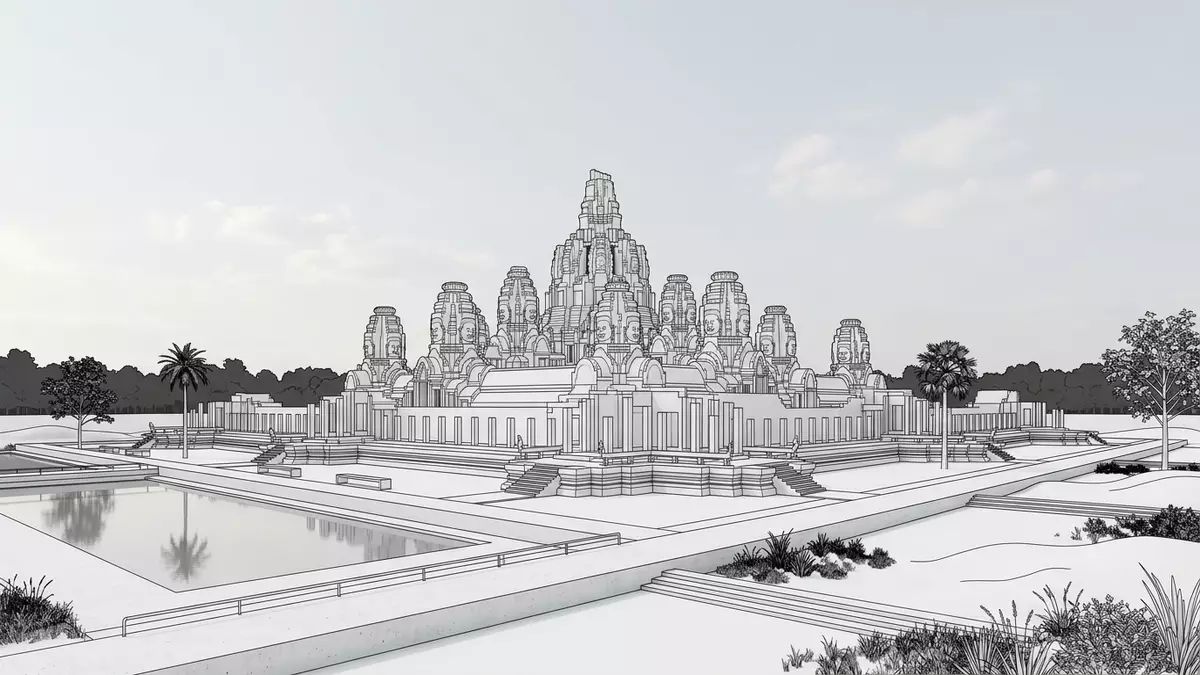
In the ancient city of Angkor Thom near Siem Reap, Bayon stands at the centre of the Khmer royal capital, its towers stacked with serene stone faces that watch the four cardinal directions. Built as a Mahayana Buddhist state temple for King Jayavarman VII in the late twelfth and early thirteenth centuries, this temple-mountain condenses the ambitions of the Khmer Empire into sandstone and shadow.
A temple-mountain of the Khmer Empire
Bayon belongs to the Angkor archaeological complex in Cambodia and rises at the geometric centre of Angkor Thom, the fortified city laid out under Jayavarman VII.the centre of Angkor Thom The temple is a richly decorated Mahayana Buddhist monument, a marked departure from the Hindu orientation of nearby Angkor Wat, and served as the king’s state temple in his new capital.Buddhist state temple Its construction is usually placed around the turn of the thirteenth century, with work beginning under Jayavarman VII after his accession in 1181 and continuing into the early 1200s.c. 1190–1220 CE
Architecturally, Bayon is a temple-mountain: a stepped pyramid structure representing Mount Meru, the cosmic mountain at the centre of the universe in Hindu and Buddhist cosmology.temple-mountain form The temple rises on three main levels arranged in successive enclosures, built largely of sandstone blocks that have weathered to soft grey and brown tones. From the outer causeways and galleries, the structure steps inward and upward towards a compact upper terrace crowned by clustered towers.
The towers of many faces
Bayon is best known for its face-towers: slender towers whose upper blocks are carved into enormous human faces, each turning towards a cardinal direction.face-towers at the centre Many of these towers carry four faces, though some carry fewer, and their slightly smiling expressions give the temple its distinctive character. The faces are usually associated with the bodhisattva Avalokiteshvara or with the king himself, but what the visitor encounters directly is the sense of being surrounded by tiers of calm stone gazes at different heights.
Scholars count more than 200 such faces distributed across dozens of towers, though erosion and reconstruction make exact numbers a matter of specialist detail.approximately 200 stone faces On the upper terrace these faces appear at close range; stepped stairways bring visitors to platforms where the carved visages are level with eye-height or looking down from just above. Between the towers, narrow passages and small courtyards frame views where several faces align, turned slightly towards and away from one another.
Bas-reliefs of empire and everyday life
At ground level, Bayon’s outer galleries carry bas-relief carvings that run along the walls like a stone chronicle of the Khmer Empire.bas-relief galleries These reliefs depict battles, court scenes and religious processions, but also crowded scenes of everyday life: markets, river journeys, games and domestic activity. One long sequence shows naval combat, with war boats rendered in profile along a carved river, while another records a military campaign with soldiers, elephants and banners advancing across the wall.
The bas-reliefs run for more than a kilometre around the temple’s base according to site surveys, with thousands of figures carved in fine detail.extensive bas-reliefs Inside the temple, further reliefs and sculpted panels pick out deities, dancers and floral motifs. These narrative and decorative carvings give the sandstone surfaces texture in contrast to the more monumental simplicity of the upper faces.
Visiting Bayon: what travellers from Western Europe should know
- Bayon stands in the centre of Angkor Thom within the Angkor Archaeological Park, north of Siem Reap, reached by road through the city’s southern gate and along the main axial route.
- Inside the temple, movement between levels involves stone stairways that are steep and narrow in places, with worn steps and confined passages on the upper terraces.
- The surrounding landscape is lowland forest and former ceremonial space, with views from Bayon’s upper levels towards the gates and walls of Angkor Thom and, beyond them, the wider Angkor plain.
- The official language is Khmer and the currency is the Cambodian riel.
- Entry requirements depend on your nationality; UK travellers can check the FCDO travel advice at gov.uk/foreign-travel-advice, Irish travellers the Department of Foreign Affairs at ireland.ie.
Searching for Bayon on social platforms
These links open searches for Bayon on each platform.Frequently asked questions about Bayon
Where is Bayon located?
Bayon is located at the centre of Angkor Thom within the Angkor Archaeological Park, north of Siem Reap in Cambodia.
What should visitors expect on a visit to Bayon?
Visitors encounter stepped levels, sandstone galleries with extensive bas-reliefs and upper terraces where towers carry large carved faces overlooking the surrounding city.
What makes Bayon distinctive among Angkor’s temples?
The combination of its central position in Angkor Thom, its Mahayana Buddhist temple-mountain form and its numerous face-towers carved with serene stone expressions distinguishes Bayon from neighbouring monuments.


