
Biomuseo and the bright edge of the Panama Canal
Published on 09/14/2026 at 16:45 | Editorial responsibility: Rafael Müller, Editor-in-Chief AD HOC NEWS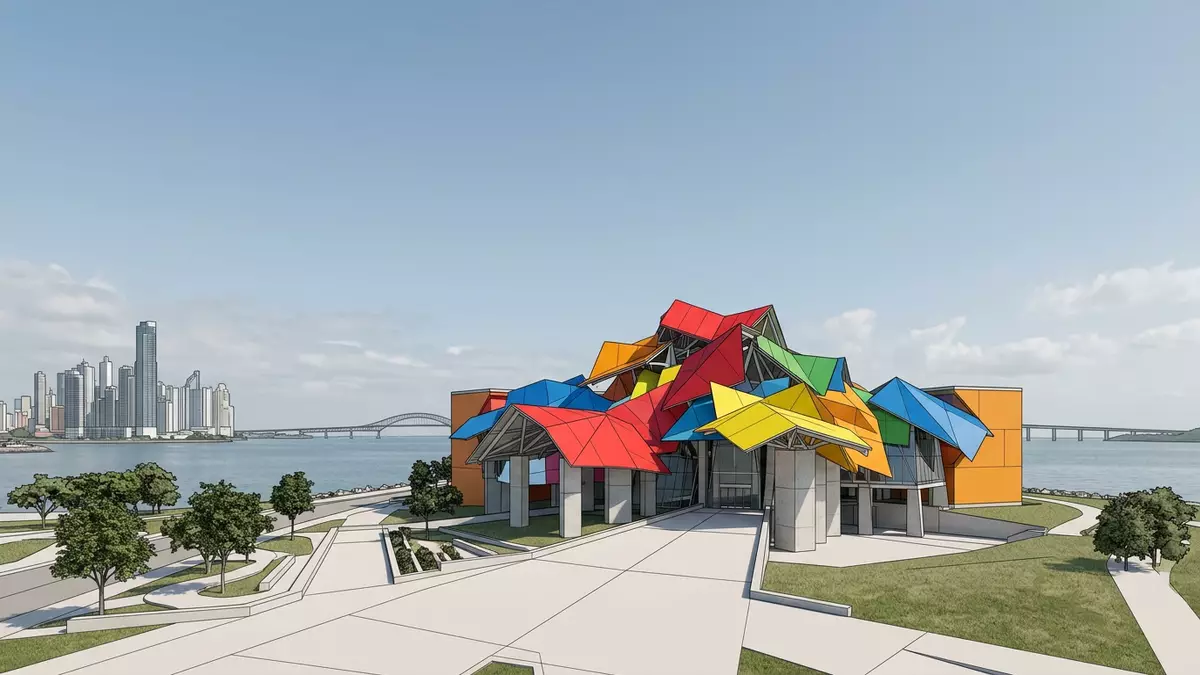
Biomuseo in Panama-Stadt is Frank Gehry’s first work in Latin America, and its steel roof planes give the museum a sharply irregular outline. The building stands on the Amador Causeway near the Pacific entrance to the Panama Canal, where the museum’s form is as visible as its subject.
Frank Gehry’s first Latin American work
Designed by Frank Gehry, Biomuseo opened in 2014 and became his first completed project in Latin America. The museum belongs to the natural history of Panama, and its galleries focus on the isthmus that linked two continents and divided two oceans.
The architecture uses strong colour and angular metal surfaces rather than a restrained museum shell. Gehry’s name and the 2014 opening place the building within his wider career, alongside the Guggenheim Museum in Bilbao and the Walt Disney Concert Hall in Los Angeles.
Colour, steel and an atrium at the centre
The building is made of steel and contains a central atrium, with galleries, a shop, a café and temporary exhibition spaces arranged around it. The roof planes step and overlap above the plan, while the atrium opens the middle of the composition.
Photographs and plans show a building that is read in layers: a bright outer envelope, an interior circulation core and a landscaped setting beyond. The steel structure sits within a broader ensemble that includes the exhibition galleries and the surrounding botanical park.
The museum’s story of Panama’s isthmus
Biomuseo presents the geological and biological history of Panama, with the rise of the isthmus as its central subject. The museum’s theme connects local natural history with a wider story of species movement between North and South America.
The park around the museum extends that theme into planting and outdoor stations. The surrounding Park of Biodiversity continues the museum’s subject in the landscape, while the building itself uses colour and irregular forms to echo Panama’s variety.
Visiting Biomuseo: what travellers from Western Europe should know
- Biomuseo stands on the Amador Causeway in Panama-Stadt, near the Pacific entrance to the Panama Canal. Taxi and bus links reach the area, and the museum is set at the end of the causeway.
- The building includes an atrium, multiple galleries and an outdoor park, so the visit moves between enclosed rooms and open-air spaces. The structure is broad rather than tower-like.
- The museum sits by the water on a low-lying causeway, with steel roof planes and strong colours visible from the approach.
- English-language visitors will find a natural history museum focused on Panama’s biodiversity and geological past. The place is associated with Frank Gehry and with the year 2014.
Searching for Biomuseo on social platforms
These links open searches for Biomuseo on each platform.
Frequently asked questions about Biomuseo
Where is Biomuseo?
Biomuseo stands on the Amador Causeway in Panama-Stadt, beside the Pacific entrance to the Panama Canal. It is part of the waterfront landscape at the end of the causeway.
What does a visit involve?
The museum combines galleries, an atrium and outdoor planting, so the route moves between interior and exterior spaces. Its subject is Panama’s natural history, with a focus on biodiversity and the isthmus.
What makes Biomuseo distinctive?
Its identity rests on Frank Gehry’s colourful steel design and on the way the building presents Panama’s geological story. The result is a museum that is both an architectural work and a natural history display.


