
Blue and white above the bay: Sidi Bou Said’s hilltop harmony
Published on 08/25/2026 at 11:38 | Editorial responsibility: Rafael Müller, Editor-in-Chief AD HOC NEWS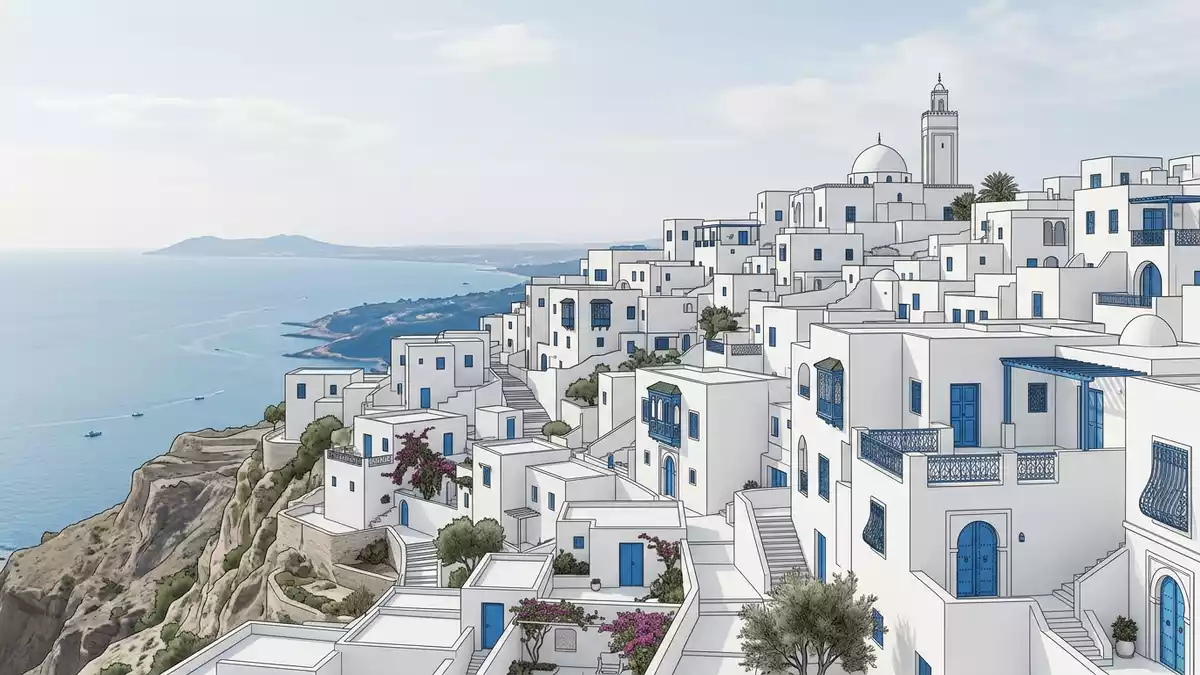
High above the Bay of Tunis, Sidi Bou Said gathers whitewashed houses and cobalt-blue woodwork on a headland that has drawn pilgrims and travellers for centuries. The hilltop village takes its name from the Sufi scholar Abu Said Ibn Khalaf Yahya al-Tamimi al-Beji, whose sanctuary shaped this corner of northern Tunisia in the thirteenth century.Abu Said Ibn Khalaf Yahya al-Tamimi al-Beji
A blue-and-white village on a Tunis headland
Sidi Bou Said stands on a steep promontory overlooking the Bay of Tunis, north-east of central Tunis and close to the archaeological remains of Carthage.a small cliffside village From the upper streets, rooftops fall away towards the water and the land curves round in a long arc of coastline.
The village is laid out as a tight web of cobbled lanes, steps and small squares edged by houses with white walls and vivid blue shutters, doors and wrought-iron grilles.blue and white colouring Many facades carry projecting balconies screened with delicate metal latticework, so that the palette repeats in layers as the alleys climb the hill.
From Sufi sanctuary to protected Arab-Andalusian ensemble
The story of Sidi Bou Said begins with Abu Said Ibn Khalaf Yahya al-Tamimi al-Beji, a Sufi scholar who settled on this hill, then known as Jabal el-Menar, in the twelfth or thirteenth century.settled in this part After his death in 1231, a religious complex with a mosque and mausoleum rose on the summit, and houses gathered around it as the site became a place of pilgrimage.
In the eighteenth century, members of the elite of the Beylik of Tunis built summer residences in Sidi Bou Said, bringing carved stone doorways, internal courtyards and Arab-Andalusian details into the village fabric.wealthy citizens of the Beylik of Tunis The result is a compact townscape where white volumes, blue timber and enclosed gardens sit side by side with the older religious core.
Heritage rules, Ennejma Ezzahra and World Heritage status
In 1915, municipal regulations began to protect the architecture of Sidi Bou Said, fixing the characteristic white walls and blue trim and restricting alterations to building exteriors.protected since 1915 by local ordinance Baron Rodolphe d’Erlanger, a Franco-German painter and musicologist who made his home here, was a prominent figure in shaping these rules and in promoting the unified palette.
D’Erlanger’s residence, the palace of Ennejma Ezzahra, crowns one of the slopes above the sea, with arcaded courtyards, carved stucco and long views along the coast.the palace Ennejma Ezzahra In 2026, Sidi Bou Said was inscribed as a World Heritage Site in its own right, recognised for its Arab-Andalusian architecture, its Sufi heritage and the consistent blue-and-white streetscape overlooking the Mediterranean.inscribed as a World Heritage Site
Visiting Sidi Bou Said: what travellers from Western Europe should know
- Sidi Bou Said stands on a hill above the Bay of Tunis, north-east of central Tunis and close to the archaeological sites of Carthage; trains and roads link the area.
- The village climbs steeply, with stepped lanes and uneven cobbles; moving between the lower streets and the hilltop sanctuary involves sustained walking uphill or downhill.
- Several viewpoints look out over the bay and the coastline; railings or low walls edge many of these terraces but open drops remain visible beyond the built-up area.
- The official language is Arabic and the currency is the Tunisian dinar; French is also widely used in public signage.
- Entry requirements depend on your nationality; UK travellers can check the FCDO travel advice at gov.uk/foreign-travel-advice, Irish travellers the Department of Foreign Affairs at ireland.ie.
Searching for Sidi Bou Said on social platforms
These links open searches for Sidi Bou Said on each platform.
Frequently asked questions about Sidi Bou Said
Where is Sidi Bou Said?
Sidi Bou Said is a hilltop village on a headland above the Bay of Tunis in northern Tunisia, just north-east of Tunis and near the remains of Carthage.
What can visitors expect when walking through the village?
Visitors encounter steep cobbled lanes, white houses with blue woodwork, enclosed courtyards behind heavy doors and vistas that open suddenly towards the sea and the bay.
What makes Sidi Bou Said distinctive among Tunisian coastal settlements?
The village combines a thirteenth-century Sufi shrine, eighteenth-century Arab-Andalusian houses, a codified blue-and-white palette and a clifftop setting recognised through World Heritage inscription.


