
Bonneville Salt Flats and the long white horizon of Wendover
Published on 09/09/2026 at 16:27 | Editorial responsibility: Rafael Müller, Editor-in-Chief AD HOC NEWS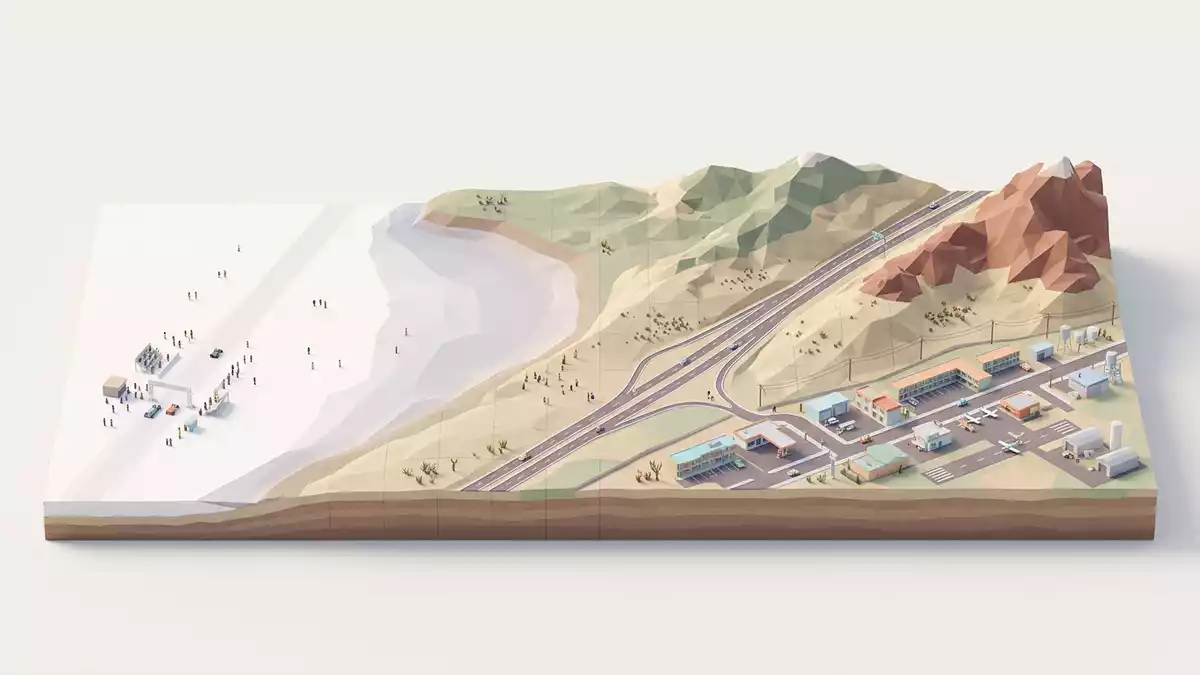
Bonneville Salt Flats west of Wendover in Utah is a broad white salt pan spreading across the Great Salt Lake Desert, a landscape shaped by water, minerals and time. It occupies part of the former floor of ancient Lake Bonneville, giving the flats both their name and their distinctive geology rooted in the Pleistocene epoch.
A dry lakebed turned to salt
The setting of Bonneville Salt Flats is a closed basin in north-western Utah near the border with Nevada, where water flowing in has no outlet except evaporation or seepage into the ground. As Lake Bonneville receded during the last Ice Age, minerals dissolved in its waters began to accumulate on the exposed lakebed, laying down the foundation for the salt crust that defines the flats today.part of the floor of ancient Lake Bonneville Shoreline benches of that former lake can still be seen as terraces on the flanks of the Silver Island Mountains north-west of the flats, tying the brilliant white surface to the surrounding darker rock.
The surface of the flats is built from a crust of halite and other salts, underlain by thick sequences of carbonate muds, gypsum and older sediments within the Wendover Graben, a structural depression in the Great Salt Lake Desert.the Wendover Graben Groundwater beneath the surface carries dissolved salts upward; when shallow water spreads across the pan and evaporates, new layers of salt crystallise, giving the flats their striking uniform colour and texture.
Geology across millennia
Lake Bonneville itself occupied a vast area of western Utah and neighbouring parts of Idaho and Nevada between about 32,000 and 14,000 years ago, filling valleys and basins with deep fresh water. As climate changed and the lake drained away, its sediments and dissolved minerals remained, leaving salt pans and desert basins such as Bonneville Salt Flats and the surrounding Great Salt Lake Desert.Lake Bonneville cycle from about 32,000 to 14,000 years ago Over thousands of years, wind deflation, changing lake levels and evaporite deposition reshaped this basin into the flat, glistening surface recognised today.
Recent geological studies have traced how sediments at Bonneville Salt Flats record a sequence of shallow lakes, erosion of earlier deposits and the later formation of gypsum sand and halite crusts. Radiocarbon analysis of pollen in salt cores places the onset of significant salt accumulation several thousand years after Lake Bonneville vanished, with gypsum deposition around 8,300 to 5,400 years ago and halite forming between roughly 5,400 and 3,500 years ago.radiocarbon analysis of pollen in salt cores The result is a layered record beneath the apparently simple white crust, connecting the flats to wider changes in climate and hydrology across the Great Basin.
From Salduro Marsh to land speed stage
The broad, level surface of Bonneville Salt Flats has made it an enduring stage for high-speed travel. Early in the twentieth century motorists began testing the salt pan as a driving surface, and by 1912 it saw organised use for motor sports, benefiting from long, straight expanses with minimal relief.speed freaks began using the terrain for racing way back in 1912 The area also carries the historical name Salduro Marsh, a reference to the hard, salt-rich ground that underlies the racing courses widely known as Bonneville Speedway.
Bonneville Salt Flats became one of the principal venues for land speed record attempts from the mid-1930s onward, with numerous records in different classes set on its straight courses.principal venue for land speed record attempts On 3 September 1935 Sir Malcolm Campbell established a world land speed record on the flats with his Bluebird car, and in 1970 Gary Gabelich drove the rocket-powered Blue Flame to a record-breaking run exceeding 1,000 km/h. These named drivers and dates form part of the cultural fabric of the place, aligning the flat white landscape with engineering ambition and motor sport history.
Visiting Bonneville Salt Flats: what travellers from Western Europe should know
- Bonneville Salt Flats lies west of Wendover in Utah near the border with Nevada, reached by road across the Great Salt Lake Desert from the direction of Salt Lake City.
- The terrain consists of a wide, flat salt crust with expansive open ground and minimal natural relief, so visitors move across level surfaces without marked gradients but under exposed sky.
- The surrounding area includes the Silver Island Mountains to the north-west, rising above the salt pan and providing a dark rock backdrop to the bright white flats.
- The official language is English and the currency is the US dollar.
- Entry requirements depend on your nationality; UK travellers can check the FCDO travel advice at gov.uk/foreign-travel-advice, Irish travellers the Department of Foreign Affairs at ireland.ie.
Searching for Bonneville Salt Flats on social platforms
These links open searches for Bonneville Salt Flats on each platform.
Frequently asked questions about Bonneville Salt Flats
Where are Bonneville Salt Flats located?
Bonneville Salt Flats lie in Tooele County in north-western Utah near Wendover, close to the Nevada border and within the western part of the Great Salt Lake Desert.
What should visitors expect when they arrive?
Visitors encounter a wide white salt crust stretching toward distant mountain ranges, with level ground underfoot, open skies and minimal vegetation across the pan itself.
What makes Bonneville Salt Flats distinctive among desert landscapes?
The combination of a bright halite surface on the former bed of Lake Bonneville, thick underlying evaporite deposits and its long association with land speed record racing gives the flats a character closely tied to both geology and motor sport history.


