
Brandenburger Tor, a neoclassical gateway in Berlin
Published on 08/22/2026 at 22:26 | Editorial responsibility: Rafael Müller, Editor-in-Chief AD HOC NEWS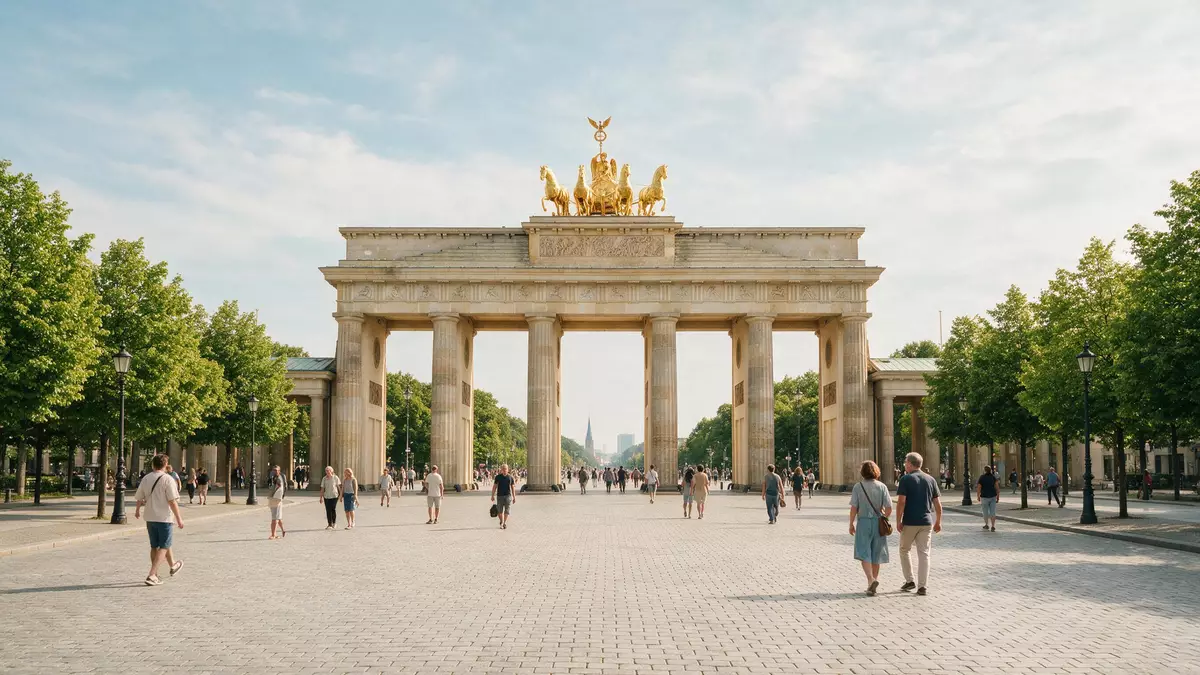
Brandenburger Tor in Berlin is an eighteenth-century neoclassical city gate, designed by Carl Gotthard Langhans for Prussian king Frederick William II between 1788 and 1791. Standing at Pariser Platz at the western end of Unter den Linden, the sandstone gateway has become a lasting architectural symbol of Germany’s capital.
A classical city gate at Unter den Linden
Brandenburger Tor marks the transition from Unter den Linden, Berlin’s grand boulevard, to the former route towards Brandenburg an der Havel. The gate occupies the western edge of Pariser Platz, forming a monumental end to the straight, tree-lined avenue that leads towards the former royal palace. The setting ties the structure to the ceremonial axis of Berlin, with the gate acting as a threshold between the historic centre and the space beyond the old customs wall.Pariser Platz axis
Designed in a neoclassical idiom, the gate was inspired by the Propylaea, the monumental entrance to the Athenian Acropolis. Langhans translated this Greek reference into a sandstone screen facing the boulevard, using classical proportions and details that signalled the adoption of Greek Revival architecture in late eighteenth-century Prussia. The gate’s role as the main western entrance into the city, aligned with Unter den Linden, reflects its status as the most representative of Berlin’s former city gates.Greek-inspired neoclassical design
Doric colonnade and five passages
The central element of Brandenburger Tor is a colonnade of twelve Doric columns, arranged in two parallel rows. These columns create five passages through the gate, with the central route historically reserved for royal use. The proportions of the colonnade follow ancient models, with fluted shafts and simple capitals supporting a substantial entablature and attic. Together, the vertical rhythm of the columns and the horizontal lines of the entablature give the structure a disciplined, regular appearance.twelve Doric columns
The gate measures roughly 26 m (85 ft) in height, around 65 m (213 ft) in width and about 11 m (36 ft) in depth. Its sandstone construction lends a pale, warm tone that contrasts with the darker paving and surrounding façades around Pariser Platz. Reliefs and sculptural panels designed by Johann Gottfried Schadow decorate the entablature and attic, with mythological themes drawn from the exploits of Heracles and other classical figures. These carvings introduce fine detail into the otherwise restrained massing, rewarding close viewing along the façades and within the passages.dimensions and sculptural reliefs
The Quadriga and flanking buildings
Above the attic of Brandenburger Tor stands the Quadriga, a bronze sculpture of a four-horse chariot created in 1793 by Johann Gottfried Schadow. The chariot, driven by a female figure, crowns the flat roof of the gate and is one of the most recognisable elements of the ensemble. The sculpture’s silhouette is visible from points along Unter den Linden and from the adjoining open space beyond the gate, adding a distinct upper profile to the otherwise rectilinear form.Quadriga by Schadow
The gate is accompanied by lower buildings to either side, forming a wider architectural ensemble at Pariser Platz. These flank structures frame the central colonnade and help define the square’s edges, giving Brandenburger Tor a breadth that extends beyond the main passageways. Together, the gate, the flanking buildings and the open square establish a carefully composed urban space, with the neoclassical architecture of the gate acting as the visual anchor for the eastern end of the former city boundary.ensemble at Pariser Platz
Visiting Brandenburger Tor: what travellers from Western Europe should know
- Brandenburger Tor stands at Pariser Platz on the western end of Unter den Linden in central Berlin, close to the Reichstag and the Tiergarten.
- The gate spans a broad paved square with level ground; the approach from Unter den Linden and the open space beyond involves urban pavements without significant gradients.
- Brandenburger Tor is integrated into a dense city setting, with major streets, government buildings and memorials within walking distance in the surrounding Mitte district.
- The official language is German and the currency is the euro.
Searching for Brandenburger Tor on social platforms
These links open searches for Brandenburger Tor on each platform.
Frequently asked questions about Brandenburger Tor
Where is Brandenburger Tor located in Berlin?
Brandenburger Tor stands at Pariser Platz in the Mitte district of Berlin, aligned with the western end of Unter den Linden.
What can visitors expect when they reach the gate?
Visitors encounter a large neoclassical sandstone gateway with a Doric colonnade, crowned by the Quadriga sculpture and framed by an open urban square.
What makes Brandenburger Tor distinctive among city gates?
Its combination of Greek-inspired neoclassical design, twelve-column colonnade, five passages and the prominent Quadriga gives Brandenburger Tor a distinctive architectural character.


