
Brandenburger Tor and Berlin’s neoclassical city gate
Published on 08/17/2026 at 13:39 | Editorial responsibility: Rafael Müller, Editor-in-Chief AD HOC NEWS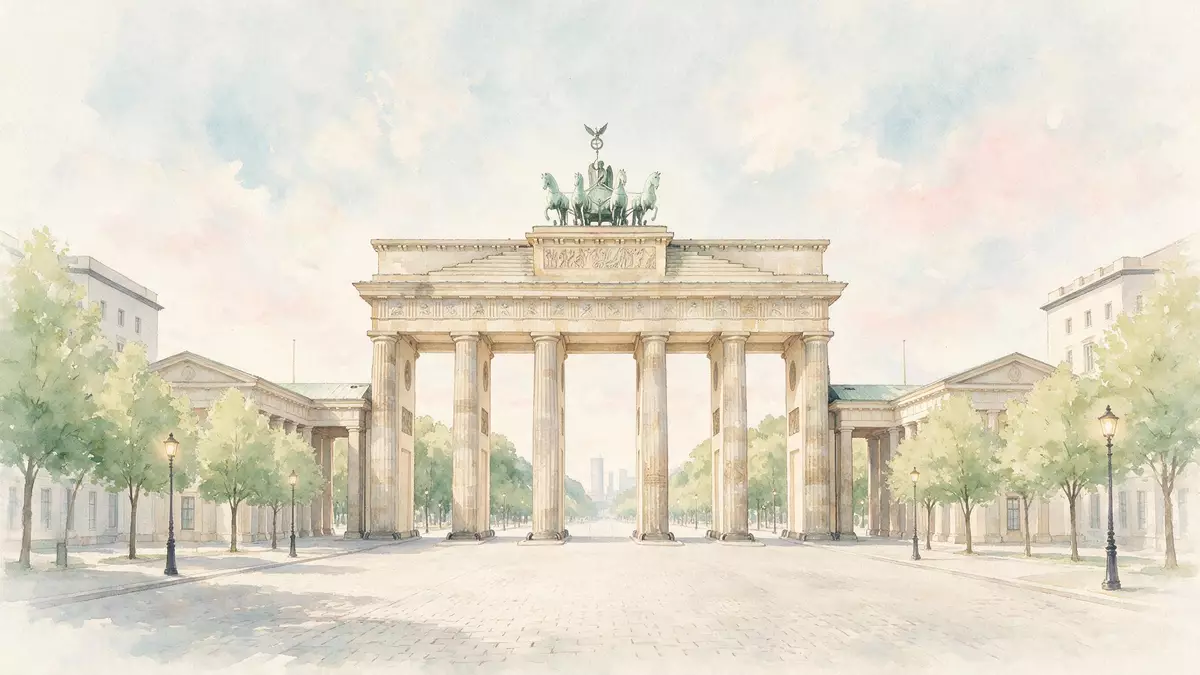
Brandenburger Tor is Berlin’s best-known city gate, a neoclassical sandstone structure at Pariser Platz. Built for Friedrich Wilhelm II in the late eighteenth century, it remains a defining feature of the city centre.
Neoclassical stone at Pariser Platz
The gate stands in the western part of Berlin’s centre, where Unter den Linden meets the open space of Pariser Platz. Its design belongs to the Berlin version of neoclassicism, with a broad central passage and balanced side bays.
The building was completed in 1791 after work began in the 1780s. Carl Gotthard Langhans is the architect most closely associated with it, and the gate’s restrained stone forms remain its clearest visual feature.
Above the columns stands the Quadriga, the sculptural group that became part of the gate’s identity in the nineteenth century. The whole composition reads as a ceremonial entrance rather than a mere opening in a wall.
A gate shaped by Prussian power
Friedrich Wilhelm II commissioned the monument as a formal city gate for the Prussian capital. That link to court architecture places it within a wider political landscape of late eighteenth-century Berlin, where monumental building helped present state power in stone.
The gate’s location at the end of Unter den Linden gives it a strong axial presence, and that boulevard remains one of the city’s most prominent historic routes. visitBerlin identifies it as the surviving city gate of Berlin, a status that helps explain its central place in the city’s historic landscape.
The same monument later became associated with the Napoleonic era, the Cold War and German reunification. Those layers sit on top of the original stone structure and give the gate a historical density that few Berlin landmarks match.
From division to public square
Brandenburger Tor stood near the line of the Berlin Wall for much of the second half of the twentieth century. Its image as a closed frontier was replaced by a ceremonial urban landmark after German reunification.
The open space around it, including Pariser Platz and the nearby axis of Unter den Linden, lets the gate read as both architecture and urban threshold. The contrast between the classical monument and the surrounding public realm is part of its enduring appeal.
A later restoration returned the stonework and sculpture to a sharper visual state, while the monument kept its original profile and proportions. The result is a gate that still works as a city entrance, a memorial surface and a focal point for Berlin’s central streets.
Visiting Brandenburger Tor: what travellers from Western Europe should know
- Brandenburger Tor stands on Pariser Platz in Berlin-Mitte, close to Unter den Linden and Berlin Brandenburger Tor station. The U-Bahn and S-Bahn network both serve the surrounding area.
- The monument is a stone city gate, so the main experience is walking around its exterior and viewing the Quadriga above the columns. The ground around Pariser Platz is level and paved.
- The official language is German and the currency is the euro.
- Nearby landmarks include the Reichstag, the Tiergarten and the boulevard Unter den Linden.
Searching for Brandenburger Tor on social platforms
These links open searches for Brandenburger Tor on each platform.
Frequently asked questions about Brandenburger Tor
Where is Brandenburger Tor?
It stands in Berlin-Mitte at Pariser Platz, at the end of Unter den Linden. The gate sits within the historic heart of the German capital.
What does a visit involve?
The experience centres on the exterior: the sandstone elevation, the colonnades and the Quadriga above the top. The surrounding square gives room to see the monument from several angles.
What makes Brandenburger Tor distinctive?
Its combination of neoclassical form, Prussian history and later association with division gives it an unusually layered presence. The gate remains both a building and a symbol embedded in Berlin’s streetscape.


