
Brandenburger Tor, the neoclassical city gate of Berlin
Published on 08/18/2026 at 14:51 | Editorial responsibility: Rafael Müller, Editor-in-Chief AD HOC NEWS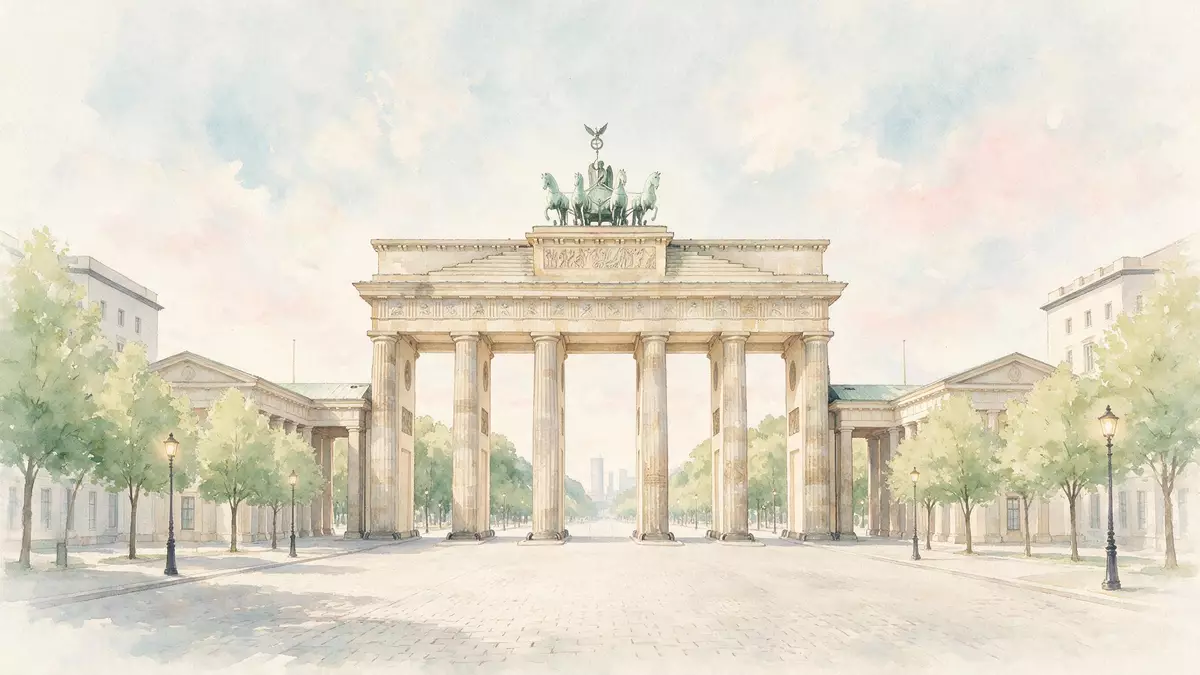
Brandenburger Tor is the grand neoclassical city gate that closes the boulevard Unter den Linden at Pariser Platz in Berlin, a sandstone monument dating from the late eighteenth century.Sandstone gate at Unter den Linden Commissioned by King Frederick William II of Prussia and designed by the court architect Carl Gotthard Langhans, it has become one of Germany’s best known symbols.Commissioned by Frederick William II
A classical gate inspired by ancient Athens
The present Brandenburger Tor was built between 1788 and 1791, replacing an earlier gate on the western edge of Berlin’s customs wall.Built between 1788 and 1791 Langhans drew heavily on the Propylaea of the Athenian Acropolis, translating its classical forms into what became one of the earliest neoclassical buildings in Prussia.Inspired by the Propylaea The gate forms a monumental termination to Unter den Linden, the tree-lined avenue that leads east towards the former royal palace.
The structure rises to around 26 m (85 ft), stretching about 65 m (213 ft) across Pariser Platz and extending roughly 11 m (36 ft) in depth.Dimensions of the gate Twelve Doric columns stand in two rows, creating five passageways through the gate, with the central route historically reserved for royal use.Twelve Doric columns The architecture is severe and ordered, with fluted shafts, simple capitals and a heavy entablature carrying reliefs and inscriptions.
The Quadriga and sculptural detail
Above the sandstone mass of Brandenburger Tor stands the bronze Quadriga, a chariot drawn by four horses, added in 1793 and designed by sculptor Johann Gottfried Schadow.Quadriga by Schadow The chariot is driven by a winged figure holding a staff, facing into the city along Unter den Linden. From Pariser Platz the composition gives the gate a vertical accent, rising above the strictly horizontal lines of the colonnade.
The gate’s sculptural programme extends across its friezes and reliefs, where allegorical figures and military trophies occupy panels between the triglyphs and metopes.Sculptural programme Inside the passageways, smaller reliefs and decorative elements line the side walls, softening the severe geometry of the stone. These details reward slow looking, contrasting with the broad, planar surfaces that dominate the gate’s silhouette.
Brandenburger Tor in the city and in history
Brandenburger Tor stands on the west side of the square known as Pariser Platz, marking the end of Unter den Linden and the transition towards the Tiergarten park and the Reichstag district.West side of Pariser Platz Its position made it the most prominent gate of Berlin’s historic wall, guiding the ceremonial route from the city towards the lands of Brandenburg and beyond. The gate’s role as an entrance and threshold has given it enduring symbolic weight, reinforced by the major events of the nineteenth and twentieth centuries that played out around it.
During the period of Germany’s division, Brandenburger Tor stood directly by the line of the Berlin Wall, inaccessible from both sides and surrounded by border installations.Position by the Berlin Wall After the fall of the Wall in 1989, the gate came to embody the idea of German reunification, turning from a symbol of separation into a focal point for shared civic space.Symbol of division and reunification Its continued presence at the meeting point of major streets and institutions keeps it central to both Berlin’s geography and Germany’s public life.
Visiting Brandenburger Tor: what travellers from Western Europe should know
- Brandenburger Tor stands on Pariser Platz at the western end of Unter den Linden in central Berlin, close to the Reichstag and the Tiergarten district.
- The gate is set in a broad paved square, with level surfaces around the monument and wide approaches suitable for walking.
- The official language is German and the currency is the euro.
Searching for Brandenburger Tor on social platforms
These links open searches for Brandenburger Tor on each platform.
Frequently asked questions about Brandenburger Tor
Where is Brandenburger Tor located in Berlin?
Brandenburger Tor stands on Pariser Platz at the western end of Unter den Linden, close to the Reichstag and the edge of the Tiergarten park.
What should visitors expect when they come to Brandenburger Tor?
Visitors encounter a large neoclassical sandstone gate with multiple passageways, framed by a wide paved square and major streets converging around the monument.
What makes Brandenburger Tor distinctive among city gates?
Its combination of Doric colonnades, the bronze Quadriga, eighteenth-century neoclassical design and a central role in German history distinguishes Brandenburger Tor from other gates.


