
Bulguksa and the stone terraces of Silla
Published on 08/24/2026 at 06:17 | Editorial responsibility: Rafael Müller, Editor-in-Chief AD HOC NEWS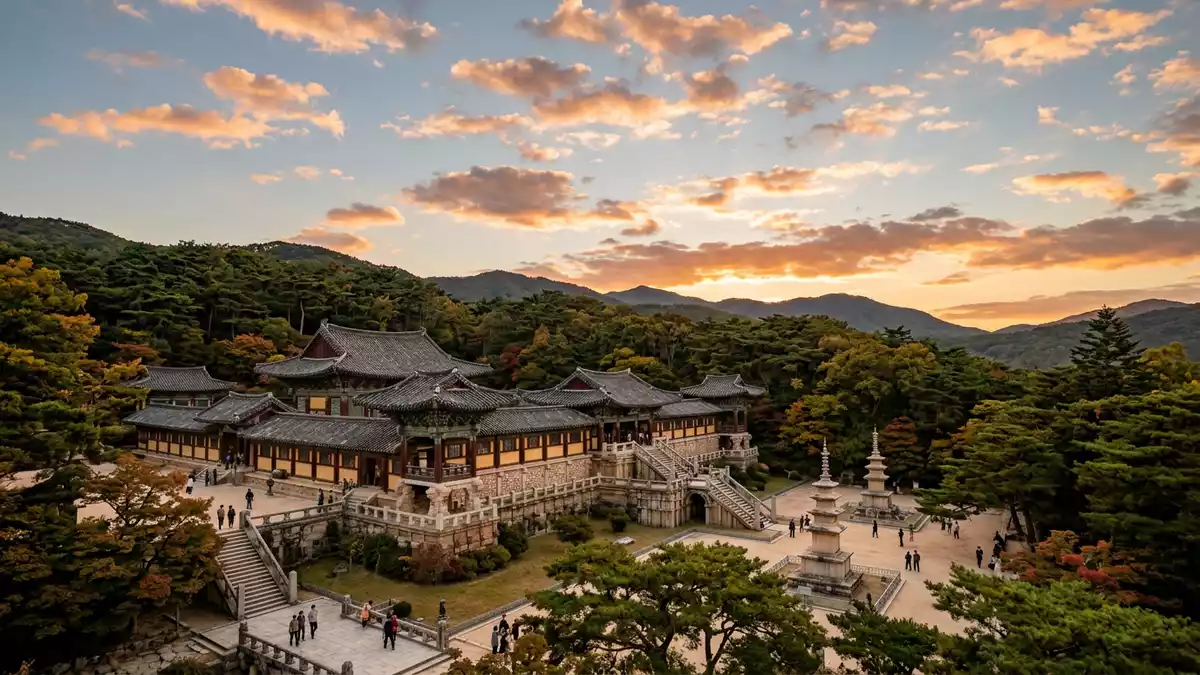
Bulguksa in Gyeongju is a Silla temple complex where wooden halls stand above stone terraces and bridges. The ensemble belongs to the 8th century and forms part of the Seokguram Grotto and Bulguksa Temple World Heritage property.
Stone terraces beneath wooden halls
The temple presents layered platforms, stairways and pavilions rather than a single enclosed hall. Its grounds include the paired stone pagodas Dabotap and Seokgatap, which face the main hall and give the complex a strong stone-and-timber contrast.
The UNESCO description places Bulguksa among the religious monuments of the Silla capital, with the temple complex built in 774 and associated with the wider Buddhist landscape of Gyeongju. That date, together with the name of Kim Dae-seong, anchors the site in a specific historical setting.
Kim Dae-seong and the Silla court
Traditional accounts connect the temple with Kim Dae-seong, a chief minister of Silla. The historical record at the temple site also points to repeated rebuilding, which is part of what gives Bulguksa its layered character.
The present temple preserves a combination of stone terraces, bridges and halls that reflects a major phase of Silla religious architecture. UNESCO characterises the property as an outstanding example of Buddhist architecture from the eighth century in Gyeongju, then the capital of the kingdom.
Pagodas, bridges and shrine halls
The most recognisable features are the stone pagodas and the stairways that rise to the main compound. The temple also includes named halls such as Daeungjeon, Geungnakjeon and Birojeon, which organise the space into distinct devotional areas.
Those elements make Bulguksa feel architectural rather than monumental in the grand palace sense. The balance of timber, stone and open courtyards gives the site a measured rhythm that remains tied to Silla-period temple design.
Visiting Bulguksa: what travellers from Western Europe should know
- The temple lies in Gyeongju, in South Korea, and is approached through the city’s eastern side towards Mount Toham. Local buses and taxi routes connect the urban centre with the temple area.
- The site includes stone steps, terraces and inclined approaches. The layout moves between raised courts and wooden buildings.
- English is not an official language, and the currency is the South Korean won.
- Entry requirements depend on your nationality; UK travellers can check the FCDO travel advice at gov.uk/foreign-travel-advice, Irish travellers the Department of Foreign Affairs at ireland.ie.
Searching for Bulguksa on social platforms
These links open searches for Bulguksa on each platform.
Frequently asked questions about Bulguksa
Where is Bulguksa?
Bulguksa is in Gyeongju, in South Korea, on the slopes connected with Mount Toham. It belongs to the UNESCO-listed religious landscape shared with Seokguram Grotto.
What does a visit involve?
Visitors move through stone terraces, stairways and wooden halls spread across a sloping compound. The setting is architectural and layered, rather than a single compact building.
What makes Bulguksa distinctive?
The temple combines Silla-period stonework with wooden halls in a single complex. Its linked pagodas, terraces and named halls give it a clear historical identity.


