
Burj Khalifa: a vertical city of glass and concrete in Dubai
Published on 08/24/2026 at 09:47 | Editorial responsibility: Rafael Müller, Editor-in-Chief AD HOC NEWS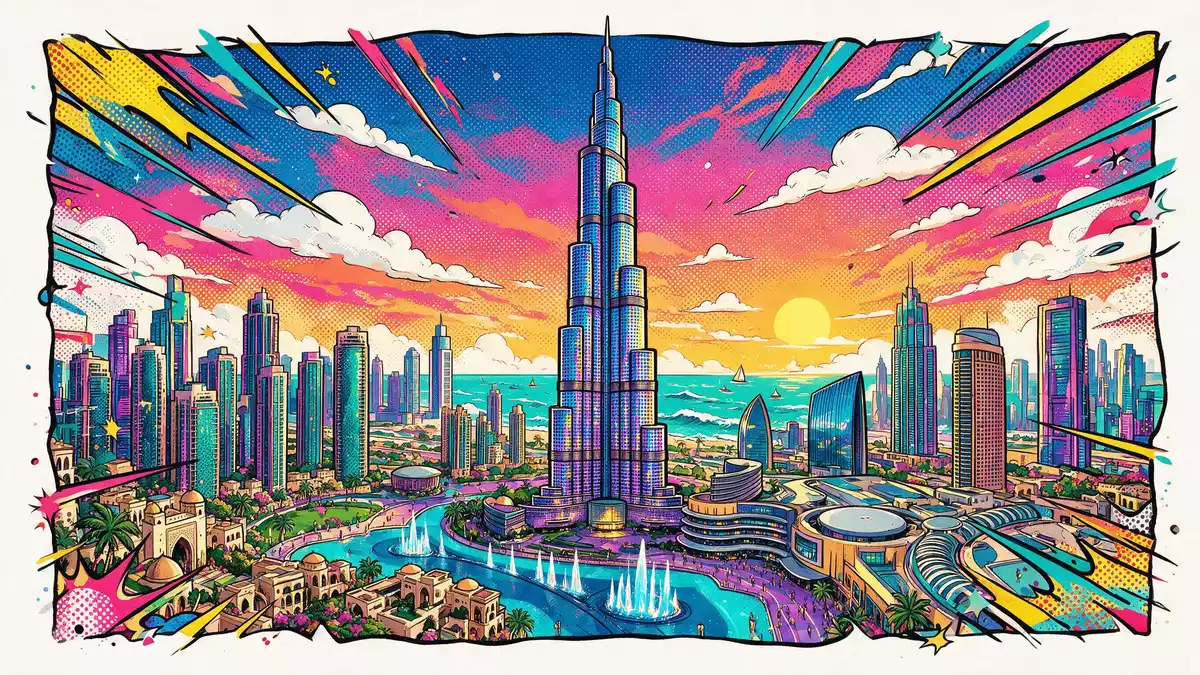
Burj Khalifa is the centrepiece of Dubai’s skyline, an ultra-tall skyscraper that rises 828 m (2,717 ft) above the city and desert and reshapes what a tower can be. Designed by Adrian Smith of Skidmore, Owings & Merrill and completed in 2010, it brings the scale of a vertical city into one tapering shaft of concrete and glass.
A tower built from a buttressed concrete core
The underlying structure of Burj Khalifa is a buttressed core system, a configuration developed by Skidmore, Owings & Merrill to carry great height with stability.Burj Khalifa’s structural design At its centre sits a hexagonal reinforced-concrete core that provides stiffness against twisting, with three wings of floor plates stepping outwards in a Y-shaped plan and tapering as they rise.central hexagonal reinforced-concrete core This geometry spreads the building’s weight and wind forces into the ground while keeping the occupied floors arranged around a central spine.
The tower’s superstructure is built largely of high-performance reinforced concrete, a material choice that gives mass and rigidity to the shaft.superstructure and height Below ground, a 3.7 m (12 ft) thick reinforced-concrete raft distributes loads into bored piles sunk deep into Dubai’s soil.reinforced concrete mat The structural steel spire completes the final portion of the height, extending the tower’s silhouette into the sky while resting on the concrete core beneath.steel spire and structural system
Glass, aluminium and stainless steel wrapping a vertical city
From the outside, Burj Khalifa reads as a column of glass catching the intense Gulf light, but the façade is a complex assembly of materials rather than a single smooth skin. The exterior is clad in double-layer glass panels set within aluminium frames, combined with textured stainless-steel spandrel elements and vertical fins that pick out the lines of the tower.double-layer glass and aluminium frames Tens of thousands of glass panels were cut and installed to follow the tapered, stepping profile without breaking the visual continuity of the shaft.glass panels and cladding
Behind this façade lies a stack of occupiable floors that has been compared to a compact city, with residences, offices, a hotel and lounges occupying different bands of height.mixed-use skyscraper The building reaches 163 occupied levels, making vertical circulation a central feature of daily life for those who use it.163 floors Elevators rise through the concrete core, connecting lobby floors at the base with observation areas and upper lounges, while the stepped wings give many interior spaces outward views across Dubai and towards the Gulf.
Height records and observation decks above Dubai
Burj Khalifa’s architectural height of 828 m (2,717 ft) has been recognised as the world’s tallest building since its opening on 4 January 2010, a record certified by Guinness World Records.tallest building in the world Construction began in 2004, with the final height revealed at the inauguration ceremony in 2010 when the tower was named Burj Khalifa in honour of Khalifa bin Zayed Al Nahyan.opening and naming in 2010 The building extends its record through related measures such as highest occupied floor and a very high outdoor observation deck, emphasising its role as a vantage point over the city.highest occupied floor and outdoor deck
Observation spaces inside the tower include levels marketed under names such as “At the Top” and a lounge set around 585 m above ground, giving visitors structured access to its height.world’s highest lounge From these levels, the stepped geometry of the wings and the surrounding developments can be seen from above, including the artificial lake and neighbouring towers at the base. The contrast between the tower’s vertical reach and the horizontal spread of Dubai’s urban fabric becomes clear when looking outwards from these decks.
Visiting Burj Khalifa: what travellers from Western Europe should know
- Burj Khalifa stands in central Dubai, within the Downtown Dubai district, with road access from major city arteries and nearby links to the Dubai Metro rapid-transit system.
- The base of the tower meets an urban landscape of pavements, plazas and steps, and visiting the observation levels involves using lifts from indoor entrance areas.
- The surrounding area includes an artificial lake and neighbouring high-rise structures, so viewpoints on and around the tower look across water features and other tall buildings.
- The United Arab Emirates is outside the UK, Ireland and the EU. Entry requirements depend on your nationality; UK travellers can check the FCDO travel advice at gov.uk/foreign-travel-advice, Irish travellers the Department of Foreign Affairs at ireland.ie.
Searching for Burj Khalifa on social platforms
These links open searches for Burj Khalifa on each platform.
Frequently asked questions about Burj Khalifa
Where is Burj Khalifa located?
Burj Khalifa stands in Dubai in the United Arab Emirates, within the Downtown Dubai district that has grown around its base.
What can visitors expect on a visit to Burj Khalifa?
Visitors encounter a mixed-use skyscraper with entrance areas leading to lifts and observation levels, where views extend across Dubai’s towers, roads and the surrounding desert.
What makes Burj Khalifa distinctive among tall buildings?
Its 828 m height, buttressed concrete core and glass-clad, tapering form give Burj Khalifa a combination of scale and structural ambition that defines Dubai’s skyline.


