
Burj Khalifa and the architecture of vertical scale
Published on 09/22/2026 at 20:24 | Editorial responsibility: Rafael Müller, Editor-in-Chief AD HOC NEWS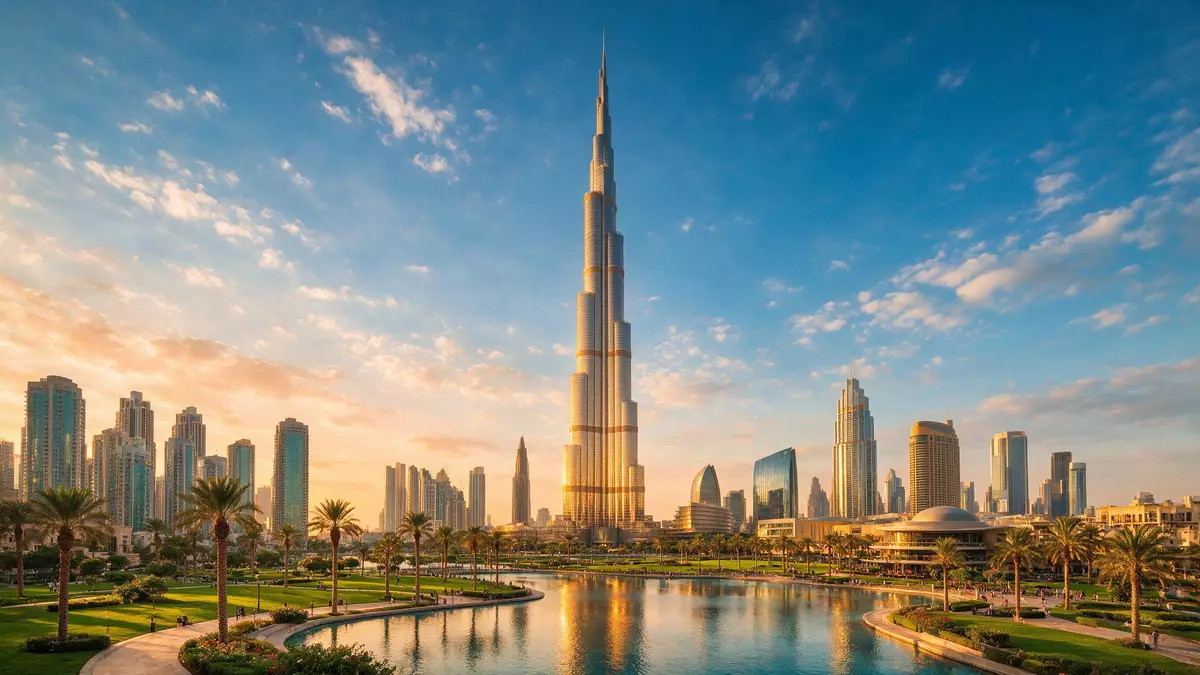
Burj Khalifa rises above Dubai as a slender composition of concrete, glass and steel. Its height is 828 m (2,717 ft) to the architectural summit, while the spire extends the full structure to 829.8 m (2,722 ft). The tower opened on 4 January 2010, giving Dubai a building whose scale remains inseparable from its design.
A tower measured in hundreds of metres
The tower has 163 floors and combines residences, hotel accommodation, offices, restaurants and observation spaces. Its mixed-use programme places several kinds of urban life within one vertical structure.
Burj Khalifa’s height is read through its tapering outline. The lower mass rises from a broad base, then narrows through a series of setbacks before reaching the spire. The visible composition is not a simple rectangular shaft, but a stepped profile that changes as the tower climbs.
Adrian Smith and SOM’s vertical composition
Skidmore, Owings & Merrill designed Burj Khalifa, with Adrian Smith serving as architect and William F. Baker as structural engineer. The Chicago-based practice completed the design during the first decade of the twenty-first century.
Reinforced concrete forms the main structure. The exterior combines glass and aluminium with vertical fins, producing a surface that changes from reflective planes to narrow lines when seen from different angles. The façade belongs to a period of skyscraper design that joined advanced engineering with a strong sculptural profile.
Construction began in January 2004, the exterior was completed in 2009, and the tower formally opened in 2010. These dates place the building within Dubai’s rapid urban expansion at the beginning of the twenty-first century.
Inside Dubai’s vertical city
Burj Khalifa is part of Downtown Dubai, where the tower stands beside a large artificial lake and the Dubai Mall. Its surroundings combine public promenades, commercial interiors, landscaped spaces and high-rise buildings.
The interior is divided between different forms of occupation. The Armani Hotel occupies lower levels, residences extend through designated sections, and office floors provide working space. Observation decks occupy elevated levels, while restaurants and lounges add public uses within the tower.
The building’s central role in Dubai’s skyline is also architectural. From ground level, the tower appears as a sequence of receding surfaces. From a distance, the spire provides a narrow vertical finish above the main body, extending the building’s visual line into the sky.
Visiting Burj Khalifa: what travellers from Western Europe should know
- Burj Khalifa stands in Downtown Dubai, beside Dubai Mall and the Dubai Fountain. The Dubai Metro Red Line serves the area through Burj Khalifa/Dubai Mall station.
- The building is an urban high-rise complex rather than a single open-air monument. A visit involves lifts, enclosed interiors and observation areas at elevated levels.
- Dubai’s official language is Arabic, and the currency is the UAE dirham. English is used extensively in tourism and commercial areas.
- Entry requirements depend on your nationality; UK travellers can check the FCDO travel advice at gov.uk/foreign-travel-advice, Irish travellers the Department of Foreign Affairs at ireland.ie.
Searching for Burj Khalifa on social platforms
These links open searches for Burj Khalifa on each platform.Frequently asked questions about Burj Khalifa
Where is Burj Khalifa?
Burj Khalifa is in Downtown Dubai, United Arab Emirates, beside Dubai Mall and the Dubai Fountain. The district forms part of central Dubai’s high-rise urban area.
What can visitors expect inside Burj Khalifa?
The tower contains hotel, residential, office, restaurant and observation spaces. Visitors enter an enclosed vertical complex with lifts and elevated viewing areas.
What makes Burj Khalifa distinctive?
Its defining feature is its scale: the tower reaches 828 m (2,717 ft) to the architectural summit. Adrian Smith and Skidmore, Owings & Merrill combined that height with a tapering concrete, glass and aluminium composition.


