
Burj Khalifa and the vertical city in the desert
Published on 09/08/2026 at 22:05 | Editorial responsibility: Rafael Müller, Editor-in-Chief AD HOC NEWS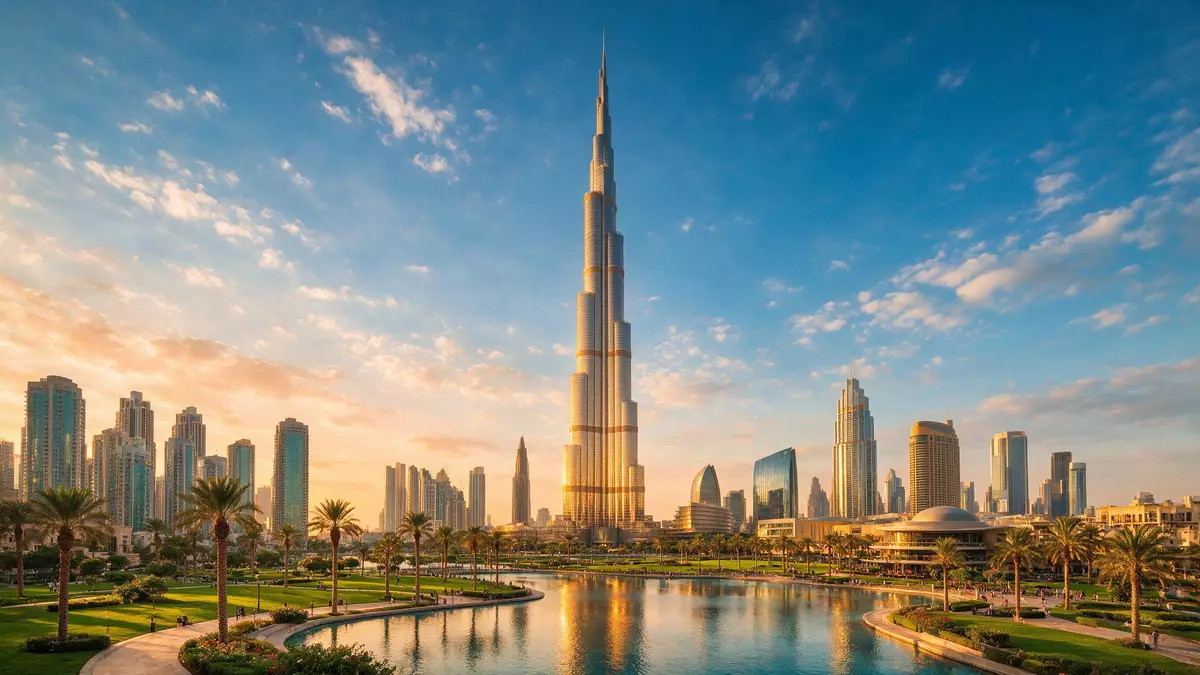
Burj Khalifa is a supertall skyscraper in Dubai that turns the idea of a city into a single, tapering tower, stacking homes, offices and hotels into one vertical silhouette. Rising to an architectural height of 828 m (2,717 ft), it has defined the skyline of the United Arab Emirates since its completion in 2010 and stands as a benchmark of contemporary high-rise engineering.height of 828 m
A desert tower shaped by stacked setbacks
Burj Khalifa stands in Downtown Dubai, just off Sheikh Zayed Road, where the desert meets a dense cluster of new towers and malls.Downtown Dubai The building’s overall form narrows in stages as it rises, using a series of setbacks that give the tower a stepped, spiralling profile when seen from a distance. This geometry creates a tall central shaft surrounded by projecting wings, producing a changing outline as the viewer moves around its base.
The tower’s structure and architecture were led by Skidmore, Owings & Merrill, with Adrian Smith as chief architect and William F. Baker as chief structural engineer, bringing American skyscraper expertise into the Gulf.Adrian Smith and William F. Baker Construction began in 2004, and the exterior was completed in 2009, before the official opening on 4 January 2010.built between 2004 and 2009 Clad in reflective glass and metal panels, the façades catch the strong Gulf light, emphasising the tower’s vertical lines and making its changing tiers visible from long distances across the flat surroundings.
Living, working and staying inside the world’s tallest building
Burj Khalifa is more than a single-use office tower; it combines residential apartments, corporate offices and hospitality spaces in one structure, forming a vertical neighbourhood that extends across more than 160 floors.163 floors and mixed uses Lower levels are occupied by a hotel, with branded hospitality opening directly onto the podium and landscaped areas of Downtown Dubai. Above these, tiers of apartments rise with increasing views over the city, while offices occupy other sections, turning the building into a place where people live and work within the same envelope.
Observation areas are located high in the tower, giving wide views across Dubai’s highway grid, the desert beyond and the Gulf shoreline. One deck sits on level 124, and higher viewing spaces have been added above, each reached by high-speed lifts that travel through the tower’s concrete and steel spine.observation decks high in the tower These viewing levels emphasise the sense of Burj Khalifa as a stacked city: from the ground, the tower’s wings frame plazas and water features, while from above, the same wings are part of a broad panorama over Downtown Dubai and neighbouring districts.
Burj Khalifa’s place in global skyscraper history
With its full height measured at 828 m (2,717 ft) to the architectural tip and slightly higher when including all equipment, Burj Khalifa has held the record as the tallest building in the world since 2010.tallest building in the world It surpassed Taipei 101 during construction, extending the scale of what a single occupied tower could be and setting new standards for high-rise design. The project was developed by Emaar Properties, a Dubai-based company responsible for much of the Downtown Dubai district, tying the skyscraper into a larger urban plan of malls, residential blocks and promenades.developed by Emaar Properties
The tower’s engineering involves a high-performance concrete core with wings that buttress the central spine, a system designed to handle the forces generated at great height.structural core and buttressed wings This approach has influenced later supertall designs around the world, making Burj Khalifa an important reference point in discussions of skyscraper form and stability. Its neofuturist style, combining strong vertical emphasis with flowing setbacks, places it within a global tradition of expressive high-rise architecture while grounding it firmly in the context of Dubai’s rapid expansion in the early twenty-first century.neofuturist skyscraper in Dubai
Visiting Burj Khalifa: what travellers from Western Europe should know
- Burj Khalifa stands in Downtown Dubai in the United Arab Emirates, close to Sheikh Zayed Road and adjacent to Dubai Mall, a large shopping and leisure complex.
- The immediate surroundings are urban and level, but reaching higher viewing areas involves travelling by lift and moving through indoor spaces across several floors.
- The official language is Arabic and the currency is the United Arab Emirates dirham.
- Entry requirements depend on your nationality; UK travellers can check the FCDO travel advice at gov.uk/foreign-travel-advice, Irish travellers the Department of Foreign Affairs at ireland.ie.
Searching for Burj Khalifa on social platforms
These links open searches for Burj Khalifa on each platform.
Frequently asked questions about Burj Khalifa
Where is Burj Khalifa located?
Burj Khalifa stands in Downtown Dubai in the United Arab Emirates, near Sheikh Zayed Road and alongside Dubai Mall within a planned high-rise district.
What can visitors expect inside Burj Khalifa?
Visitors encounter a mix of hotel spaces, apartments, offices and high-level observation decks reached by lifts, with interior routes passing through polished lobbies and circulation areas.
What makes Burj Khalifa distinctive among skyscrapers?
Its 828 m height, stacked setback form and role as a mixed-use vertical city give Burj Khalifa a singular presence in global high-rise architecture and in Dubai’s urban landscape.


