
Butchart Gardens in Brentwood Bay’s transformed quarry
Published on 09/10/2026 at 12:54 | Editorial responsibility: Rafael Müller, Editor-in-Chief AD HOC NEWS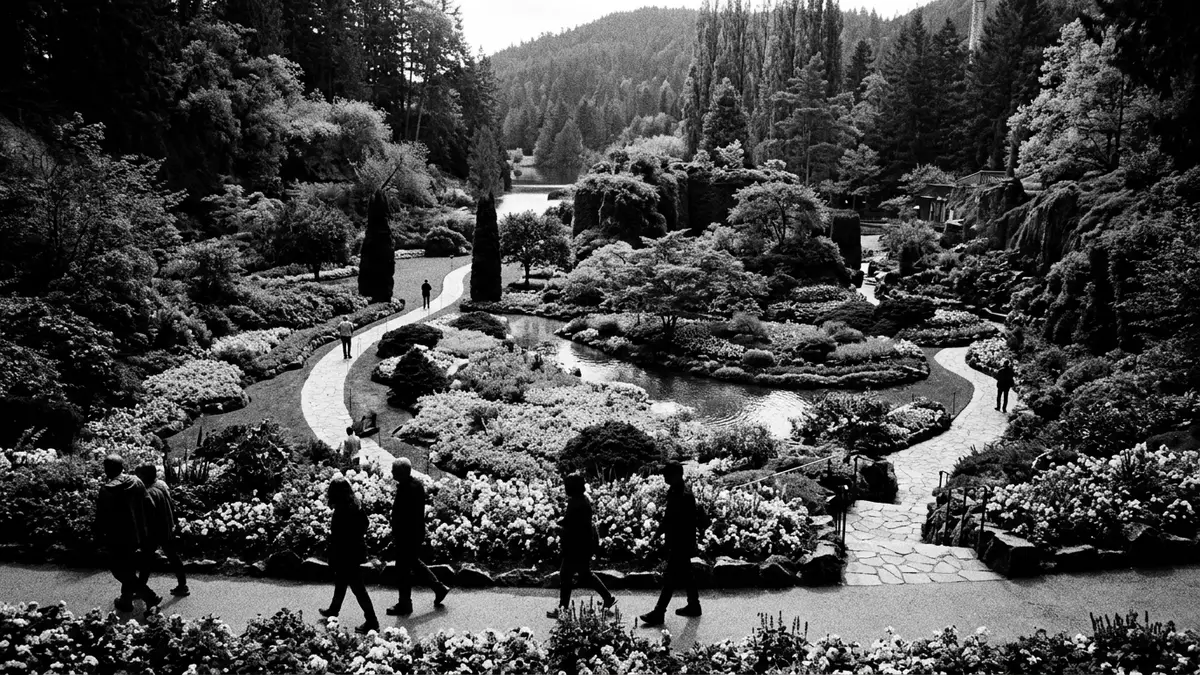
On the wooded shore of Brentwood Bay on Vancouver Island, Butchart Gardens turns a former limestone quarry into a sequence of carefully composed landscapes that unfold across an extensive coastal estate. The garden complex grew around the home of industrialist Robert Pim Butchart and his wife Jennie in the early twentieth century, and in 2004 it was recognised as a National Historic Site of Canada for the way that transformation reshaped an industrial site into a celebrated ornamental garden.National Historic Site of Canada
From limestone quarry to Sunken Garden
Butchart Gardens occupies land beside Tod Inlet where Robert Pim Butchart established a cement works at the start of the twentieth century, using a limestone deposit to feed his Vancouver Portland Cement Company.Vancouver Portland Cement Company As rock was taken out for cement production, the quarry walls rose around a deep pit, leaving a steep-sided hollow close to the house that demanded a new use once the limestone was exhausted.
Jennie Butchart began reshaping this quarry in the decade after 1904, laying out paths and planting shrubs and trees on the exposed faces so that the industrial void became a garden floor framed by stone. By 1921 the resulting Sunken Garden had taken on its present role as one of the central features of the estate, with lawns, flower beds and mature trees arranged below surrounding viewpoints.Sunken Garden completed in 1921 Near one end of this garden a lookout on a rock outcrop gives a view over the patterns of planting and towards the Ross Fountain, a mid?twentieth?century water feature introduced by Jennie and Robert’s grandson Ian Ross in 1964 to mark the sixtieth anniversary of the gardens.Ross Fountain installed in 1964
Japanese, Italian and Rose Gardens around the house
Beyond the former quarry floor, Butchart Gardens extends across the wider estate in a series of themed gardens that reflect different strands of early twentieth?century landscape design. In 1906 Jennie Butchart laid out a Japanese Garden on the seaside section of the property and later worked with Japanese landscaper Isaburo Kishida, whose involvement tied the composition to Japanese traditions.Japanese Garden 1906 Paths lead through maples and evergreen planting, past bamboo and a Shinto?style gate, and down towards Butchart Cove, where the garden meets the waters of Brentwood Bay.Shinto gate and cove
Closer to the family residence, a tennis court beside the house became the setting for an Italian Garden in the 1920s, laid out with formal flower beds, decorative paving and a central water element that echo Renaissance?influenced garden design.Italian Garden on former tennis court Nearby, a separate Rose Garden was developed during the same period and refined with input from landscape architect Butler Sturtevant of Seattle by 1929, giving this part of the estate a structure of arches, borders and paths that support a large collection of rose varieties.Rose Garden design in 1929 The house itself was enlarged and remodelled between 1911 and 1932 with designs by Canadian architect Samuel Maclure, whose work brought an Arts and Crafts sensibility to the residence that anchors the gardens around it.Samuel Maclure remodelling
A privately owned National Historic Site on Vancouver Island
Butchart Gardens lies in Brentwood Bay in British Columbia on the Saanich Peninsula, north of Victoria on Vancouver Island, and its coastal setting shapes the experience of moving between the different garden areas and down towards Tod Inlet. The estate covers around 55 acres, with gardens, lawns and wooded sections organised around the original house and the reclaimed quarry basin.55?acre display garden on Vancouver Island The gardens remain privately owned and operated by the Butchart family, maintaining a direct line of continuity from Jennie Butchart’s early twentieth?century designs through later additions such as the Ross Fountain.
Within the National Historic Site designation, Parks Canada identifies a period from 1904 to 1939 as central to the construction and significance of the gardens, reflecting the decades in which Jennie Butchart and her collaborators shaped the quarry and estate into its layered form.1904–1939 construction and significance The site recognises figures such as Isaburo Kishida, Butler Sturtevant and Samuel Maclure as architects and consultants involved in specific parts of the garden and house, underscoring the way Butchart Gardens brings together industrial history, family estate planning and international influences in a single coastal property.
Visiting Butchart Gardens: what travellers from Western Europe should know
- Butchart Gardens stands beside Tod Inlet in Brentwood Bay on Vancouver Island in British Columbia, reached by road from Victoria and from ferry terminals serving the Saanich Peninsula.
- The terrain includes sloping paths down into the former quarry of the Sunken Garden, stairways to elevated lookouts and walkways through wooded sections, so parts of a visit involve gradients and changes in level.
- Brentwood Bay lies in Canada, where the official languages are English and French and the currency is the Canadian dollar.
- Entry requirements depend on your nationality; UK travellers can check the FCDO travel advice at gov.uk/foreign-travel-advice, Irish travellers the Department of Foreign Affairs at ireland.ie.
Searching for Butchart Gardens on social platforms
These links open searches for Butchart Gardens on each platform.
Frequently asked questions about Butchart Gardens
Where are Butchart Gardens and what kind of place are they?
Butchart Gardens are an extensive display garden on a former limestone quarry beside Tod Inlet in Brentwood Bay, British Columbia, on Vancouver Island.
What can visitors expect during a walk through Butchart Gardens?
Visitors move between distinct garden areas such as the Sunken Garden, the Japanese Garden, the Italian Garden and the Rose Garden, linked by paths, lawns, wooded sections and coastal views.
What makes Butchart Gardens distinctive among Canadian garden sites?
The combination of an early twentieth?century industrial quarry, themed gardens shaped by designers including Jennie Butchart and Isaburo Kishida, and recognition as a National Historic Site of Canada gives the place a layered character.


