
Bwindi Impenetrable National Park and its layered rainforest
Published on 09/24/2026 at 11:39 | Editorial responsibility: Rafael Müller, Editor-in-Chief AD HOC NEWS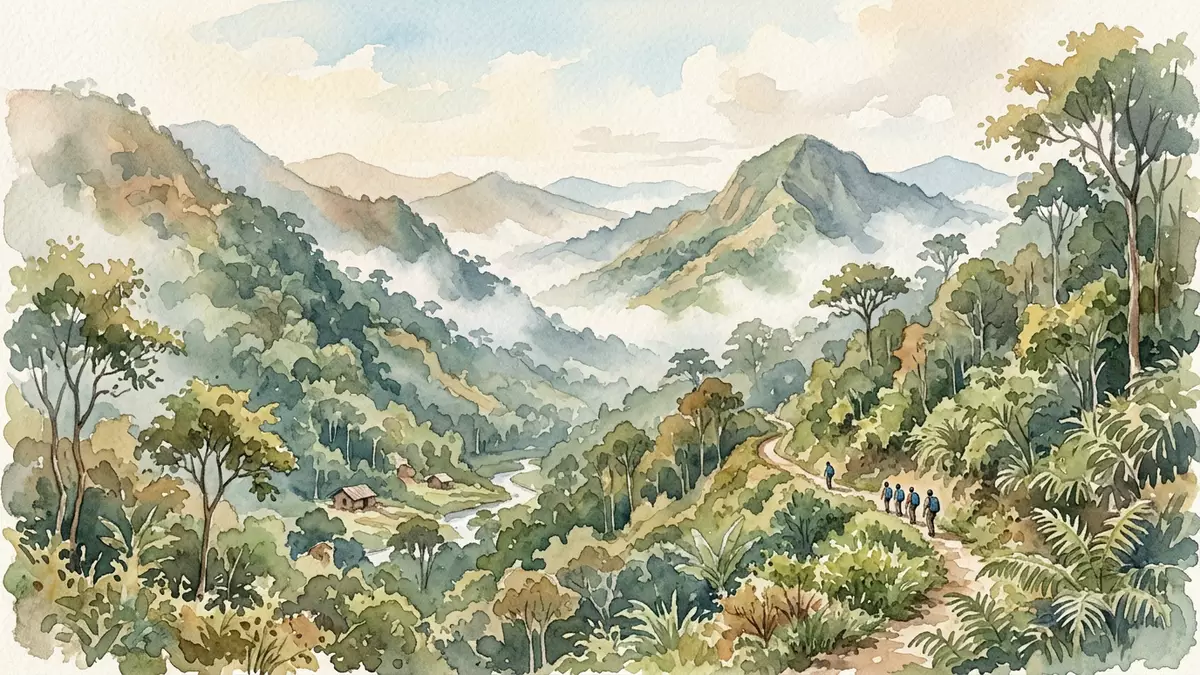
Bwindi Impenetrable National Park is a dense rainforest spread across the highlands of south-western Uganda. Its defining feature is a meeting of forest environments, where lowland vegetation reaches into mountain country and steep ridges hold habitats for mountain gorillas, birds, butterflies and an extensive range of plants.
The park covers 32,092 hectares and became a national park in 1991. It entered the UNESCO World Heritage List in 1994, giving its forest, wildlife and Albertine Rift setting a formal place in global conservation history.
Bwindi’s forest rises from lowland to mountain country
Bwindi lies on the eastern edge of the Albertine Rift, in the Kigezi Highlands of south-western Uganda. The forest occupies rugged uplands at the junction of plain and mountain forests, with elevations ranging from about 1,160 metres to 2,706 metres.
This change in altitude creates a varied landscape within a compact protected area. Dense forest covers ridges and valleys, while streams cross the slopes and the western boundary reaches towards the Democratic Republic of the Congo. Kabale lies to the east, with Kisoro and Kanungu serving as other regional reference points.
The park’s name reflects the dense character of its forest. Vegetation includes more than 160 tree species and over 100 species of ferns, alongside flowering plants, climbing plants and undergrowth that give the landscape its layered appearance.
Mountain gorillas in an Albertine Rift habitat
Mountain gorillas are Bwindi’s best-known animals, but they form part of a broader ecological picture. The forest also holds chimpanzees, L’Hoest’s monkeys, African elephants and other mammals, together with birds and butterflies associated with the Albertine Rift.
The park contains more than 347 recorded forest bird species. Several are linked to the Albertine Rift, a region whose highland forests contain species found in restricted parts of central and eastern Africa.
Butterflies add another visible dimension to the forest. Bwindi contains a large variety of species, including Albertine endemics. The combination of altitude, rainfall and the meeting of ecological zones gives the park a mosaic of habitats rather than a single uniform forest.
Mountain gorillas remain central to Bwindi’s identity. The population lives within a protected forest surrounded by cultivated highlands, making the relationship between conservation, neighbouring communities and regulated tourism part of the park’s broader setting.
From forest reserve to World Heritage landscape
Protection of the forest began with Crown Forest Reserves created in 1932. The reserves were combined and enlarged in 1942, forming the Impenetrable Central Crown Forest. In 1964, the protected area also received animal sanctuary status.
The forest became Bwindi Impenetrable National Park in 1991. Its inscription on the World Heritage List followed in 1994, recognising its biological diversity and its importance for threatened species. The park is managed by the Uganda Wildlife Authority.
Its World Heritage designation records both the forest’s biodiversity and its position within a wider ecological region. The protected area contains lowland and montane forest, while its boundaries meet a landscape of farms, settlements, lakes and mountain slopes.
Conservation in Bwindi includes community programmes connected with ecotourism and regulated resource use. These arrangements form part of the park’s human geography, alongside the forest, its wildlife and the settlements of south-western Uganda.
Visiting Bwindi Impenetrable National Park: what travellers from Western Europe should know
- Bwindi lies in south-western Uganda, across the districts of Kanungu, Rubanda, Kabale and Kisoro. Road approaches include the Kampala–Kabale–Ruhija route and routes through Kisoro towards the southern sectors.
- The park is divided into trailhead areas including Buhoma, Ruhija, Nkuringo and Rushaga. Each sector has its own approach roads and forest setting.
- The terrain consists of steep ridges, narrow valleys and dense vegetation. Walking routes take place in a highland rainforest landscape rather than on level ground.
- English is an official language of Uganda, and the currency is the Ugandan shilling.
- Entry requirements depend on your nationality; UK travellers can check the FCDO travel advice at gov.uk/foreign-travel-advice, Irish travellers the Department of Foreign Affairs at ireland.ie.
Searching for Bwindi Impenetrable National Park on social platforms
These links open searches for Bwindi Impenetrable National Park on each platform.
Frequently asked questions about Bwindi Impenetrable National Park
Where is Bwindi Impenetrable National Park?
The park is in south-western Uganda, within the Kigezi Highlands and on the eastern side of the Albertine Rift. Kabale lies to the east, while Kisoro and Kanungu provide other regional access points.
What can visitors expect in the park?
Visitors encounter dense rainforest, steep ridges, narrow valleys and trails connected with sectors such as Buhoma, Ruhija, Nkuringo and Rushaga. Mountain gorillas, forest birds, butterflies and varied plant life form the principal natural attractions.
What makes Bwindi distinctive?
Bwindi combines lowland and montane forest within a World Heritage landscape. Its recognised features include exceptional plant diversity, Albertine Rift species and a major habitat for mountain gorillas.


