
Caislean na Blarnan and the stone that shaped a word
Published on 09/10/2026 at 11:00 | Editorial responsibility: Rafael Müller, Editor-in-Chief AD HOC NEWS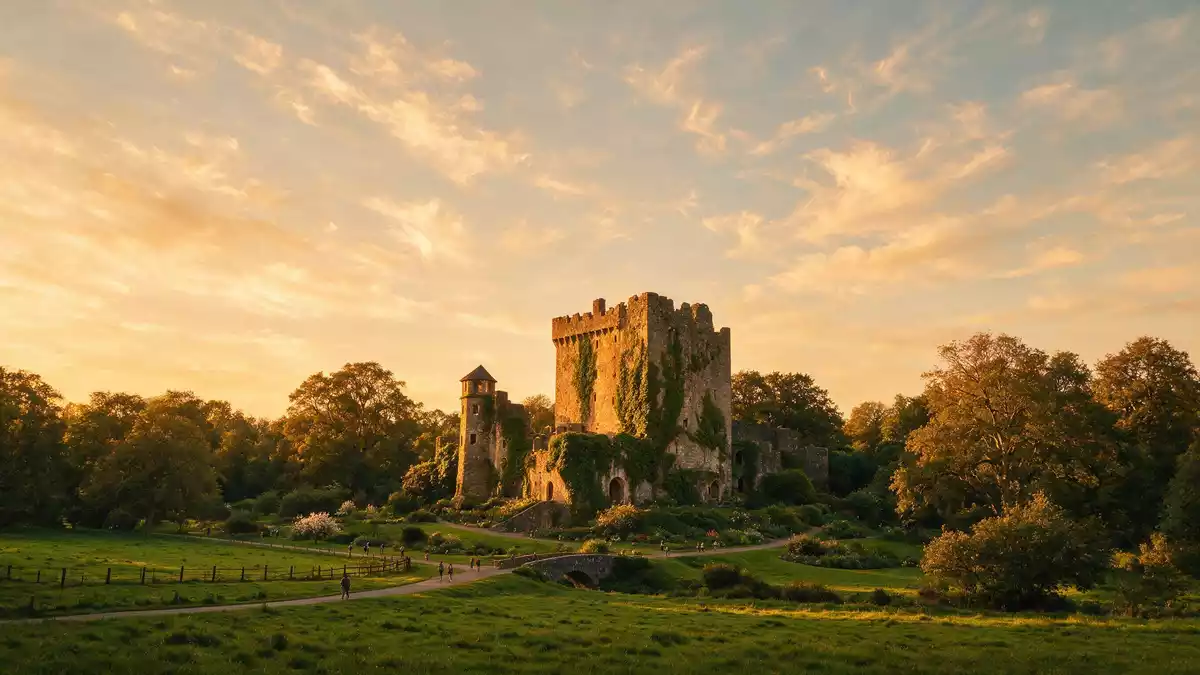
Caislean na Blarnan in Blarney, Ireland is a late medieval tower house rising from quarried rock above a landscaped estate, best known for a stone set into its battlements that is linked with eloquent speech. The castle that visitors see dates to the fifteenth century and stands within grounds that also contain Blarney House and extensive gardens shaped in the eighteenth and nineteenth centuries.
A fifteenth-century tower house on quarried rock
The present stone keep of Caislean na Blarnan is a rectangular tower house dating from 1446, built by Cormac Láidir MacCarthy, Lord of Muskerry, on a rocky outcrop above the River Martin and surrounding lawns.dates from 1446 Earlier strongholds on the site included a timber structure before 1200 and a stone fortification raised around 1210, but the present castle replaced these when the MacCarthys rebuilt on a grander scale.timber structure before 1200
The tower house stands on bedrock partly quarried to supply stone, with underground passages and chambers cut into the rock beneath, some used historically for imprisonment and others as escape routes.bedrock foundation contains passages The original keep formed a four-storey block with defensive features typical of an Irish tower house of the fifteenth century, including thick walls and bartizans, while a later extension added a taller wing that created the L-shaped plan visible in the masonry seam on the exterior.later five-storey extension
MacCarthy stronghold and shifting owners
Caislean na Blarnan was the seat of the MacCarthy of Muskerry, a branch of the MacCarthy kings of Desmond, who held extensive lands in Munster until their estates were confiscated in the Williamite War of the 1690s.McCarthys of Muskerry The castle was captured by Parliamentarian forces under Lord Broghill during the Irish Confederate Wars in 1646, later restored to Donough MacCarty as Earl of Clancarty after the Stuart monarchy returned, and finally lost when the fourth Earl’s lands were forfeited in the late seventeenth century.captured in 1646
Following confiscation, the estate passed through several owners, including the Hollow Sword Blade Company and Sir Richard Pyne, Lord Chief Justice of Ireland, before Sir James St John Jefferyes, governor of Cork City, acquired it in the early eighteenth century.Sir James St John Jefferyes His descendants built Blarney House, a Scottish baronial mansion completed in 1874 that looks across a lake towards the medieval tower, and through marriage in the nineteenth century the estate passed into Colthurst family ownership, which continues to this day.Blarney House completed in 1874
The Blarney Stone and a word in English
The feature most closely associated with Caislean na Blarnan is the Blarney Stone, set into the battlements of the tower house and reached by climbing to the wall-walk and leaning back over an opening with assistance. The stone is linked in legend with the Stone of Scone, with one tradition stating that Robert the Bruce gave part of that coronation stone to Cormac MacCarthy in gratitude for support at the Battle of Bannockburn in 1314, and that the gifted block was later incorporated high in the castle.legend of Stone of Scone
The Blarney Stone gained its reputation for conferring the “gift of the gab” on those who kiss it, connecting this physical object with a broader idea about persuasive, flattering speech.gift of the gab A later story links the modern sense of the word “blarney” with Queen Elizabeth I, who received reports about delays and elaborate excuses from Cormac MacDermot MacCarthy when her officials tried to secure the castle, and is said to have dismissed these reports with the remark “this is all Blarney”, helping turn the place name into a term for cleverly evasive talk.term for flattering talk
Visiting Caislean na Blarnan: what travellers from Western Europe should know
- Caislean na Blarnan stands on the edge of Blarney in County Cork, south-west of central Cork City, and is reached by road from the city and wider region.
- The tower house rises on an uneven rock base with underground chambers, and visiting the upper levels involves narrow stone staircases and exposed battlements.
- The estate includes landscaped gardens, wooded paths and the lake beside Blarney House, so a visit involves walking across varied terrain including lawns, rock close features and garden routes.
- The official language is Irish and English and the currency is the euro.
Searching for Caislean na Blarnan on social platforms
These links open searches for Caislean na Blarnan on each platform.
Frequently asked questions about Caislean na Blarnan
Where is Caislean na Blarnan?
Caislean na Blarnan stands beside the village of Blarney in County Cork, in southern Ireland, on a rocky rise above the River Martin and surrounding parkland.
What can visitors expect on a visit?
Visitors encounter a fifteenth-century stone tower house with narrow staircases and battlements, together with landscaped gardens, rock close features and views towards Blarney House.
What makes Caislean na Blarnan distinctive?
It combines a medieval MacCarthy stronghold built in 1446 with the Blarney Stone in its battlements and an estate where the place name entered English as a word for flattering talk.


