
Capilano Suspension Bridge and the forest canyon of North Vancouver
Published on 08/20/2026 at 06:26 | Editorial responsibility: Rafael Müller, Editor-in-Chief AD HOC NEWS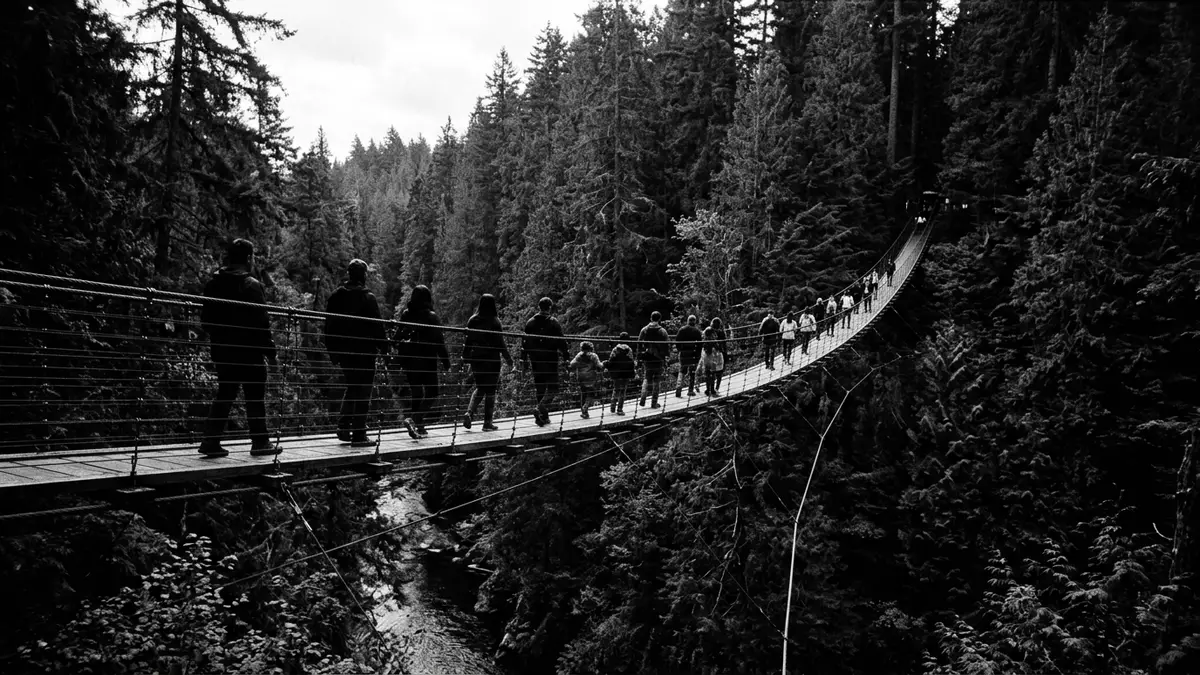
Capilano Suspension Bridge in North Vancouver is a simple span of planks and cables stretched high above a forested canyon, yet it anchors an entire park of elevated walkways and viewpoints in the coastal rainforest of British Columbia. First built in 1889 by Scottish civil engineer George Grant Mackay, it crosses the Capilano River and has become a landmark where engineered structure and dense woodland meet in one dramatic crossing.First built in 1889
A timber and cable span above the Capilano River
The present Capilano Suspension Bridge is a pedestrian bridge formed of a timber deck carried by steel cables, hanging above the Capilano River in a steep-sided canyon in North Vancouver. The span is around 137 m (450 ft) long and rises about 70 m (230 ft) above the water, creating a narrow crossing that feels exposed to the forested slopes and the river far below.450 ft long, 230 ft above the river The bridge deck is lined with vertical railings and cables, giving a continuous barrier on both sides while still leaving open views along the canyon.
Seen from the riverbank, the bridge appears as a single shallow curve between its two end platforms, the cables rising to anchor points in the forest on each side. It lies within Capilano Suspension Bridge Park, a privately operated attraction in North Vancouver that combines the historic bridge with trails, interpretive areas and elevated routes through the forest.Capilano Suspension Bridge Park The setting is a coastal temperate rainforest, with tall conifers climbing from the canyon floor and undergrowth crowding the slopes beneath the span.
From hemp ropes to a modern visitor bridge
The story of Capilano Suspension Bridge reaches back to the late nineteenth century, when George Grant Mackay bought land on both sides of the Capilano River and needed a practical crossing.George Grant Mackay bought land on both sides The first bridge, completed in 1889, used hemp ropes and a deck formed of cedar planks, giving a basic but effective suspension structure across the canyon.Originally made of hemp ropes and cedar planks In 1903 the crossing was rebuilt using wire cables, marking a shift from a rough private access bridge to a more durable structure able to carry regular visitors.
Ownership of the bridge changed several times in the early twentieth century, and its role shifted towards organised tourism as a visitor attraction in North Vancouver.Ownership changed in the early twentieth century The current bridge structure dates from the mid twentieth century, when the deck and cables were reconstructed to modern standards, while retaining the established crossing point over the Capilano River.The current bridge was rebuilt in the 1950s Through these changes the basic idea has remained constant: a narrow suspension bridge for pedestrians, hung high between the forested slopes and forming the centrepiece of a wider park.
Treetops Adventure and Cliffwalk in the forest park
Beyond the main span, Capilano Suspension Bridge Park contains further elevated routes that extend the experience of walking above the forest floor. On one side of the canyon the Treetops Adventure leads visitors onto a series of suspended footbridges attached to tall Douglas fir trees, forming a circuit through the mid-level canopy.Seven suspended footbridges attached to Douglas firs These smaller bridges connect platforms held around the trunks, allowing a progression from tree to tree high above the ground.
A contrasting route runs along the rock face in the form of Cliffwalk, a set of narrow cantilevered walkways and platforms anchored into the granite cliff beside Capilano Canyon.Cliffwalk anchored to the cliff face Sections of this path hover many storeys above the river, the slender deck projecting out from the rock with railings on the outer side and sheer stone rising on the inner. Together, the bridge, the treetop route and the cliff walk form a layered set of paths at different heights, all within sight of the Capilano River and under the canopy of the surrounding rainforest.
Visiting Capilano Suspension Bridge: what travellers from Western Europe should know
- Capilano Suspension Bridge Park lies in North Vancouver, on Capilano Road above the Capilano River canyon, and is reached by road from the city across Burrard Inlet.
- The main bridge, Treetops Adventure and Cliffwalk all involve elevated walkways and stairways, with narrow paths and substantial height above the river and forest floor.
- The park sits within a coastal temperate rainforest, so surfaces and steps can be damp, and the air beneath the canopy holds moisture even in dry weather.
- English is the official language in British Columbia and the currency is the Canadian dollar.
Searching for Capilano Suspension Bridge on social platforms
These links open searches for Capilano Suspension Bridge on each platform.
Frequently asked questions about Capilano Suspension Bridge
Where is Capilano Suspension Bridge located?
Capilano Suspension Bridge stands above the Capilano River in a forested canyon in North Vancouver, British Columbia, reached along Capilano Road from the urban area.
What should visitors expect on a visit?
A visit includes crossing a long pedestrian suspension bridge high above the river and exploring further elevated walkways among the trees and along the rock face within the park.
What makes Capilano Suspension Bridge distinctive?
The combination of a historic suspension span, treetop bridges attached to Douglas firs and a cantilevered cliffside walkway in one compact canyon setting makes the site distinctive.


