
Capilano Suspension Bridge and the forest canyon of North Vancouver
Published on 09/09/2026 at 19:40 | Editorial responsibility: Rafael Müller, Editor-in-Chief AD HOC NEWS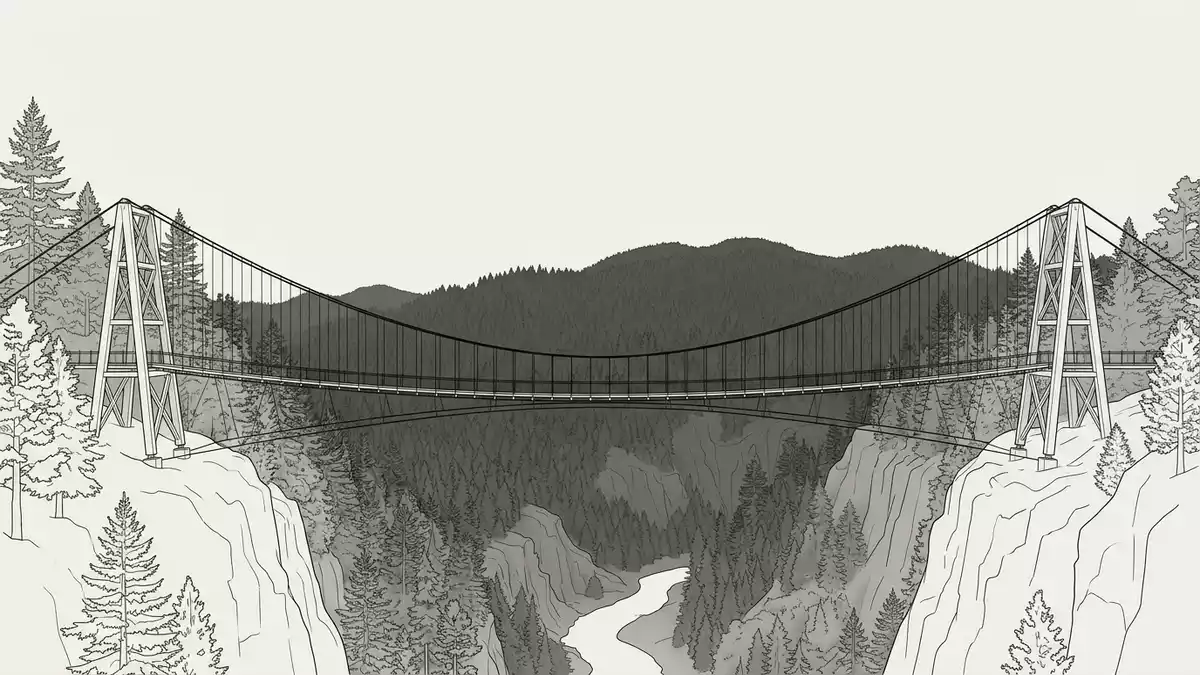
Capilano Suspension Bridge spans the forested canyon of the Capilano River in North Vancouver, carrying a narrow walkway high above the water and between tall Douglas fir trees. First completed in 1889 by Scottish civil engineer George Grant Mackay, it has developed into a broader park of trails and elevated paths that share the same steep ravine and temperate rainforest setting.Completed in 1889
A bridge suspended above a river canyon
The main suspension bridge carries visitors across the Capilano River on a narrow deck hung from steel cables, with forest rising steeply from the canyon floor. The crossing is roughly 137 m (450 ft) long and about 70 m (230 ft) above the river, giving a clear view of the ravine and the dense trees on both sides.137 m long and 70 m above the river The cables and deck seen today date from a rebuild in 1956, replacing earlier rope and cable structures while keeping the same canyon span.Rebuilt in 1956
When Mackay first established a crossing in 1889, he used hemp ropes and cedar planks to hang the bridge between trees above the water, creating a simple but adventurous route over the canyon.Hemp ropes and cedar planks Later owners rebuilt the crossing with wire cables in the early twentieth century, and the modern steel?cable span follows the same general line while offering a much more robust structure for the flow of visitors.Wire?cable successor and modern span
Treetops Adventure and walks among Douglas firs
Beyond the main bridge, the park extends into the surrounding temperate rainforest, with the Treetops Adventure threading a sequence of elevated footbridges between Douglas fir trunks. This canopy walk, introduced in 2004, links several platforms around trees that are described as centuries old, carrying visitors roughly 30 m (98 ft) above the forest floor along a loop of more than 200 m.Treetops Adventure added in 2004 The structure is built so that the bridge elements attach to the trunks without requiring deep foundations in the ravine slopes.
The Douglas firs here form part of a characteristic Pacific rainforest, with thick trunks rising from a carpet of ferns and undergrowth, and the treetop platforms presenting the forest at several levels. Ground?level trails and boardwalks such as the Nature’s Edge route weave through this landscape, offering views back to the suspension bridge and the canyon while passing interpretive displays about rainforest ecology and local First Nations history.Nature’s Edge boardwalk and forest trails
Cliffwalk and the broader park setting
On one side of the canyon, the Cliffwalk traces the granite rock face on a narrow cantilevered path bolted directly into the cliff. Opened in 2011, it extends for about 213 m (699 ft) above the river in a sequence of bridges, platforms and stairs that follow the curve of the ravine wall.Cliffwalk opened in 2011 Sections of this route project out from the rock, giving clear vertical views down into the canyon and across to the suspension bridge.
The wider park brings together these elevated structures with quieter spaces among the trees and cultural exhibits. Totem poles carved by artists from Squamish and Kwakwaka’wakw communities stand in cleared areas on the forest floor, and the Kia’palano displays discuss Indigenous stories connected with the Capilano area and the meaning of the carvings.Totem poles and Kia’palano exhibits Other features, including a small bird enclosure known as Raptor Ridge and a story centre with historical photographs, underline how the site has evolved from a single crossing to a multi?layered park.Raptor Ridge and story centre
Visiting Capilano Suspension Bridge: what travellers from Western Europe should know
- The park lies in North Vancouver, on Capilano Road above the lower reaches of the Capilano River canyon, reached by road from central Vancouver.
- The bridge deck is narrow and carried high above the river, and many routes in the park involve staircases, elevated walkways and uneven forest paths.
- North Vancouver forms part of British Columbia in Canada, where the official languages are English and French and the currency is the Canadian dollar.
- Entry requirements depend on your nationality; UK travellers can check the FCDO travel advice at gov.uk/foreign-travel-advice, Irish travellers the Department of Foreign Affairs at ireland.ie.
Searching for Capilano Suspension Bridge on social platforms
These links open searches for Capilano Suspension Bridge on each platform.
Frequently asked questions about Capilano Suspension Bridge
Where is Capilano Suspension Bridge?
Capilano Suspension Bridge is in North Vancouver in British Columbia, crossing the Capilano River canyon near Capilano Road above the lower river.
What should visitors expect during a visit?
Visitors encounter a high suspension bridge, forest trails, elevated treetop walkways and a cliffside path, with many staircases and sections of uneven ground.
What makes Capilano Suspension Bridge distinctive?
The combination of a long suspension bridge above a steep river canyon, treetop bridges among Douglas firs and a cantilevered Cliffwalk along granite cliffs makes the park distinctive.


