

Carthage, the layered ancient city above the Gulf of Tunis
Published on 08/14/2026 at 14:22 | Editorial responsibility: Rafael Müller, Editor-in-Chief AD HOC NEWS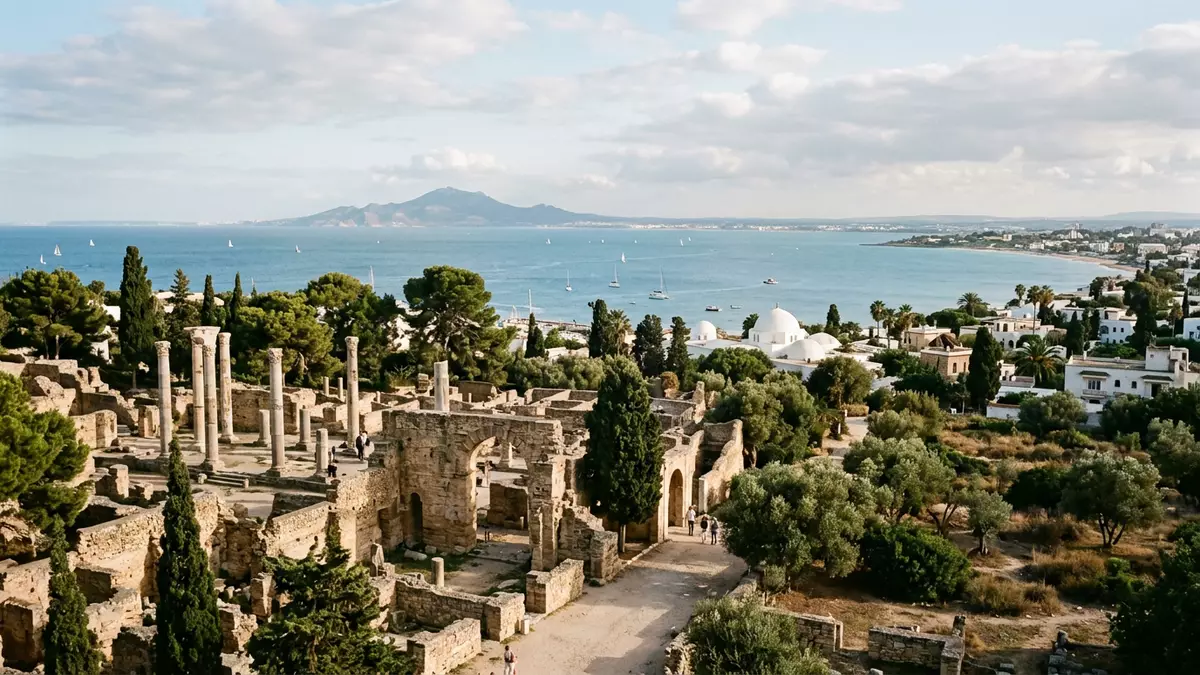
On the north coast of Tunisia, Carthage occupies a series of low hills overlooking the Gulf of Tunis, where the ruins of an ancient city sit among a modern suburb. The name evokes Phoenician traders, the Punic Wars and Roman Africa, yet at street level Carthage is also a municipality of Greater Tunis with villas, embassies and the presidential palace set around scattered archaeological zones from different eras.
Carthage between Phoenician harbour and Tunisian suburb
Carthage grew out of a Phoenician foundation on the eastern side of the lake that connects with the Gulf of Tunis, becoming the centre of a Carthaginian civilisation that dominated trade across the western Mediterranean.the Carthaginian Empire The ancient city stood where a twenty-first century municipality now spreads along the shoreline and up Byrsa Hill, one of the main heights above the coast.a suburb of Tunis
The Punic city was destroyed in 146 BC at the end of the Third Punic War, when Roman forces razed Carthage after a prolonged siege, and a new Roman city was later founded on the same site as Colonia Julia Carthago.Roman Carthage Over time, layers of Punic, Roman and later constructions accumulated around the citadel area on Byrsa Hill, around the former harbours and along the coast, leaving an archaeological landscape that extends across much of the modern town.
UNESCO archaeology in the streets of Greater Tunis
The Archaeological Site of Carthage is formally inscribed on the UNESCO World Heritage List and is described as a dispersed site within the present-day city of Carthage, classified in 1979.UNESCO inscription in 1979 Rather than a single enclosed park, the protected zones appear as separate areas: the hill of Byrsa with its museum, the Punic tombs of the Tophet, the remains of Punic ports near the shore and the vast concrete and stone masses of the Antonine Baths facing the sea.
Byrsa Hill carries both foundations from the Punic period and later Roman buildings and now houses the Carthage National Museum, where carved stonework and mosaics from the site are displayed beside views over the modern town and the Gulf.ruins within present-day Tunisia Down towards the water, the Punic ports form an inland basin and channel that once sheltered warships and merchant vessels, their outlines still visible amidst contemporary streets and houses.
Roman engineering: the Antonine Baths and aqueducts
Among the Roman remains, the Antonine Baths on the shore stand out by scale, spreading across a broad area that once contained massive vaulted halls, service rooms and sea-facing terraces.Antonine Baths of Carthage Built in the second century AD, during the reigns of emperors such as Antoninus Pius and Marcus Aurelius, the complex formed one of the largest bath ensembles in the Roman Empire, with a frigidarium hall carried on thick concrete piers and lined with tall columns whose bases and capitals are still visible on site.
The baths were supplied by aqueducts and cisterns that brought water from inland sources like Zaghouan, feeding reservoirs whose surviving arches and barrel-vaulted chambers remain a feature of Roman Carthage.cisterns and aqueduct from Zaghouan Stone streets, scattered columns, fragments of theatres and villas together convey the Roman phase of the city around the baths and hill, while later structures and churches introduce further historical layers above and around the ruins.
Visiting Carthage: what travellers from Western Europe should know
- Carthage lies north-east of central Tunis on the coast of the Gulf of Tunis and is reached by suburban rail services and local roads from the city.
- The main archaeological zones, including Byrsa Hill and the Antonine Baths, involve walking over uneven ground and climbing steps among ancient masonry.
- Carthage forms part of Greater Tunis, with residential districts, diplomatic compounds and the Tunisian presidential residence close to several of the archaeological sites.
- The official language is Arabic and the currency is the Tunisian dinar.
- Entry requirements depend on your nationality; UK travellers can check the FCDO travel advice at gov.uk/foreign-travel-advice, Irish travellers the Department of Foreign Affairs at ireland.ie.
Searching for Carthage on social platforms
These links open searches for Carthage on each platform.Frequently asked questions about Carthage
Where is Carthage in relation to Tunis?
Carthage stands on low hills along the north-eastern shore of the Gulf of Tunis, forming an upmarket coastal suburb within the metropolitan area of Tunis.
What can visitors expect at the Archaeological Site of Carthage?
Visitors encounter separate archaeological areas, including Punic remains, Roman baths, harbours and the museum on Byrsa Hill, interwoven with streets and houses of the modern municipality.
What makes Carthage distinctive among ancient Mediterranean cities?
Carthage combines Phoenician foundations, destruction in 146 BC, a substantial Roman rebuilding and a UNESCO-listed archaeological landscape embedded in a living Tunisian suburb.


