
Casas Colgadas and the cliffside skyline of Cuenca
Published on 08/20/2026 at 08:51 | Editorial responsibility: Rafael Müller, Editor-in-Chief AD HOC NEWS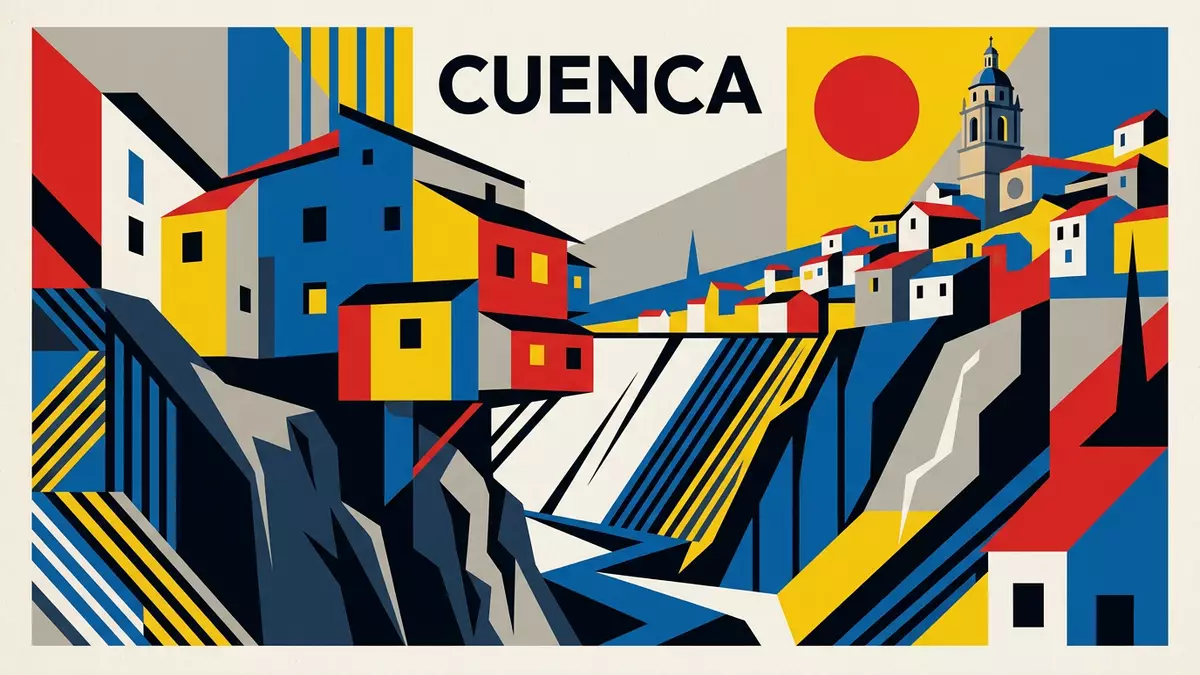
Casas Colgadas in Cuenca is a compact cluster of historic houses built right on the edge of the Huécar gorge, their timbered balconies projecting over a steep rock face. The group forms part of the historic walled town of Cuenca in central Spain, recognised as a UNESCO World Heritage Site in 1996, and stands as one of the most distinctive silhouettes in Castile-La Mancha.
Medieval houses on the edge of a gorge
The Hanging Houses occupy a prominent position in Cuenca’s old town, perched on the rocky lip of the Huécar river canyon where the urban fabric meets a sheer drop. From a distance they read as a vertical stack of narrow façades rising straight out of the limestone cliff, punctuated by tiers of wooden balconies that extend over the void.The historic walled town of Cuenca sets these houses among fortified walls, a Gothic cathedral and steep streets climbing between the gorges of the Huécar and the Júcar.
The complex known as Casas Colgadas consists of a small group of surviving cliffside houses rather than a single structure, with the best-known examples clustered above the stretch of gorge below the San Martín cornice.The regional heritage catalogue describes them as popular houses composed of several interlinked buildings sharing party walls and internal connections, forming a continuous front along the precipice.
From late medieval dwellings to cultural landmark
Documentary references place Casas Colgadas in the late fifteenth century, with one of the earliest known mentions recorded in 1481, which indicates that the houses already stood in the late medieval phase of Cuenca.The same regional record notes that they belong to the broader tradition of cliff-edge dwellings that once lined the eastern edge of the old city, of which only a fraction survives.
Their fabric reflects successive building campaigns between the thirteenth and fifteenth centuries, with masonry bases in stonework and upper levels in timber framing, and they appear prominently in a 1565 panoramic view of Cuenca attributed to the Flemish painter Anton van den Wyngaerde.Historical summaries describe how many cliffside houses were altered or demolished over the centuries, leaving the present ensemble as a rare concentration of this once more widespread building type.
Balconies, beams and abstract art
Up close, the character of Casas Colgadas is dominated by its projecting balconies, supported by timber corbels and braced back into the masonry, which create the sense that the upper rooms float above the gorge. The ground floors are built in robust ashlar masonry that anchors the houses into the rock, while the upper storeys express the lighter timber framework typical of traditional Gothic domestic architecture in the region.Tourism descriptions highlight that visitors stepping inside can still see original structural elements such as heavy wooden beams and corbelled floors.
The three best-known houses within the group carry individual names: two are known as Casas de los Reyes and one as Casa de la Sirena, and together they frame the most photographed portion of the cliffside.Accounts of the houses emphasise that they were built several centuries ago and later adapted for new uses, and since 1966 one of them has housed the Museo de Arte Abstracto Español, bringing works by modern artists into a setting shaped by late medieval craftsmanship.
Visiting Casas Colgadas: what travellers from Western Europe should know
- Casas Colgadas stands in the upper part of Cuenca’s historic centre, on the edge of the Huécar gorge, with access via streets such as Calle Canónigos and C/ Obispo Valero.
- The approach through the old town involves steep streets and stairways, and the terrain around the houses includes abrupt drops at the gorge edge protected by walls and railings.
- The most widely used viewpoints include the San Pablo footbridge across the Huécar and terraces on the opposite side of the gorge, which give a clear view of the cliffside façades.
- Cuenca lies in central Spain, in the region of Castile-La Mancha; the official language is Spanish and the currency is the euro.
- Entry requirements depend on your nationality; UK travellers can check the FCDO travel advice at gov.uk/foreign-travel-advice, Irish travellers the Department of Foreign Affairs at ireland.ie.
Searching for Casas Colgadas on social platforms
These links open searches for Casas Colgadas on each platform.
Frequently asked questions about Casas Colgadas
Where are Casas Colgadas and what surrounds them?
Casas Colgadas stands in the historic upper town of Cuenca in Castile-La Mancha, Spain, on the edge of the Huécar river gorge within the UNESCO-listed walled city.
What should visitors expect when they reach the houses?
Visitors encounter narrow streets, steep approaches and a dramatic cliff edge, with the houses rising directly from the rock and balconies projecting above the gorge.
What makes Casas Colgadas distinctive among historic houses?
The combination of late medieval cliffside construction, projecting timber balconies and the presence of the Museo de Arte Abstracto Español within a historic domestic shell gives Casas Colgadas its distinctive character.


