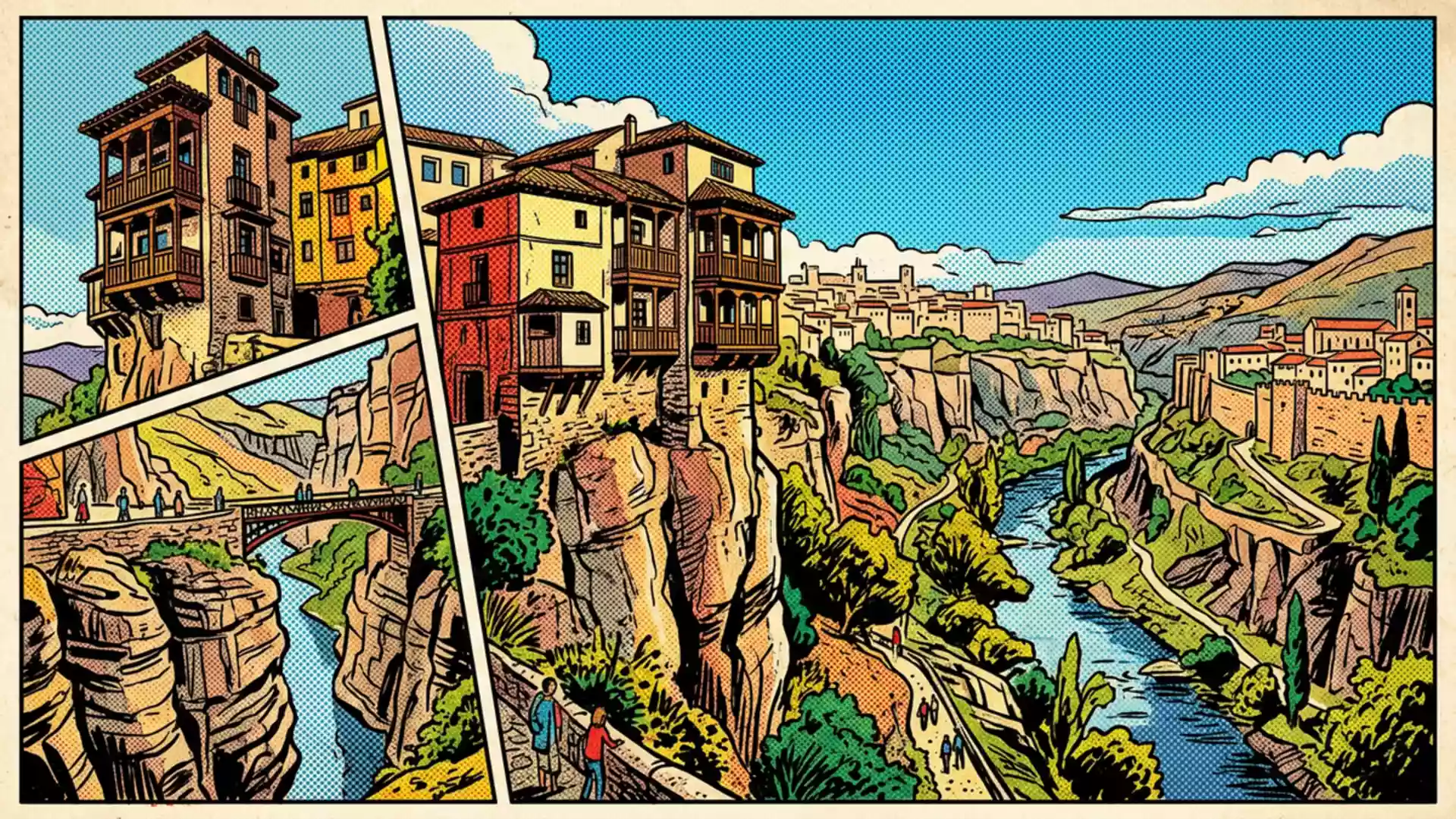
Casas Colgadas, Cuenca’s houses on the cliff edge
Published on 08/22/2026 at 22:17 | Editorial responsibility: Rafael Müller, Editor-in-Chief AD HOC NEWS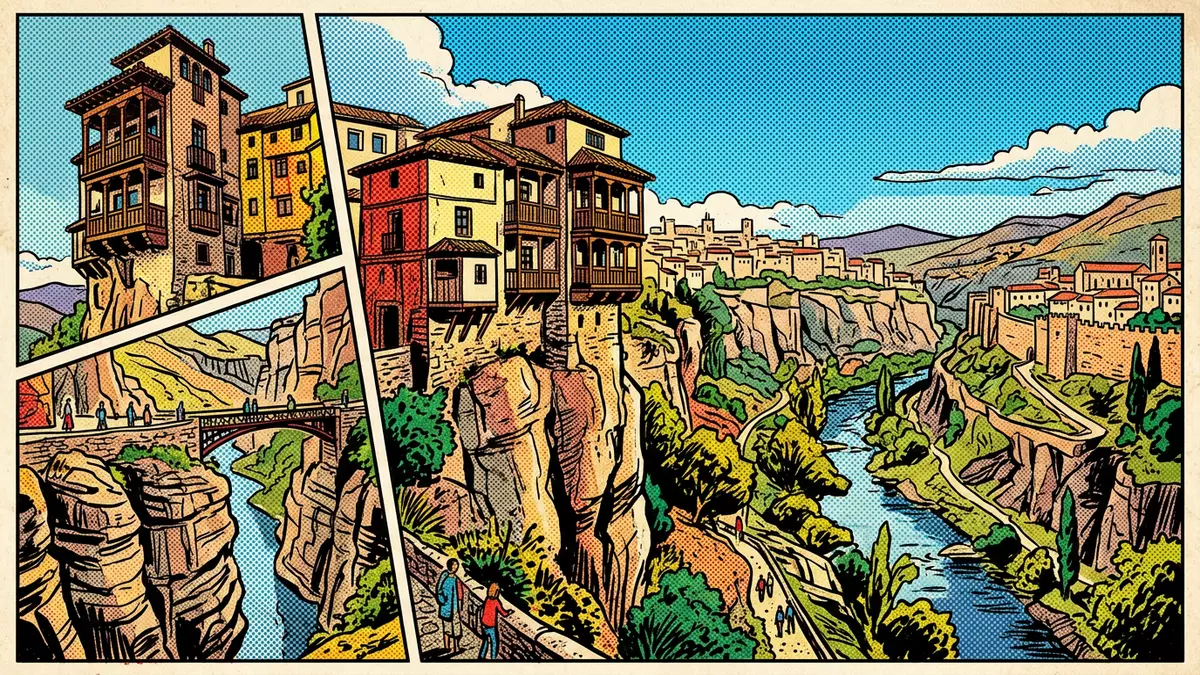
Casas Colgadas in Cuenca is a cluster of medieval houses that seem to grow straight out of the rock above the Huécar river gorge, their timber galleries hanging over the void. Dating to the late medieval period between the fourteenth and fifteenth centuries, they have become the architectural symbol of this Castilian hill town and a rare surviving example of a once more widespread way of building along the cliff edge.
Medieval houses anchored to the Huécar gorge
The Casas Colgadas occupy a ledge on the rocky cornice of the Huécar ravine on the eastern side of Cuenca’s old town, where the plateau breaks off in a near-vertical drop towards the river. The houses are built in stonework with dressed corner blocks and narrow floor plans that stack upwards, creating tall façades which look out towards the gorge.
A distinctive feature of the complex is the series of large wooden balconies that project beyond the rock face, supported by corbels and diagonal braces fixed back into the wall. It is these cantilevered galleries that give the houses their name, and that make them appear to hover above the cliff when seen from the valley or from the Puente de San Pablo footbridge.wooden cantilevered balconies Inside, the rooms are narrow, with two or three spaces on each level and a mix of masonry walls and timber structures visible in beams and ceilings.houses are of narrow plan and several storeys
From medieval dwellings to abstract art museum
The first documentary mention of the Casas Colgadas dates to 1481, indicating that the houses stood in the fifteenth century and were already part of a fully formed medieval townscape.first recorded in 1481 Their origin is placed between the fourteenth and fifteenth centuries, in the later Middle Ages, when Cuenca was a fortified city on the frontier of Castile and builders made intensive use of the rocky margins of the plateau.origin between the fourteenth and fifteenth centuries
Only three hanging houses of this type survive along the Huécar cornice: the Casa de la Sirena and two Casas de los Reyes, together forming the ensemble known as Casas Colgadas.Casa de la Sirena and two Casas de los Reyes Over the centuries the buildings have served as dwellings, council premises and an inn, and their current uses combine hospitality with culture. Two of the palatial houses house the Museo de Arte Abstracto Español, a museum of Spanish abstract art founded in the second half of the twentieth century by Fernando Zóbel and fellow artists.museum of Spanish abstract art founded by Fernando Zóbel The Casa de la Sirena accommodates a restaurant in its interior, extending the tradition of food and lodging on the cliff.
A protected monument and emblem of Cuenca
In heritage terms the Casas Colgadas are recognised as a monument of cultural interest, forming part of the historic walled city of Cuenca that is inscribed as a World Heritage Site. The ensemble was declared a “bien de interés cultural” with monument status on 25 October 2016, a formal protection that reflects its architectural and historical value.declared Asset of Cultural Interest in 2016 Within Cuenca, the hanging houses stand as the best-known silhouette of the city, regularly used as a visual shorthand for its medieval character.icon of the city of Cuenca
Architecturally, the surviving complex shows late Gothic popular forms merged with elements from other periods. Timber ceilings include carved and painted beams in the Mudéjar tradition, while certain doorways and decorative arches carry Renaissance motifs.Mudéjar ceilings and Renaissance decoration The outer entrance portal that now fronts part of the building comes from a former palace in Villarejo de la Peñuela, bringing the memory of another noble residence into the ensemble.Renaissance doorway from Villarejo de la Peñuela
Visiting Casas Colgadas: what travellers from Western Europe should know
- Casas Colgadas stands on Calle Canónigos on the edge of Cuenca’s historic quarter, above the Huécar river gorge in Castilla-La Mancha in central Spain.
- The approach from the old town involves walking streets that climb towards the cliff edge, with stairways and uneven paving leading to viewpoints near the houses.
- The Puente de San Pablo footbridge crosses the Huécar ravine near the complex and offers an elevated view of the hanging balconies against the rock face.
- The official language is Spanish and the currency is the euro.
Searching for Casas Colgadas on social platforms
These links open searches for Casas Colgadas on each platform.Frequently asked questions about Casas Colgadas
Where is Casas Colgadas located?
Casas Colgadas is in Cuenca, in the autonomous community of Castilla-La Mancha in central Spain, above the gorge of the Huécar river on the edge of the old town.
What can visitors expect on a visit to Casas Colgadas?
Visitors see medieval houses anchored to a cliff with projecting wooden balconies, and inside the accessible buildings there are historic interiors and the Museo de Arte Abstracto Español.
What makes Casas Colgadas distinctive among historic houses?
The ensemble combines late medieval cliff-edge construction, timber galleries projecting over a ravine and a respected collection of Spanish abstract art housed within the surviving palatial structures.